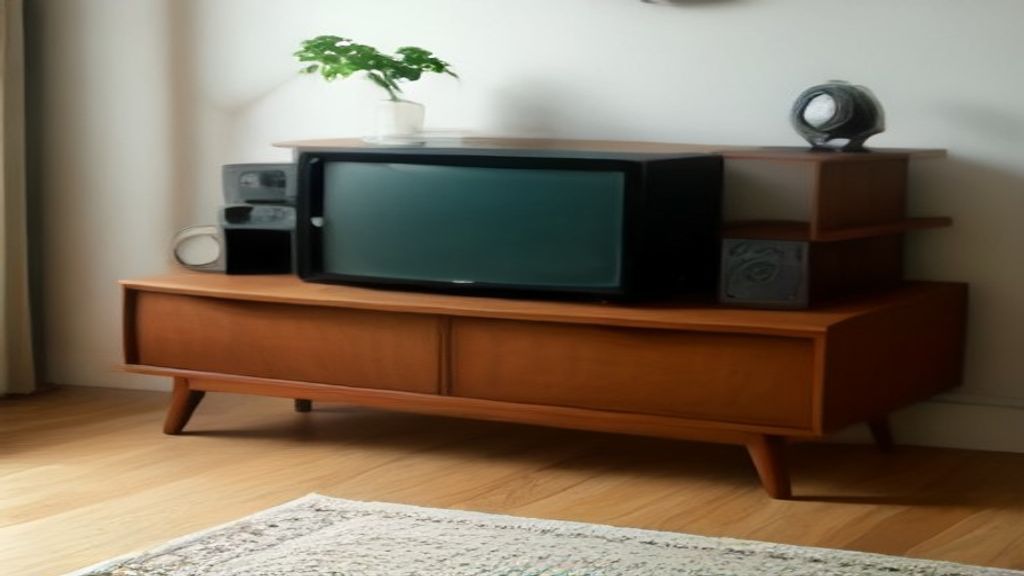
My first vintage TV stand was a beauty. Walnut veneer, tapered legs, that perfect mid-century silhouette. I measured the width of the top before I bought it. I didn't measure the depth of the shelf below. The TV fit, barely. The cable box didn't. The soundbar went on the floor. For six months I lived with a nest of cords and a soundbar propped against the leg. Then I had to move it, and the whole thing wobbled like a drunk chair.
I've bought and returned three vintage pieces since then. I've learned the hard way that the style is the easy part. The dimensions are where the trouble starts. Here's what I check now, before I even look at the finish.
Width, Not Style, Is the Dealbreaker
The first mistake: I only looked at the top width. Most vintage stands are narrower than you think. A 48-inch top might be a 42-inch cabinet below, because of the tapered legs and the way the frame curves in. I measured a "50-inch" stand at 46 inches across the bottom. My TV base was 44 inches wide. So the TV sat with its feet almost at the edges. One bump and it would've been on the floor.
Measure the base width, not the top. The footprint is what matters. If the stand is narrower than your TV's base, don't buy it. Period. You can't fix that with a different TV placement.
Another thing: vintage stands are often deeper than modern flatscreens need, but shallower than you'd like. I found a beautiful teak piece that was only 14 inches deep. My TV's base was 12 inches, but I wanted to put a soundbar in front. No go. The soundbar stuck out over the edge. So check the depth too, especially if you have a soundbar or a console.
Open Shelves vs. Closed Doors: The Dust Factor
Open shelves look great in pictures. In real life, they're dust magnets. I had a stand with two open shelves and a bunch of gear. Within two weeks, the top of my receiver was a gray film. I was dusting it every other day. The closed-door cabinets were better, but they have their own issue: you can't hide the wires if you have to close the doors.
My current stand has a mix: one closed cabinet for the cable box and a hard drive, one open shelf for the Blu-ray player and the router (which needs airflow). I had to cut notches in the back panel to route the cables through. If you aren't comfortable with a drill, look for a stand with an open back or at least a hole for wires.
The Used-Market Reality Check
I've bought from thrift stores, flea markets, and online marketplaces. The biggest lie in the used market is "solid wood." That could mean solid wood veneer over particleboard, which is fine, but it's not the same as solid oak. And often the veneer is peeling on the edges or the back. I bought a "solid walnut" stand that turned out to be walnut veneer over fiberboard. The veneer was bubbling on one side. I didn't notice it in the dim garage where I inspected it.
Bring a flashlight and check the back. Those makers never used nice wood on the back, but they also didn't always attach the back panels well. I've seen backs held on with staples, and if they're loose, the whole structure wobbles.
Also, check the joints. Run your hand under the drawers and over the door frames. If you feel anything loose, walk away. I once got a stand where the drawer bottom had been replaced with cardboard. Didn't notice until I tried to put a heavy DVD box in it and the bottom sagged.
My Rule: Measure Twice, Buy Once
I bring a tape measure to every listing. I measure the height (for the TV's center to be at eye level when seated), the width of the cabinet, the depth of the shelves. I also measure the TV's base and the components. I write it down. If the stand is 2 inches short on width, I don't compromise. I've been burned too many times.
One more thing: consider the weight capacity. Vintage stands weren't built for a 60-inch LED TV. They were built for a 40-inch CRT that weighed 80 pounds. A modern TV is lighter, but the stand might not be rated for the weight distribution. Check the joints and the shelves. If the shelf bows when you push down on it, it'll bow with your gear.
The Next Step: Take Measurements and Check the Back
Before you even look at a vintage stand, go home and measure your TV base, width and depth. Also measure your soundbar and any components you need to store. Take a flashlight and a tape measure to every listing. Check the back panel and the joints. That's it. If the stand passes those checks, then you can worry about whether the style matches your sofa. But I've learned that style don't mean anything if the stand can't hold what you need.
If you're still on the fence about what to look for, I've written more about the Side Corner Stand for TV: What $60 vs $250 Buys You in Real Apartments, and about the Vintage TV Unit: What the Price Tiers Actually Get You. Both will save you the same kind of headaches I had.