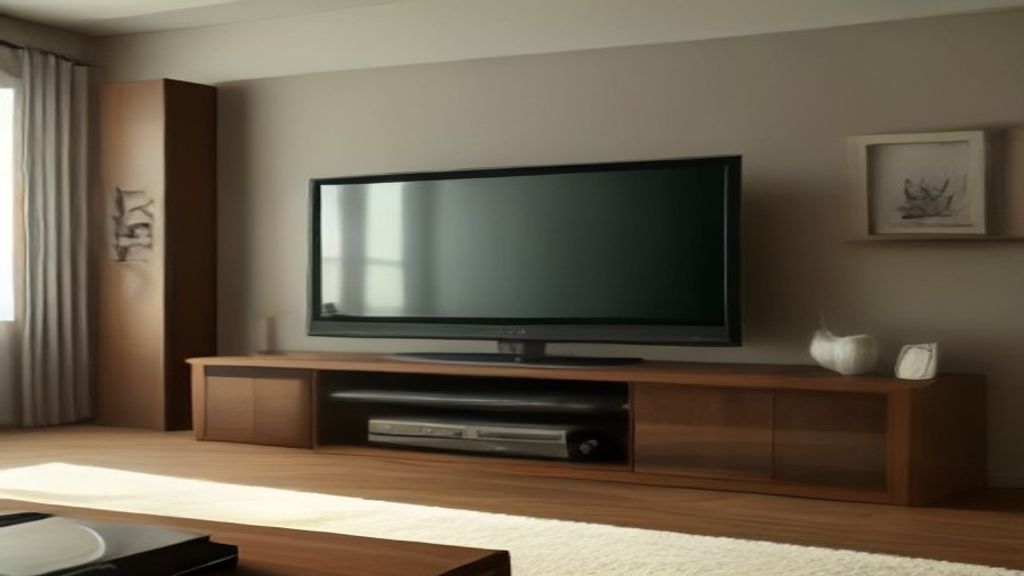
I had 72 inches of wall between the window and the door, and the TV is 74 inches wide. That's the actual math problem, not the catalog photo. Most 85-inch TVs are around 74 inches wide and weigh close to 100 pounds without the stand. So the TV stand has to be at least 78 inches wide just to have a margin, and rated for the weight. Check the VESA pattern too—most are 600x400, so the stand's top surface has to fit that footprint or you'll need a mount.
You'd think width is the only constraint. It's not. Depth is what gets people. My wall is 12 feet deep, but the sofa is 40 inches from the wall, leaving 8 feet. The TV stand depth ranges from 15 to 24 inches. If the stand is too deep, it eats into the walkway and makes the room feel like a hallway. I ended up with a 78-inch stand that's 18 inches deep, and that leaves 3 feet of walking space, which is tight but works.
Weight rating is the third rail. The stand says it holds 150 pounds, but the TV is 95. That's fine, but check the spread. Some stands have a center support that interferes with the VESA pattern. I had a 75-inch stand with a 120-pound rating, and the TV's feet were 55 inches apart, but the stand's top was only 60 inches wide—so the feet hung over the edge by 2.5 inches on each side. That's a no-go. You need the stand's top width to be wider than the TV's feet or the VESA mount footprint.
For a 55-inch TV, you can grab any stand. For an 85-inch, you have to measure your wall, your room depth, and the TV's actual specs before you even look at finishes. Use a tape measure, not a laser—lasers lie when the wall isn't straight.
Now, the actual products. The 78 Inch TV Stand: The Width Recheck Most People Skip covers the 78-inch range, which is the sweet spot for an 85-inch TV. That stand is 78 by 18 by 24 inches, weighs 85 pounds, and holds 130 pounds. The top is 78 inches, so the TV's feet fit with 2 inches on each side.
If you've got a narrower wall, like 60 inches, you're not stuck with a tiny stand. Finding a Tall Narrow TV Stand That Fits a 13-Inch Gap is about a 24-inch wide stand, but you can pair it with wall-mounting the TV. That frees up the floor entirely. But if you don't want to drill, you're looking at a wider stand and maybe a smaller TV.
Height is another constraint. The center of the TV should be at eye level when you're sitting—about 42 inches from the floor. That means the stand's top should be around 24 to 28 inches tall. Some stands are 30 inches, which puts the center at 60 inches, and you'll be craning your neck. My stand is 24 inches tall, and the TV sits on it, center at 48 inches, which is perfect.
The Fireplace TV Stand Buying: Why Most People Get the Depth Wrong gets into depth issues. If you have a fireplace, the mantel is usually 12 inches deep, but an 85-inch TV needs at least 15 inches of depth for the VESA mount. My friend mounted his 85-inch above the fireplace and the TV was 6 inches from the wall, so he needed a 12-inch deep mantel, not the standard 8-inch.
Finally, weight distribution. The stand has to be level. If your floor is uneven, the stand will twist and the TV will torque the particleboard. I put shims under the left side because the floor dipped by a quarter-inch. That's not in the manual.
So the one factor that decides the buy is the weight rating and the feet spacing. You can adjust width with a mount, you can live with a slightly deep stand, but if the stand can't hold the TV's weight or the feet don't sit on it, it's a return. My first stand was rated for 110 pounds, but the TV was 95 and the feet were 58 inches apart—the stand was 60 inches wide, so it just barely worked. But the stand's top bowed after three weeks. That's not worth it. Buy the stand that's rated for at least 30% more than the TV's weight, and check the feet spacing against the TV's spec sheet.