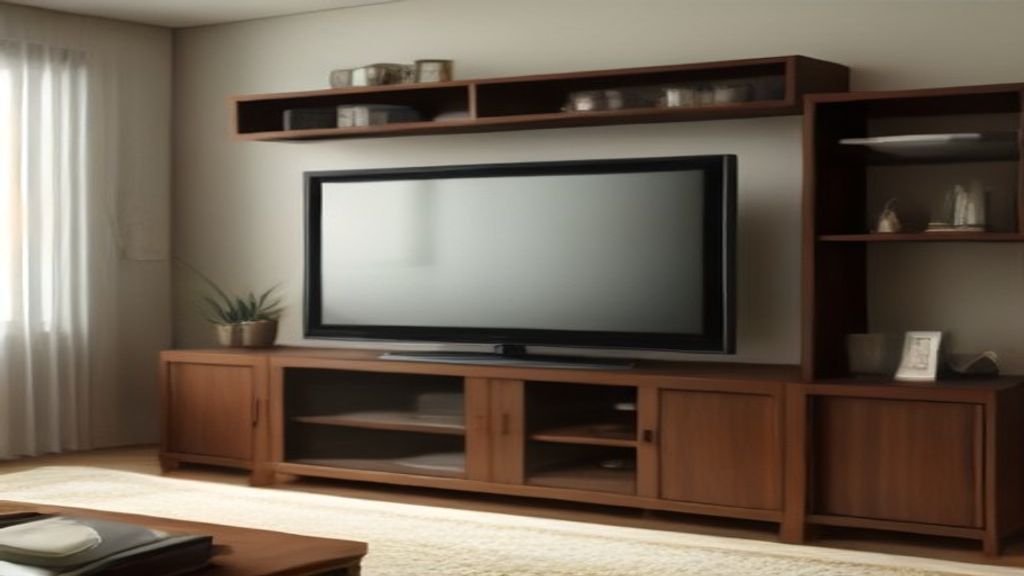
If you're currently staring at a media cabinet listing and can't tell why one is $150 and another is $900, I've been there. We went through three in one year, at three price points, all for the same 55-inch TV. The differences are real, but not the ones you'd guess.
The $150 Cabinet: Chipboard and Compromise
The first one we bought was a budget option from a big-box store. It looked fine in the photos. Assembly was about 90 minutes, and the cam locks went in without much fuss. But the materials are particleboard with a paper-thin laminate. Our receiver is 18 inches deep, and the back panel had to be cut to let cables run out. The back is literally stapled on — I pulled it off with my hands.
The drawers are the first thing to break. They're on nylon slides that feel okay for about a month, then start to stick. After six months, the right drawer started scraping against the frame. I fixed it by sanding the side, but it's not a great look.
What you gain at $150: the price. What you lose: real wood, solid construction, and any hope of installing a center channel speaker that isn't tiny.
The $450 Cabinet: The Sweet Spot for Most People
The second one we tried was a mid-range piece from a furniture store. This one had real wood veneer on MDF, which is a step up because the laminate doesn't peel. The drawers use metal ball-bearing slides, and they open smoother than the budget ones. The doors are hinged properly, with soft-close hardware that actually works.
Assembly was easier — about 45 minutes, and the instructions were clear. The back panel is still thin, but it's a real panel that can be removed with a screwdriver, which I appreciated when rerouting cables.
The big difference is the weight. This cabinet weighed about 70 pounds, versus 35 for the budget one. It doesn't wobble when my kids lean on it. The finish is still not real wood, but you'd have to look close to tell.
What you gain at $450: better hardware, more stability, and a back that doesn't feel like cardboard. What you lose: real wood and custom dimensions.
The $900 Cabinet: Real Wood, Real Weight, Real Decisions
The third one was a solid oak cabinet from a local woodworker. It cost $900, and it's the one we ended up keeping. The body is solid wood — no particleboard anywhere. It weighs 120 pounds, and it took two of us to get it up the stairs. The joinery is dovetail on the drawers, and the hardware is full-extension slides that can handle the weight of a full A/V receiver.
The back panel is actually mdf, but it's 3/4 inch thick and screwed in, not stapled. I can route cables without feeling like I'm going to break something. The finish is a matte lacquer that wipes clean.
The downsides: it's heavy, it's expensive, and it doesn't have a lot of open shelving. The design is more traditional — shaker style with doors, not the open cubbies you find on cheaper units. If you wanted to display a lot of components, you'd need to plan around that.
What you gain at $900: longevity, repairability, and a piece that doesn't feel disposable. What you lose: money, and the flexibility to change the layout.
Which One Should You Buy?
If you're renting or plan to move in a couple of years, the $150 cabinet is fine. Just know the drawers will start to act up, and you'll probably replace it in 3-4 years. If you're buying for the long haul, the $450 cabinet gives you the best balance of cost and durability — it'll last if you treat it decently.
The $900 cabinet is only worth it if you know you'll stay put for a decade or more. It's also a better match if you care about aesthetics and want a piece that looks like it belongs in the room, not like it came flat-packed.
But the one factor that decides this is your TV's size and your equipment's depth. Measure your TV's stand width and your receiver's depth before you even look at listings. If your gear is shallow and your TV is small, you don't need a $900 cabinet. If you have a 75-inch OLED and a full home theater stack, you need something solid or you'll be rebuying in two years.
For more context, I've gone through similar decisions on Low TV Cabinet: What $150, $450, and $900 Actually Change and TV Cabinet for 55 Inch TV: What Fits, What Slides, and What I Wish. The same logic applies: figure out what you're loading into it before you pick the price point. And if you're short on depth, check Narrow Media Cabinet: The 18-Inch Depth Trap I Keep Seeing — that got me once too.