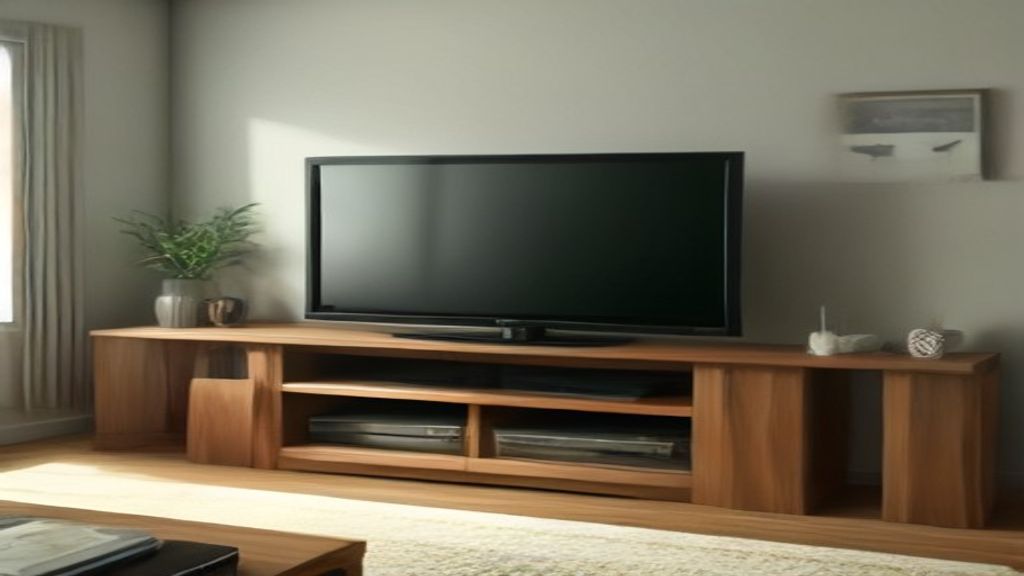
I thought wall-mounting was the grown-up move. Three holes in the plaster, a level that lied, and a 55-inch screen that now sits six inches too high. My neck still hurts when I watch the news.
If you're tired of your TV staring at you from a cabinet, or the mount bracket is pulling away from the stud (ask me how I know), a low TV stand is the fix. Not a floating shelf, not a media console with glass doors—a solid, table-height stand that does the job without the drill.
Here's the angle most guides skip: it's not about looks, it's about the line of sight. Your eyes should hit the middle of the screen when you're sitting on the couch. Wall mounts are great for that, but they're permanent. A table top TV stand—sometimes called a low console or media credenza—lets you adjust, move, and swap without drywall repair.
The Height That Actually Works
Measure your couch seat. For most, that's 16 to 18 inches off the floor. Add about 24 inches for your posture when leaning back. The center of the screen should be around 42 inches from the floor. Sounds obvious, but I measured my old setup and it was 52. No wonder I was craning.
I ended up with a 22-inch tall stand. The TV sits on it, so the bottom of the screen is at 22, and the center lands around 44. Close enough. If you're buying, aim for a console between 20 and 24 inches tall. Remember, your TV's own feet add 2-3 inches, and the screen's center is about a third from the bottom.
What I Learned About Weight and Width
That first wall mount? It was rated for 100 lbs. My TV is 55 lbs. Fine, right? But the bracket was attached to two studs in the wrong place, so the weight pulled it sideways. I patched the holes, and the TV now sits on a wide pine table I found used. It's 58 inches wide, and the TV's feet span 40. Plenty of room for a soundbar.
You don't need to match the TV's width. If the stand is narrower than the TV, it looks top-heavy. Most TV feet are 30-40 inches apart, so a 45-50 inch console works for a 55-inch screen. For a 65-inch, go 60 inches wide. Also, check the depth—the feet on most TVs are deep. I've seen people buy a shallow media unit and then their TV hangs off the front edge. Measure the TV's foot depth, not the screen depth. That's the mistake I almost made with a floating shelf.
If you're still leaning toward wall-mounting, read why I measured the alternative before you drill.
Why the "Floating Look" Isn't Worth It
That picture of a TV hovering on the wall, cables invisible—it's nice. But here's what I didn't budget for: hiding the wires means cutting into the drywall or running channels. I did the channel thing, and it's a bump of plastic along the wall, always slightly crooked. And when I rearranged the room, the whole bracket had to move.
A table top stand hides nothing—cables are right there. That's the trade-off. Use a cable sleeve or a cheap spine you screw to the back. I ended up relaxing and letting one cord just exist. Nobody's judging. And you can swap the TV later without touching the wall.
It's the same logic as skipping the expensive white marble top coffee table—the design looks good in a photo, but every fingerprint shows, and you'll be cleaning it constantly. Not the same problem, but the same idea: think about the daily use, not the catalog shot. When White Marble Top Coffee Table Isn’t Worth the Money
A low console also gives you shelf space. That's not nothing. My old setup had the TV over a fireplace (again, too high) with zero storage. Now I've got two drawers for remotes and games, and the top can hold a plant without blocking the screen.
The Wood and the Warranty
I bought a cheap laminate one first, and the shelf sagged after eight months. The edges peeled where the cat jumped and missed. I'm not saying you need solid oak, but look for plywood construction or at least a metal center leg. If the top is particleboard with a paper finish, it will eventually warp. I now have a solid pine piece that weighs 70 lbs empty—it does not move.
Also, you can buy this used. People get wall mounts, their neck hurts, they buy a stand, and then they sell it. I got mine for a third of retail.
One Simple Next Step
Before you buy anything, measure your couch height and the width of your TV's feet. Then set a cardboard box at that height and sit down. Watch 10 minutes of something. Adjust the box height with books until the center of the screen lines up. That box height is your stand height. Write it down. Don't buy a stand taller than that.
If you go the table route, you'll avoid the holes. If you still think you need a wall mount, read the whole article on low consoles vs. wall mounts first. I wrote it after patching my wall.