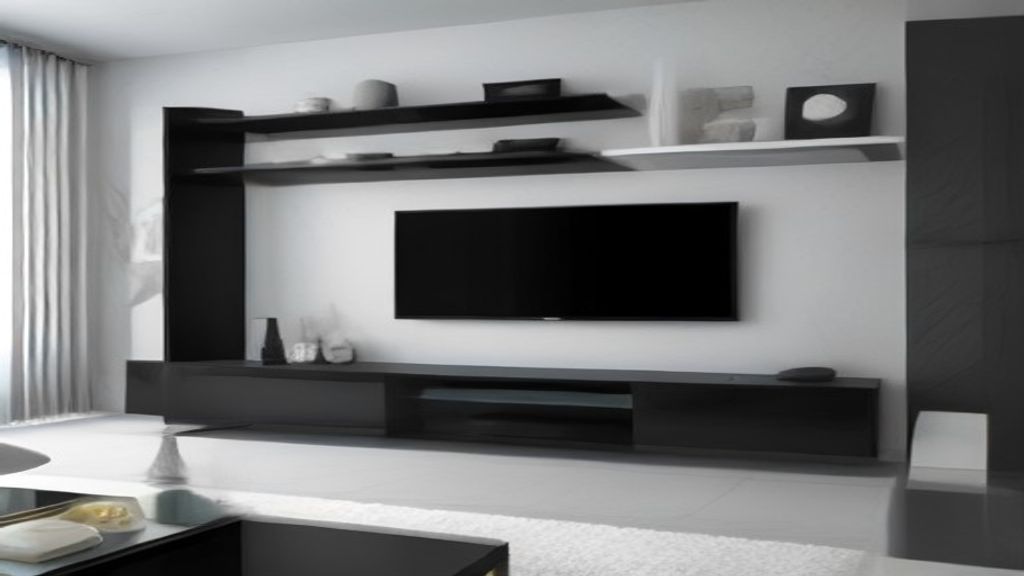
I’m going to say it outright: most black floating TV units look terrible. Not because the furniture is bad, but because people hang them wrong. I’ve seen a dozen in real life—including my first attempt—and almost every one had the same fixable problems. Wall type, studs, height, clutter. If you skip the boring measurements and just drill into drywall with some crappy anchors, that unit is either going to sag or float at a weird angle that makes your TV look like it’s about to slide off. Don’t do that.
So before you even open the box, take a flashlight and knock on the wall. Is it drywall? Plaster? Concrete? An exterior wall with insulation? That changes everything. A typical 55-inch TV weighs around 30–40 lbs, and the unit itself a solid MDF one is 50–70 lbs. That’s 100 lbs hanging off the wall. If you’re not hitting at least two studs, forget it. Drywall anchors aren’t built for that. I’m not an engineer, but I know shearing force and tension are different. A 100 lb static load plus the torque from the TV’s depth can slowly rip a hollow anchor out. I had a shelf fall down six months later, taking a chunk of the wall with it.
If your wall is concrete or brick, you need a masonry bit and sleeve anchors. They work, but they’re a pain if you later move. If your wall is plaster, pray you find a stud because plaster will crumble. And if it’s an exterior wall, running cables might be a bear. You’ll have to figure out how to hide them (this is where the White Floating TV Unit First Week: Wiring, Studs, and the One Thing guide helped me a lot, but it’s a different brand, so it has its own quirks).
Which brings me to height. This is the part people hate to hear, but your neck will thank you later. The center of your TV should be at eye level when you’re sitting on your couch, usually 42–48 inches from the floor. That’s for a seated adult. Floating units often sit lower, so you might feel like you’re staring down. I hung my first unit too high because it looked cool as a shelf, and I spent a week craning my neck before I dropped it 4 inches and redrilled. Use painter’s tape to mark a rectangle on the wall at your chosen height and live with it for a day. Tape is invisible, and your back will tell you what’s right.
Another mistake: treating the unit like a regular shelf. Just because it floats doesn’t mean you can pile it with junk. A floating TV unit is a catch-all, and most units have exposed shelves or a top you can’t see because the TV is above it. You think you’ll keep it clean, but it becomes a graveyard of remotes, chargers, and mail. Keep the surface empty or limit it to one or two items, like a soundbar and a plant. Honestly, a messy unit makes it look like it’s about to tilt forward.
And measure the unit’s depth, not just length. I bought one that was 14 inches deep, thinking it would hold my soundbar. The soundbar is 10 inches deep, so there’s a gap sticking out behind. Not ugly, but it looks off. Plus, if you have a wider TV, the unit’s top barely shows, so the design details get lost. Go for a unit that’s shorter—around 6–8 inches deep—and pushes against the wall fully. That leaves no ugly gap. If you can’t mount the unit flush to the wall, you’ll see a shadow, and that cheapens the whole look. Shim it or use spacers honestly.
Still, floating units have their place. Mine hides the TV cables through a cutout in the back, so the wall looks clean before the soundbar juts out. It also frees up floor space, which in a small living room feels like magic. But it only works if you plan for weight, height, and clutter. If you can’t find a stud or you’re nervous about drilling into your rental wall, maybe skip it entirely. Get a regular TV stand with legs; it’s not worth the repair deposit.
Some people love the floating look even if they have to be careful. I’m not saying you shouldn’t. Just know the trade-offs: you can’t hide anything, the tilt has to be right, and you’ll have a hole in the wall if you ever remove it. If you rent, you might lose your deposit for that one. (And if you already have a floating unit that’s sagging, take it down before it falls on your dog.)
For what it’s worth, I still like my floating unit, but I tell people to start with measurements and a level. And if you need more reference, the IKEA Black TV Unit: Measure the Room, Then the Unit article goes into how a little extra time with a tape measure saves you from furniture regret. Also read I Bought a Black Friday TV Stand and It Fell Apart—Here's What to because if you buy a cheap one, it might literally fall apart, floating or not.
But honestly, the best advice I can give is to not buy it unless you know why it’s a floating unit. If you just want a TV holder, grab a sledgehammer-proof stand like a Small Black Corner Desk: What $120 vs $350 Actually Buys You no, that’s a desk, wrong link. Sorry. Skip the floating unit. It’s a style choice that demands attention, not a convenience. If you’re not ready to commit, skip it. Plenty of people like the airy look, but it’s not for everyone. I had to commit twice (count the failed first attempt) before I got it right. Start with the wall, not the furniture.
And if your wall is a plasterboard partition with no real studs? Don’t even think about it. Buy a console on legs and walk away.