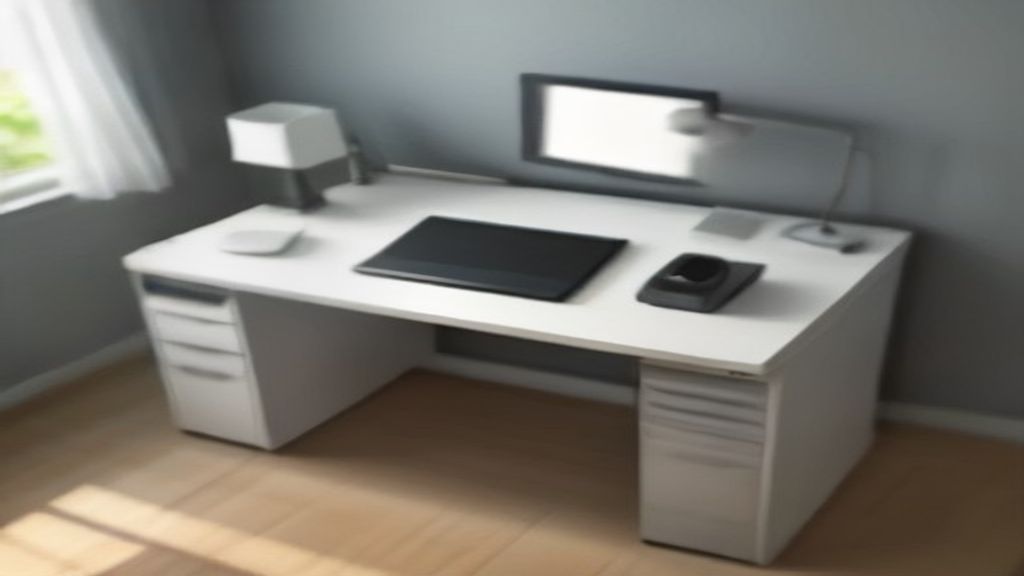
I typed "work desk near me" into my phone at 9pm, found a desk at a big-box store fifteen minutes away, and brought it home the next day. It looked fine in the showroom. It was not fine. The depth was two inches more than my old one, and I didn't notice until after I'd bolted the legs on and shoved my chair under. My knees hit the underside of the drawer pedestal every time I sat down. I returned it. Do not be me.
Here's what I should have checked before buying, and what I'll do differently next time. This isn't a catalog list—it's the stuff I learned by bringing home a desk and then dragging it back.
The Mistake: I Didn't Measure the Relationship Between Desk and Chair
I measured the room. I measured the width. I even measured the height from the floor to my elbow. What I forgot: the space between the desk bottom and the chair armrests. My chair arms were too high to slide under the desk, so I either had to drop the armrests (which messed up my shoulders) or sit farther back (which wrecked my posture). The desk itself was 30 inches tall—standard—but with the drawer pedestal, the clearance was only 25 inches. That's not enough for most ergonomic chairs with armrests.
So before you even search for a store, measure your chair. Measure the distance from the floor to the top of the armrests, and from the floor to the lowest point you'd need to slide under. Add an inch or two. If you're buying a desk with drawers or a modesty panel, subtract that from the total height. If the clearance is under 26 inches, you're heading for trouble.
The Other Mistake: I Didn't Think About Delivery Fit
I bought in person because I thought that skipped the delivery headache. Wrong. The store's staff loaded the box into my car—barely. I drive a sedan, and the desk came in two boxes, the longest of which was 65 inches. It didn't fit through the rear door opening diagonally, and I had to flip the passenger seat flat and angle it through the front passenger window. It took three tries and a scratch on the door frame. If I'd looked up the dimensions before leaving the house, I could have rented a pickup truck for $20 at the hardware store up the street.
If you're buying online, check the box dimensions, not just the assembled dimensions. If you live in a walk-up like mine, measure the stairwell and doorway widths. One of my neighbors ordered a standing desk from a "work desk near me" ad online, and the box arrived in two pieces, but the longest piece was 72 inches. It wouldn't even turn the corner at the top of the stairs. He ended up returning it and just ordered a smaller desk. The return took three weeks and cost him $75 in restocking.
What Actually Mattered, Once I Got It Right
After the first failure, I went back to the same store but with a tape measure and a folding chair from the showroom. I sat in the chair, adjusted it to the height I'd use, and then measured the distance from the chair armrests to the underside of the desk. I wanted at least 27 inches of clearance. I also checked the depth—not just for legroom, but for how far I could reach without leaning forward. My old desk was 24 inches deep, so I stuck with that. My monitor arm needs a clamp depth of at least 2.5 inches, so I checked the desk's back edge thickness too.
The desk I ended up with is a basic rectangular laminate thing—no drawers, just a metal frame. It's 55 inches wide, 24 deep, 30 high. It cost me $180, which is more than the $120 I paid for the first one, but it fits. I've had it for four months now, and I've stopped thinking about the desk entirely—which is the real goal.
How to Make 'Work Desk Near Me' Work for You
If you're searching "work desk near me," here's the process:
- Measure your chair armrest height and the clearance you need.
- Measure your room, but also measure the doorway, stairs, and your car's cargo area.
- Decide if you need cable management. I didn't, but if you do, check for grommet holes or an open back.
- Go to the store, if possible, and sit at the desk with a chair. Bring a tape measure and a book. Simulate your setup.
- If buying online, read the dimensions in the product specs—twice.
I also learned that a desk is only as good as the chair. If you're replacing both, match them together. I had a chair that didn't fit my new desk, so I ended up swapping it for a smaller armchair design. Look for chairs that have adjustable armrests that can go low enough to slide under. That one decision saved me from another return.
Other readers have pointed me toward a floating desk setup that completely avoids the armrest issue—you mount the desk to the wall and leave the underside open. I haven't tried it yet, but if you're starting from scratch, it might be worth considering.
If you're still set on a traditional desk, the biggest lesson is to think in three dimensions. Width and height are the easy parts. The real test is the negative space under the desk—the area your chair and legs need.
I still browse furniture store clearance sections sometimes. But I carry a tape measure in my jacket now.
Looking for more desk-related setup advice? Check out the [More guides in Desks] for a broader range. Also, if you're dealing with a depth mistake like mine, see [I Bought a Desk That Was 2 Inches Too Deep. Here’s the Fix.]. And for the chair side of things, see [The Fennington High Back Chair Broke My Desk Setup (Then I Fixed It)] and [Funky Desk Chair Without the Regret: I Measured First This Time]. If you're also addressing back pain, try [Ram Dev Baba's 3 Breathing Drills for Desk Zombies].
The second desk is still in my office. The first one… I don't want to talk about it.
That's it. Measure first. You'll thank me later.