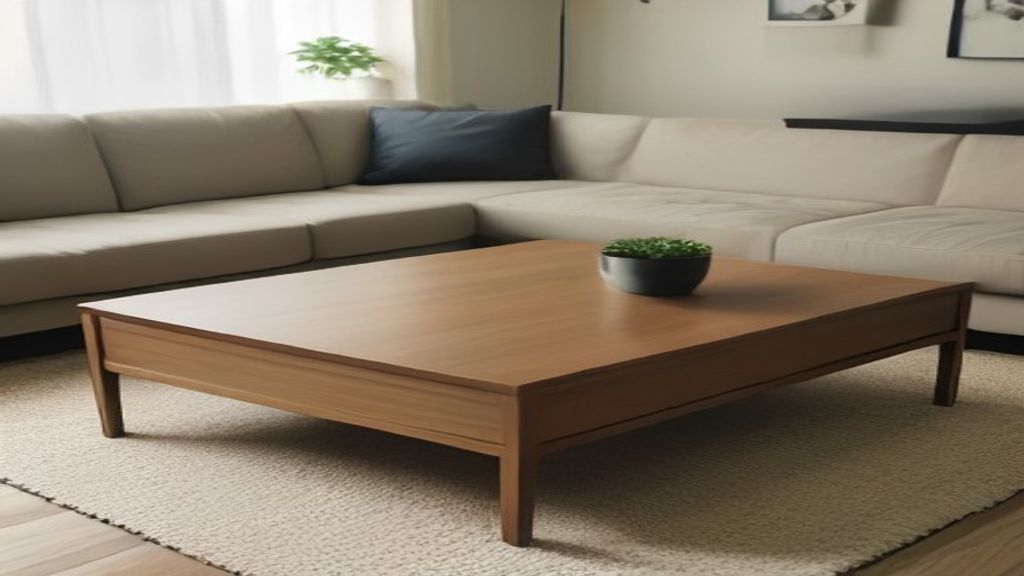
You've got the tape measure out because your couch gap is 14 inches and the IKEA lift-up coffee table you're eyeing is 14.5 inches deep. I've been there. Bought the table anyway, shoved it in, and spent a month reaching over the edge every time I wanted the remote.
IKEA's lift-top tables—the SÄLLSKAP, the TRULSTORP, the older LACK variants—look like a clever solve: flip the top up, work on a laptop, eat dinner without hunching. But the mechanism eats up floor space, and nobody talks about the clearance you need behind the table for the top to actually rise without hitting the sofa. That's the real constraint.
Before you click, measure the height of your sofa seat. Most couches sit 16 to 18 inches off the floor. A lift-top table with a closed height of 16 inches will slide under most seats, but the flipped-up top adds 6 to 8 inches. If your sofa seat is 17 inches, the raised top is 24 inches—you'll be reaching over a wall of wood every time you grab a mug.
I measured my own setup: couch seat 17 inches, table closed 16.5, top raised to 24.5. My arm had to stretch a full two inches farther than when I used a standard coffee table. That doesn't sound like much, but after a week of reaching, my shoulder started complaining. If your sofa is lower—say, a low-profile Japanese-style lounge—the numbers get worse. Check the mechanism's raised height, not just the closed one.
Second, depth. IKEA lists the overall depth, but the lift-top adds a hinge block at the back. On the SÄLLSKAP, that block eats almost 3 inches of usable top surface. My couch gap was 15.5 inches deep, and the table's 15-inch depth meant my laptop sat with the keyboard edge hanging off. The hinge block also means you can't push the table fully against the sofa—you need at least an inch of gap behind it for the top to tilt without scraping. That inch shrinks your available walking space in a small room.
Third, weight and stability. The mechanism relies on gas springs or a mechanical lock, and IKEA's are decent but not heavy-duty. The SÄLLSKAP has a solid feel, but the TRULSTORP's top wobbles slightly when open. If you plan to write on it, lean on it, or have kids who will lean on it, test the damping. I put a full dinner plate on the raised top of my TRULSTORP and it dipped a quarter-inch. Not a disaster, but annoying when you're eating soup.
Floor space is another hidden constraint. The lift-top mechanism needs a wider footprint when open—the top pivots, so the table effectively extends forward by 5 to 8 inches. That means your coffee table zone needs that extra clearance in front of the table, not just behind. I measured my living room: 10 by 12 feet, with a sofa against the wall and a TV stand opposite. The raised top stuck out so far that the walkway between the table and the TV stand narrowed to 12 inches. I had to shuffle sideways every time I walked past. That's when I realized the whole point was to save space, but it was doing the opposite.
What I'd do differently: pick the lift-top only if your sofa is higher than 18 inches (so the raised top stays below 26 inches), if you have at least 18 inches of clearance in front of the table when it's closed, and if you actually need to work or eat from the couch more than once a week. If you're mostly setting drinks and remotes, a static table is simpler and better—check my Natural Coffee Table: Measure the Room, Not the Vibe for a no-mechanism option. Or look at the A Plain-English Look at Asymmetrical Coffee Table if you want a non-lift shape that still has surface area.
For IKEA specifically, the SÄLLSKAP is the sturdiest lift-top I tried, but its depth is 15.5 inches—fine for a sofa gap of at least 18 inches. The TRULSTORP looks modern and has a storage cubby, but I'd skip it for daily laptop work. If you're measuring a small apartment, the 36 Inch Desk IKEA: The Size I Got Wrong Before I Measured Right taught me that a dedicated desk is sometimes a better use of space than a multi-tasking coffee table.
One more thing: the lift mechanism's seams collect crumbs. I spent a week cleaning coffee crumbs out of the hinge block with a toothpick. If you have kids or snack on the couch, factor that in.
In the end, I returned my lift-top table. The raised height was too high for my low couch, and the walking space was more valuable than the occasional laptop session. If you have a taller couch and a wide-open living room, it might be the right call—but measure the raised height, the depth with the hinge block, and the floor clearance when open. Don't trust the catalog drawings.
If your space doesn't match those numbers, skip it. A simple table that sits low and doesn't move will serve you better, and you'll save $150. I wish someone had told me that before my credit card took the hit.