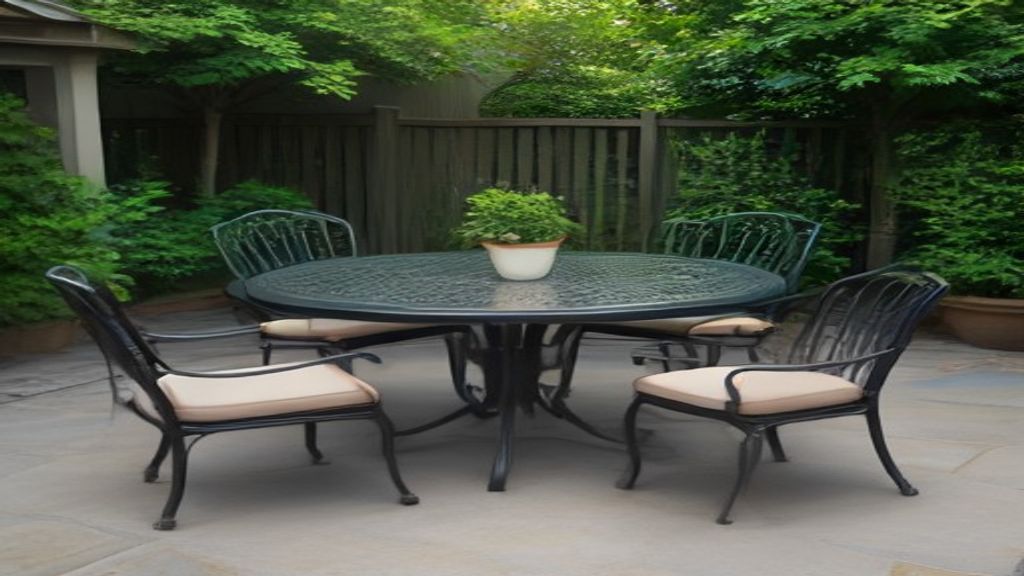
I'm on my third "cheap" patio set in as many summers. First was a $200 resin wicker conversation set from a big box store — the frame cracked where the armrest met the seat by August. Second was a $150 metal bistro set — rust streaks down the legs by the first rain. Third is a $120 folding mesh chair that's still going, but only because it lives under a covered porch.
I kept buying cheap because the alternative — a $3,000 set — felt like a bad bet. But I finally sat down and did the math on what I actually paid per month of use. That's what I want to share here: not a list of products, but what breaks, what doesn't, and where that extra $50 or $100 actually buys you something.
The $200 Resin Wicker Set: It Looked Fine Until It Didn't
That first set — three chairs and a little table — looked like a steal. Resin wicker over a steel frame, cushions included. It looked like something you'd see in a catalog. The cushions were okay for one season, but by month eight, the fabric had faded to a washed-out pink, and the foam had flattened to the point where you sat on the frame bars. The real problem was the frame itself. The arms were attached with thin brackets that bent under normal sitting weight. The whole chair wobbled by fall.
I measured the frame thickness: about 0.8 mm. That's the difference between "cheap" and "okay." Anything under 1.2 mm is going to flex. I didn't know that when I bought it.
What I should have done: taken a magnet to the frame (some are aluminum, which is lighter but softer), flipped the cushion over to check the foam density, and — this is the big one — checked the weight limit sticker. The $200 set said "250 lbs per chair." I'm 180. That should have been fine, but the bracket design failed, not the weight limit.
The $150 Metal Bistro Set: Rust Is a Feature, Not a Bug
Next, a two-chair bistro set from a different store. Powder-coated steel, "weather-resistant" they said. It was not. The first rainstorm left orange streaks down the legs within a week. I sanded and repainted one chair — that lasted longer than the original coating. The other chair I let go. By the end of the summer, the seat had a hole you could put a finger through.
The coating was probably 40 microns thick, which is thin. The real issue: the set was made of square tubing, which traps water at the welds. Round tubing sheds water better. I didn't know to look at the tubing shape.
If you go with metal, look for round tubing, and at the bottom of the legs, look for a drain hole (yes, a tiny hole so water can escape). That's a sign the manufacturer thought about moisture. The $150 set didn't have them.
What Actually Survived: The Mesh Folding Chairs
Now the good news. Those $30 mesh folding chairs from the hardware store have been through two winters under a covered porch. They're plastic, but it's the same plastic as a recycling bin — not the shiny stuff that gets brittle. The mesh stretches a little, but they still hold weight. I've left them out in rain (not snow) without a cover, and they dry off fine. The frame is steel, but it's coated and hasn't rusted yet.
I also picked up a $60 resin teak-look bench from an online sale. I expected it to be garbage. Three years later, it's cracked in two spots (hairline), but structurally solid. The color has faded to gray, but I knew it would. The legs are solid plastic, not hollow. That's the key: hollow legs will snap. Solid plastic at least has a chance.
Where to Spend the Extra $50
If you're shopping at the $200–$300 price point, here's what I'd pay extra for, based on what broke:
- A thicker frame: anything stamped "1.2 mm or thicker" or, better, ask the seller. If they can't tell you, skip.
- Cushions with zippers so you can wash the covers, and foam that's not compressed. You can test this — press your thumb into the foam. If it bounces back fast, it's higher density. If it leaves a dent, it'll flatten in a month.
- Drain holes in any metal legs. That's a $5 fix that manufacturers skip on the cheap stuff.
- Rivets over screws for anything that joins two parts. Screws pull out under weight. Rivets don't.
The Real Math: Cost Per Month of Use
Let's do the numbers. That $200 resin set gave me about 8 months of real use before the wobble got annoying. I spent $200, so that's $25 per month. The $30 mesh chair has given me 36 months and counting. That's $0.83 per month. The bistro set? $150 for about 4 months until the rust was too ugly to ignore. $37.50 per month.
Cheap isn't the enemy — badly designed cheap is. A $30 chair that lasts three years is a better deal than a $200 set that lasts one.
The One Factor That Decides the Buy
After all this, here's the one thing I check before I buy anything for the patio: will it survive being left out, or am I going to have to move it? Every failure I had was partly because the furniture was too heavy to drag inside or didn't have a cover. If you have a covered porch or a garage, you can get away with cheaper stuff. If it's open to the elements, you need either a heavier budget or furniture that's light enough to move easily.
That's the deciding factor. Not the price, not the look, not the reviews. It's where it will live and how much effort you're willing to put into protecting it. I still buy inexpensive patio furniture, but now I buy it expecting to either store it or replace it every few years — and I choose the ones that are easier to move. My back thanks me, and my wallet is okay with it.
If you're already deep on the cheap side, you might want to read Patio Furniture Sale Prices: What I Learned After Three Seasons of Discounts — I found some decent steals, but you have to know what to look for. And if you're debating whether to buy local, Patio Furniture Nearby: Why Buying Local Beat the Big Boxes has a few gems, especially for returns and warranties. For the long haul, Patio Furniture That Lasts? Start With Your Feet, Not the Catalogs is where I get into the details on frame construction.