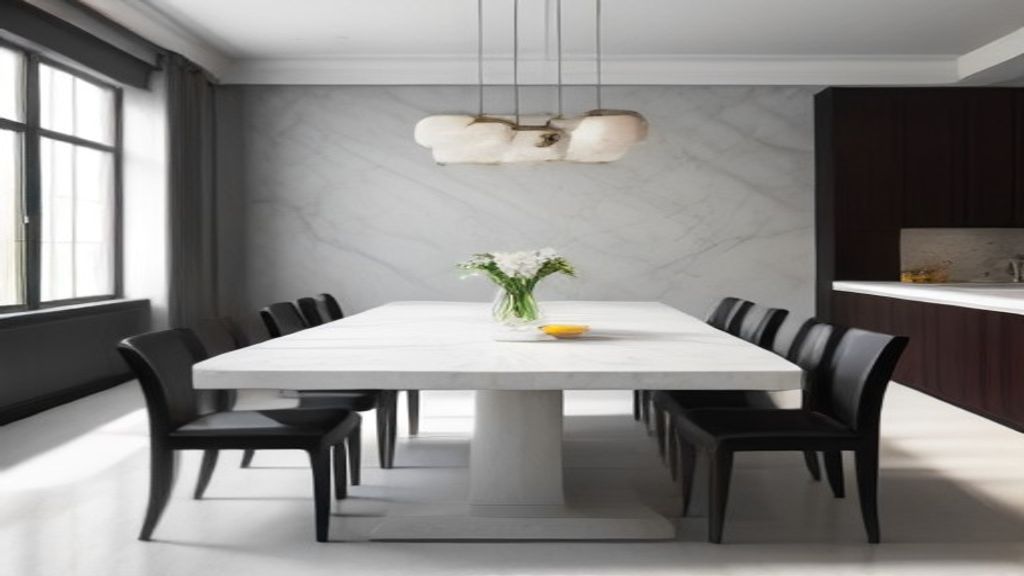
I've bought three marble dining tables in the last two years and returned two. The one I kept taught me more about room dimensions and marble grain than any catalog ever did.
First, the room. My dining area is 10x12 feet. I kept seeing beautiful 72-inch marble tables online, but when I taped out the footprint on the floor, it left 18 inches behind a chair. That's not enough to pull out a chair and sit down. I know now: 60 inches is the longest I can fit, and I need 36 inches between the table edge and any wall or furniture to move chairs.
Marble is heavy. A 60-inch, 3/4-inch thick slab weighs about 220 pounds. Delivery is a two-man job, and if the table comes in pieces and the slab is set on the base, it's risky—I've seen cracks happen at the bolt holes because the base isn't perfectly level. Check if the base sits on a steel frame. I made the mistake of thinking a thick slab meant sturdiness, but the base wobble is what actually matters.
Marble scratches. I put a ceramic mug directly on my first table and left a light gray streak. It's not a dull mark, it's more like a scratch you can feel with a fingernail. Now I use a mat for everything hot, and I wipe spills fast—acid from tomatoes or lemon will etch the finish. That's a dull spot you can't buff out. If you have hands-on kids or you're a messy cook, consider honed marble: it hides scratches better than polished, but it stains more easily.
Don't buy online without asking about the marble type. You'll see 'marble' but it could be Carrara, Calacatta, or Nero Marquina. Calacatta is the white with bold gray veins—it's expensive, but the pattern is dramatic. Carrara is softer gray, streaks are finer, and it's more budget-friendly. If you care about durability, ask about the density and whether it's been sealed. Sealing isn't permanent; you'll need to reapply every year or so.
Another thing: the sample. Marble is natural, so the slab you see in the store may not be the slab you get. I asked for photos of the actual slab before delivery. That saved me once—the delivered table had a vein running right across the intended dining spot, which would have been distracting. I requested a different slab.
For price, a 60-inch modern marble dining table runs $1,200 to $2,500 if you're getting a real slab. If you're seeing under $800, it's probably not solid marble—it might be porcelain or veneer, which looks like marble but is more durable. For my money, I'd rather have a good porcelain that I don't stress over, but if you want the real thing, budget for care.
One more thing: measure the aisle. I have a door on my left and a wall on my right. My table is 60 inches, and I left 36 inches on each side. That lets me walk around without sidestepping. I got that from taped-out floor plans—do that before you commit.
I also had a disastrous delivery with a round marble coffee table that taught me to always check the hallway dimensions. Same rule applies.
If you're eyeing a slab, ask about the total weight and whether your floor can handle it. I learned that the hard way with the second table—it wobbled because the floor flexed slightly. That's not the table's fault.
I've also learned from a dining table for two that seating depth matters more than length. And when I read about wooden table pricing, I realized wood is more forgiving than marble for families.
Anyway, if you're on the fence about marble, get the slab photo, measure the room, and check the base rigidity. Then, go for it—but keep a good sealer handy.
It's not about the hype. It's about whether the table fits your actual floor plan without turning your dining room into a hallway.