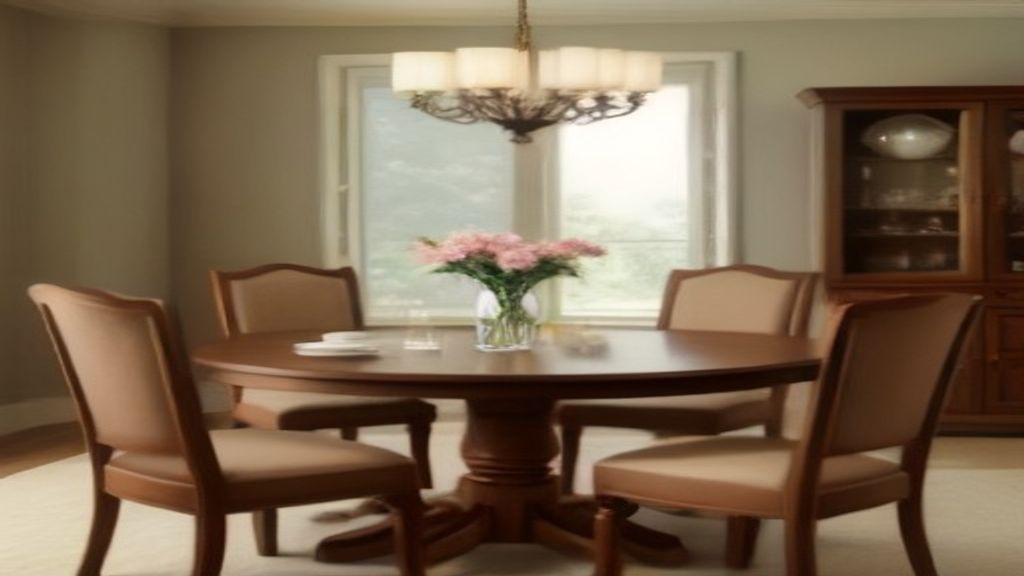
The 36-Inch Rule That Changes Everything
You're looking at round dining room sets because corners are dead space, right? But the hard part isn't the shape — it's the room you're dropping it into. If you've already got the table pushed against a wall because nothing else fits, stop here. That's not a round set. That's a half-circle with a dust collection problem.
Here's the rule I've learned from measuring too many rooms: you need at least 36 inches from the table's edge to the wall or furniture behind a chair. That's what lets someone scoot back and actually stand up. For a 48-inch round table, you're talking about a room that's at least 112 inches (or 9 feet 4 inches) in one direction. And that's the bare minimum. If you want a buffet or a sideboard, add 18 to 24 inches more.
The Bodies Test
Forget the room for a second. Look at who's eating. A 48-inch round table fits four adults, maybe five if you're all skinny and don't mind elbows. A 54-inch feels comfortable for five, tight for six. For six adults who actually sit down and eat without doing yoga, you need 60 inches in diameter. And that's a big circle. It takes more floor than you think, because the chairs stick out in every direction — that's the whole point of round, but it's also the surprise.
I pulled up the dimensions blog once, and the mistake was always the same: people buy the 60-inch because it seats six, then realize their kitchen is 12 by 10 and there's no room for the fridge side. Measure the path from the stove to the table. If it's less than 24 inches, you're going to be feeling that bruise on your hip by week two.
Chair Depth: The Sneaky Variable
Chair depth is the thing everyone forgets. A round set looks like it's only as big as the tabletop, but the chairs add 18 to 24 inches sticking out, even when pushed in. That's why that 44-inch round set you loved in the showroom suddenly swallows the whole nook when you get it home — because the chairs are big, or the arms flare out, or the back leans back.
Rule with a tape measure: for every chair that will be used, add 24 inches from the center of the table. If your room feels cramped at that number, you need a smaller table or a table with a pedestal base so there's nowhere for legs to kill the chair position. That's actually where the round table wins — a pedestal base lets you tuck the chairs in tighter, so you can fudge the depth by a few inches each side.
Delivery Day Realities
Now the part no one wants to admit — the set has to get through the door and over the threshold. Round sets are heavy. A 60-inch table with an oak top and a decent pedestal runs 150 pounds or more, plus the chairs. The boxed table won't fit through a narrow hallway unless the table comes apart. So ask: is the table one piece? Does the pedestal split? Does the top come off? I read a review once where the guy measured the door, not the box, and then spent a Saturday afternoon with a Sawzall and a lot of swearing (the box wouldn't clear the stair landing).
That's why I tell people to read the shipping box dimensions, not the table dimensions. Also, look at the delivery fee. Sets with a bulky round top can be a pain in hallways, and if the company only does curbside, you're the one hauling it up the steps. Good thing round sets are less likely to have a vein of veneer crack in the middle, like long rectangles do. But a drop on the edge is still a drop.
Setting the Layout Before You Swipe
Walk the room with painter's tape. Tape a circle the actual size of the table plus 24 inches on each side for chairs. Live with that for a few days — cook, eat, drop your keys on the way in. The angle of the door swing, the TV sightline, the path to the patio — they all matter more than the color of the wood. I once talked a neighbor out of a beautiful 54-inch set because her kitchen pass-through was exactly 26 inches wide. She'd have had to crawl to get to the coffee maker.
If you're leaning toward a glass top, there's a whole other thing about smudges and how the base shows up. More on that here: Round Glass Top Dining Table Set 4 Chairs: Pick the Base, Everything. But the base matters for real: a four-legged base is stronger, but the feet stick out and you'll always be kicking them. A central pedestal gives you the leg room but can tip if it's poorly weighted. Go heavier on the base for a bustling household.
What You'll Actually Do at That Table
I know I sound like I'm just measuring, measuring, measuring. But the reality is, what you use the table for shapes the set you can get away with. Are you folks who play board games (round is a pain for cards — everyone's at a different angle), or do you eat in shifts? If you're a breakfast reader, you need a table light enough to pull into the corner. The set's sturdiness comes up right here. Soft pine that tops out at 300 pounds of chinese takeout might rock with four heavy adults. Oak or acacia will hold.
That's the thing about round sets — they do better in a breakfast nook or a laid-back kitchen than in a formal dining room. For formal, people actually want rectangular partly out of tradition, partly because serving platters line up on the long axis. I'd still take a round set in a small open plan any day; it lets you squeeze eight chairs at a pinch for parties. Just know that pinch means you're hitting knees, not just grazing.
The Stuff Nobody Tells You
Round sets love soft-close glides and wheels on the pedestal if you crave flexibility. Skip any set with a leaf — that's a hack job on a circle and it always looks weird. And check the chair fabric if it's upholstered. I ordered a set once with textured gray linen and it's not the fabric that turned out to be the problem; it's that the crumbs fall into the texture and the fabric's hard to wipe. Go with a performance fabric or flat weave if you've got kids.
Another thing: don't buy a set where the chair height doesn't match the table's apron. Standard chair height is 18 to 19 inches, and table height should be 29 to 30. But the table's apron — the solid band under the top — can get in the way. Measure the chair to tabletop clearance: you need at least 7 inches above the chair seat, otherwise you'll be hunching.
So What Do You Do?
If you're space-tight, get a 42-to-48-inch round set with a pedestal base and tuck it against a wall if you must, but only for two people to eat — the other sides will be facing the wall. If you've got the clearance, go 54 to 60 inches and go solid wood instead of veneer; a round top gets edges rubbed and veneer flakes. Don't be seduced by the four-leaf faux-wood sets at the chain stores; they look okay in the photo, but the hardware jiggles and the glue smell takes a full month to fade (real story from a friend who bought a cheaper set and returned it after two weeks).
The exact one you pick is up to you — but the measurement test is the whole game. And once you've lived with the tape circle for a few days, you'll know. I've seen too many rooms where a round set became the thing you bump into on your way to the back door. And that's not style, that's a bruise in the making.
For more on the start-to-finish setup, check Formal Dining Room Sets: Skip the 9-Piece and Measure the Door First — it walks the same triangle: room, doors, and the table you thought you wanted.
If you're comparing that to a rectangular, RH Dining Tables in the First Week: The One Decision That Sets the Tone hits the same measuring beat, but for the long ones.
And if you're already mulling the base for a glass top, Oak and Glass Dining Table First-Week Setup: The One Decision That is worth a read.
One last thing: whatever set you're eyeing, read the box dimensions before you hit purchase and check the freight delivery — I've got a scar on my knee from a pedestal base that was no problem in the diagram. You'll be fine.