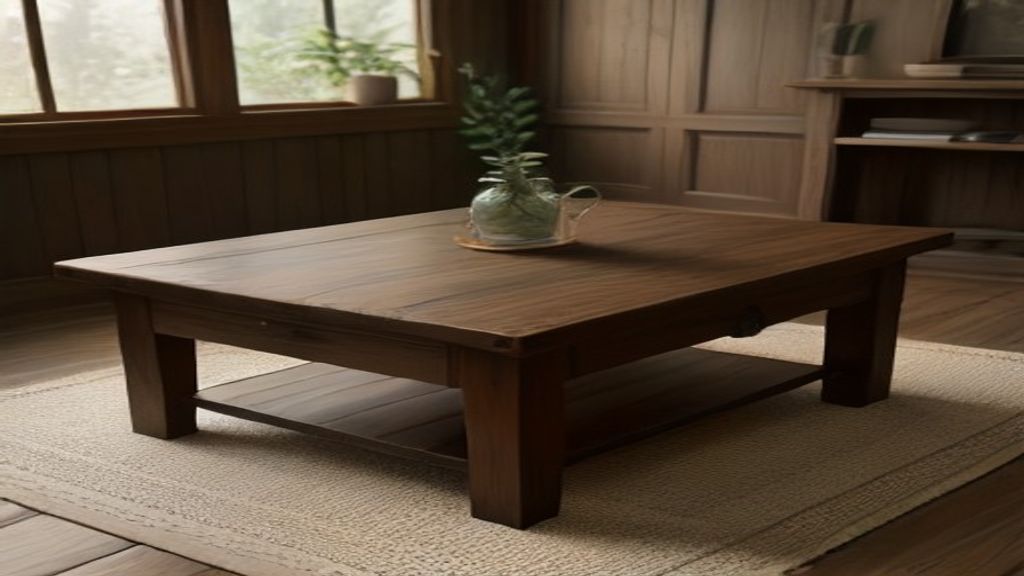
Let's be straight: I've owned three primitive coffee tables in the last five years. Two were reproductions, one was a salvage-yard find. The first one—a fake wormhole special from an online store—looked great in the listing photo and arrived with a finish that flaked off in thirteen days. I measured nothing. I read zero reviews. I bought on vibes, and vibes cost me money.
Here's the thing about primitive furniture: the whole point is that it's supposed to look old, but cheap replicas just look cheap. The 'distressed' finish is a coat of paint over MDF, and the 'hand-carved' details are stamped. You can spot it from across the room. My second table was a step up—solid pine, hand-stained—but I still didn't measure the space properly. It sat too far from the couch, and my knees hit the edge every time I leaned forward. I sold it at a loss six months later.
So before you buy any primitive coffee table, measure your room like a person who's been burned: get the couch height, the seat depth, and the distance from couch to wall. You want the table top to sit about the same height as your couch cushions, maybe an inch or two lower. If it's higher, you'll be reaching up for your mug. If it's too close, you'll bruise your shins. I wrote a whole piece about Coffee Table with Extendable Top: The One Decision That Matters in that talks about how extendable tops change the math, but for a primitive style, you're usually looking at fixed sizes.
Now, when I talk about primitive, I mean the real thing: rustic, hand-hewn, often made of pine or oak, with visible saw marks, iron hardware, and a finish that looks like it's been worn down over decades. That doesn't come cheap. A genuine antique from a dealer will run you $800 to $1,500, and that's if you can find one. Replicas range from $150 to $600. The gap in price reflects a gap in materials and workmanship.
What do you really gain in the higher tiers? Let's talk numbers. A $200 reproduction might have a 1/2-inch thick tabletop and a base that's glued, not joined. I know because I took a flashlight to one. The 'antique' paint job chips in week one. A $500 replica from a dedicated primitive furniture maker uses solid wood (usually pine, sometimes oak), dovetailed or mortise-and-tenon joints, and a finish that's actually distressed by hand—dents, scrapes, and all. It's heavier too; mine weighed 42 pounds versus the 28 pounds of the cheap one. That weight tells you it's not hollow.
Then there's the salvage route. I found my third table at a flea market for $120: solid oak, chipped edges, a drawer that sticks, but it's built like a tank. It has character that no factory can fake. The downside? It's got a stain that smells a bit like an old barn, and I had to sand and oil it myself. That took an afternoon and $15 in supplies, which is cheaper than buying new.
But here's the kicker—I almost skipped buying the salvage table because I had the cheap replica already doing the job. In the end, the replica went to the curb. The primitive look I wanted came from the salvage piece, but I had to invest time.
If you're considering a primitive coffee table, ask yourself two questions. First: do you want furniture that actually looks like it's from 1820, or just a coffee table with rough edges? If it's the latter, a $200 replica might work, but keep your expectations low. Second: will you actually use it? If you're the kind of person who puts a tray down and never moves it, maybe a primitive piece with a rough surface isn't for you. The uneven top of my salvage table makes it annoying to set a glass of water down without a coaster, because the glass wobbles.
That's the trade-off with primitive: authenticity over convenience. My salvage table's surface is worn, but not level. My replica looked level, but the finish didn't last. In the end, I kept the salvage table. I sanded it down, applied a couple coats of tung oil, and now it's a permanent part of my living room.
Who should skip a primitive coffee table? Anyone who wants a perfect, level surface for a playroom or a modern loft with white couches. The rustic look can clash hard with modern interiors. And if you don't like cleaning crevices, a hand-hewn tabletop with nail holes and cracks will trap crumbs and dust like crazy. My table has a groove that collects cat hair no matter how often I vacuum. So if that's you, save your money and buy a glass-topped table instead. I've owned those too—3 Piece Glass Coffee Table Set: Clear Glass Fails, But Only If You explains why glass works in a way that primitive doesn't.
If you're ready to take the plunge, measure twice, buy once. And don't be afraid to go the salvage route if you have the patience. It's cheaper and the character is unbeatable. But if you go replica, at least spend enough to get real wood construction. You'll be happier in the long run. Just don't say I didn't warn you about the dust.