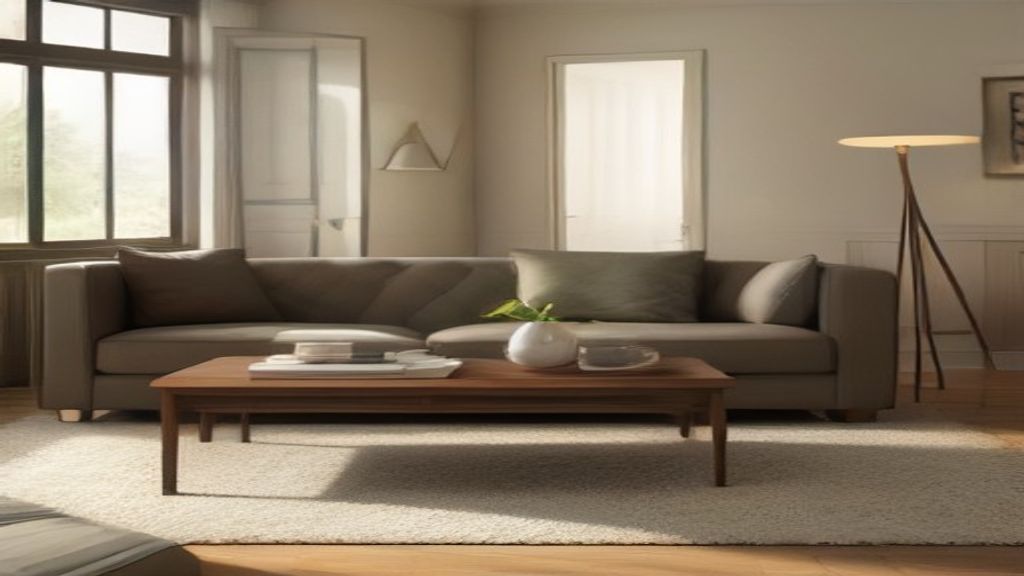
I bought a $150 coffee table from a big online store, and it looked great in the photos. Two weeks in, the drawer pull came loose. By month three, the veneer was starting to lift on the edges. I returned it after a year—mostly because the frame wobbled so bad I couldn't stand it. Then I bought a $600 table locally, and the difference wasn't just looks. It was the weight, the joints, and how it felt when I dragged it across the rug. Here's what the money actually gets you, and where it doesn't matter.
The Wood: Not All Solids Are Equal
At $150, you're usually getting MDF or particleboard with a paper or veneer wrap. It can look fine from across the room, but it dents easily. My old console table—also cheap—got a black mark from a hot mug that never came out. At $300–$600, you might start to see solid wood on the legs or frame, with MDF or plywood on the top. That's not a dealbreaker. What matters is where the stress points are. For example, a table with solid legs and a plywood top will hold up better than an all-MDF piece that looks shinier.
Once you cross $700–$1,000, you're paying for hardwood—oak, walnut, maybe reclaimed wood. The grain is continuous, not printed. The edges are beveled, not rolled to hide a seam. I'm not saying you need to spend that much. If you're renting and moving every two years, an inexpensive table is fine—just don't expect it to survive a second move. I've moved three times with my $600 table, and it's still tight. My $150 table didn't live through one.
The Factory Finish vs. the Hand-Finish Puzzle
Cheap tables come out of the box ready to use. But the factory finish on that $150 table was basically a coat of lacquer over the print. It looked shiny in the listing, but in person it had a weird polyester look—like a sticker. The $600 table I bought had a matte lacquer that let the wood show through. You can feel the difference. One is furniture; one is furniture-shaped product.
If you're thinking about refinishing or painting a cheap table to upgrade it, here's the thing: the wood underneath is often so soft or so thin that sanding goes straight through the veneer. I tried that with a $200 nightstand once. Total disaster. If you want a piece you can refinish later, skip the budget tier and go up to at least $400.
Size Counts More Than Price
I've seen people spend $800 on a coffee table that overwhelms a 10x12 room. The price tag doesn't solve proportion problems. Measure your sofa first: your table should be about two-thirds the length of your sofa, and not taller than the seat height. I made that mistake once—my table was higher than the sofa cushions, and it felt like a barstool in front of the couch.
If you're shopping in the $150–$300 range, take the time to measure the actual footprint. Many budget tables are smaller than they look online. I ordered a square table once that was 30 inches across, but in the room it looked like a footrest. On the other hand, my current $600 table is 48 inches long, and it anchors the seating area perfectly. If your living room is small, a lighter visual table—glass or a slim metal frame—can work better than a bulky wooden one. It's not about price; it's about optical weight. If Your Room Is Tight, Read This on All Modern Coffee Table
The Assembly Nightmare Nobody Mentioned
Under $200, you'll usually get a box of parts and an instruction sheet with confusing arrows. Budget an afternoon. My $150 table took three hours because the cam locks didn't line up. For $600, assembly might take 15 minutes—often the legs screw in, done. If you hate assembling furniture, that price difference is real. I'd rather pay more upfront than curse at a hex key again.
Another failure point: screws. Cheap tables use Phillips-head screws that strip easily. I've rounded more than a few. Mid-range tables use better hardware—some even include a wrench. If you're a renter or move often, that matters. Nothing worse than a leg that won't stay tight after a move.
Glass Tops and Cheap Steel: Where It Falls Apart
Glass can look great on a budget table, but the quality varies. Tempered glass is a must—it's harder to break. But even then, the thinner the glass (like 5mm), the more it flexes when you put down a drink. My sister had a budget glass table that developed a stress fracture after a year from uneven surface exposure. The frame was the bigger issue—cheap steel tubes collapse. 3 Piece Glass Coffee Table Set: Clear Glass Fails, But Only If You Ignore This
If you're going glass, I'd stick to at least 8mm thickness. That usually means moving up to the $300–$500 range. At that point, you're paying for the glass quality and the joints, not just the look.
The $300 Sweet Spot: What You Actually Gain (and Lose)
If you're not ready for four figures, $300–$500 gets you a decent mix: better veneer (still not solid, but thicker), more stable joints, and maybe a subtle design detail you'd miss on a cheaper model. My current coffee table at $600 is solid walnut, but I've seen nice ones at $400 with a plywood core and walnut veneer that felt nearly as sturdy. The downside? That price still trades on warehouse models, so expect some particleboard in the drawers or back panels. It's a compromise. If you can stretch to $800, you might get a piece that lasts decades. But if you're in a temporary place, $300 will do.
Who Should Skip This Guide
If you're not measuring your room, if you want something to just put drinks on for the next two years, or if you already own a $50 garage-sale find that does the job, then none of this matters. I'm not here to tell you to spend more. I'm here to help you understand what the price tiers actually mean. If you're planning to keep your table for a decade, a $150 table will likely fail you. If you're buying for a first apartment and know you'll move in a year, don't blow a paycheck. So, measure first, think about what happens when it gets bumped, and maybe check the delivery process—that's often where the real surprises hide. More guides in Coffee Tables