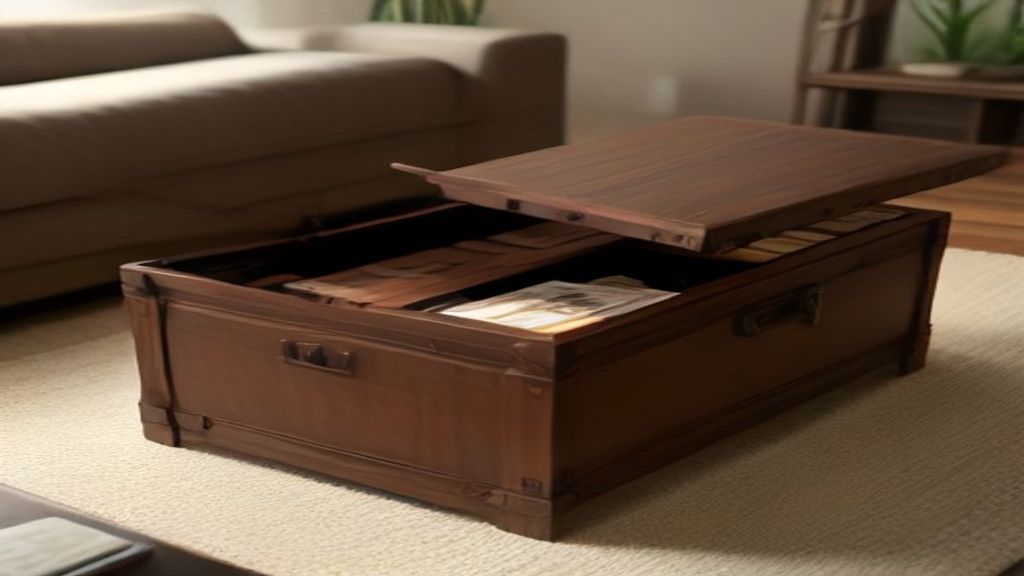
I bought a trunk table online because it looked like a vintage steamer trunk, and I liked the idea of hidden storage in the living room. It showed up, I assembled the legs, went to open the lid — and the hinged top swung back and hit the wall behind the couch. The lid doesn't stop at 90 degrees; it goes further, and the hardware isn't designed to hold it mid-way. Two weeks later, I moved the trunk to a spot with more clearance, but the scratch on the wall is still there.
If you're thinking about a trunk table for your living room or entryway, measure the hinge travel before you commit. Most trunk tables have a full-open lid that needs about 18 inches of clearance behind it. If you place it against a wall and that wall is your sofa, you'll either block the lid or you'll be leaning over it every time you dig out a blanket. Also, check the hinge stops: some lids have a locking mechanism that holds them upright, others just flop back. The flopping ones are the ones that hit the baseboard.
The Fix: Work Backwards from the Lid
Instead of measuring the table footprint first, open the lid and note the maximum height and depth it needs. For a typical 20-inch trunk, the lid swing adds about 12–15 inches behind the back edge. If your wall is less than 18 inches from the front edge of the trunk, you'll have to leave it closed or push it away from the wall. That sounds obvious now, but online images rarely show the clearance behind the trunk, so you don't think about it.
Also, look at the hinge pins. Many are so thin they bend under the weight of the lid — especially if the lid is one solid slab of wood or faux leather. I measured the cheap ones I got: the hinge pins are 4mm diameter. For comparison, a solid oak trunk from a decent maker uses at least 5mm pins and three hinges. I found a trunk locally with 6mm pins and a steel bar that runs across the back edge, and it felt much safer.
What to Measure Before You Buy
- Clearance behind: Add 16 inches to the depth you think you need, and measure floor-to-heart. If that clearance is against a wall, subtract it from your usable depth.
- Lid weight: If it's a tall trunk, you'll be lifting a lid that can weigh 15–20 lbs. Anything more and children or older folks will struggle. Mine is 22 lbs; I'm 5'2" and I can manage, but my partner avoids opening it.
- Floor clearance: Many trunks have short legs or casters that look like a buyable feature. But 3-inch legs give you no storage underneath — you can't run a vacuum under it. That was my second mistake. I bought one with 2.5-inch legs, and the dust bunnies live there.
- Lid stay: Look for a friction hinge or a gas strut. A trunk table that opens like a box (where lid flips back flat) needs a clear 25 inches behind. The ones with a lid that lifts upward but only to 45 degrees are less likely to hit the wall, but you'll have to hold it with one hand while you grab something.
The Downside Nobody Talks About: Lid Latch
Most trunk tables have a tiny latch that holds the lid shut. After a week, that latch gets loose if you open and close it often. I used mine as a coffee table; every time I wanted a remote or a magazine, I'd press the latch, and the lid would fly open. It didn't fall off, but the latch wasn't magnetic either — it was just a simple flip catch that relied on friction.
If you intend to use the trunk's lid as a tabletop for drinks or casual work, keep it closed. That sounds obvious, but people think because it's a table, the lid stays closed. The moment you want something inside, you have to move your laptop and any mugs off. Not a deal-breaker, just know that, with a large trunk, you won't be storing the everyday stuff you need while the surface is hot.
Who Should Skip This Alternative?
Actually, let me rephrase: if you find a good trunk table, it's worth it. I just overspent on mine because I didn't know the specs. The good ones with a three-hinge system and a steel stay cost more, but they're not unaffordable. The bad ones are just slightly cheaper than a regular coffee table, and you'll live with a scratch or a loose latch which is cheaper to fix than a dented floor. If your living room is under 12 feet wide, look for a trunk that's no more than 22 inches deep, and stick to one that sits on full-length legs — not little feet that will wobble on high-pile carpet. I use my trunk table every day now, but for the wrong reason: it's just a table. If I had to do it again, I'd test the hinge in a store, not online.
For more coffee table buying tips, check out the Cocktail Table: Skip These Three Mistakes and the Traditional Coffee Table First Week: The One Decision That Matters. And if you're thinking about a new dining space, the 6 Seater Table First Week Setup: The One Decision That Matters article has similar clearances to keep in mind. If your room's tight, the notes in If Your Room Is Tight, Read This on All Modern Coffee Table are worth reading.