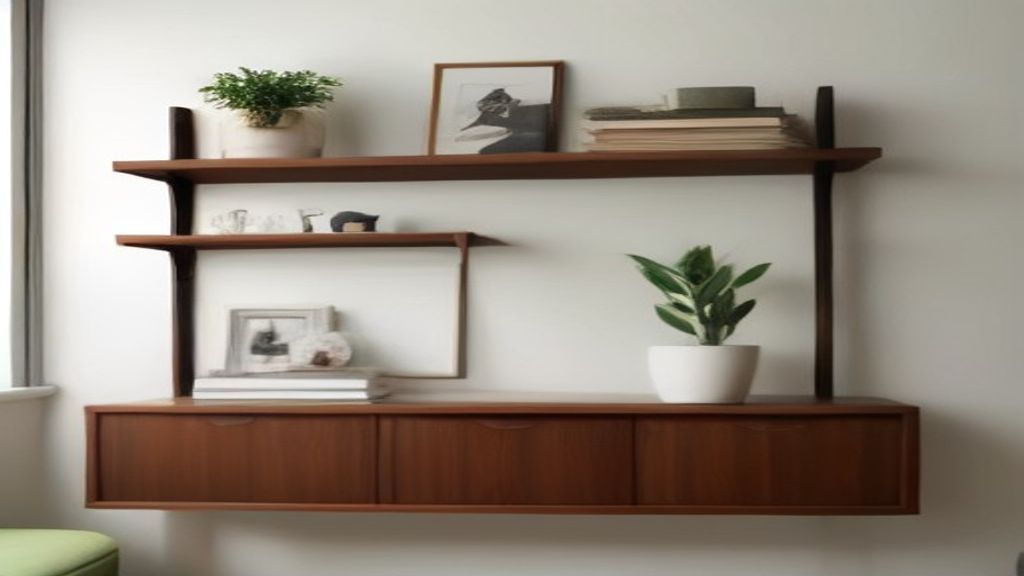
I've had three mid century wall shelves in the last year. A $60 one, a $150 one, and a $300 one. They all look similar in photos. They don't feel similar when you're hanging them or loading them with books.
Here's the plain truth: you're paying for wood, not style. The silhouette is easy to copy. The wood and the hardware are where the price shows.
What the $60 Shelf Gets You
Rubberwood or MDF with a walnut veneer. It's light—maybe 8 lbs. The bracket is thin steel, painted black. It'll hold a couple of paperbacks and a plant. Don't push it past 20 lbs, or the shelf will bow. I saw it happen.
Mounting is straightforward: two screws into studs, if you catch them. If you don't, you're using drywall anchors and crossing your fingers. The screws they include are cheap, so swap them out.
The finish looks fine from across the room. Up close, the veneer has seams, and the edges aren't rounded like real walnut. In a year, the veneer can peel at the corners if you bump it.
The $300 Shelf: What You're Actually Buying
Solid walnut or white oak. The grain is continuous, not printed. It's heavier—20 lbs or more—so you need better hardware. The brackets are thicker, often with a hidden steel core. The shelf holds 50 lbs without sagging.
The finish is oiled or lacquered, so it resists scratches and water marks. The edges are soft, milled by hand or CNC, not sharp. It'll look good in ten years, not just in the first week.
Installation is less forgiving because it's heavier. You'll need a stud finder and probably a helper. But once it's up, it's solid. You could hang from it (I wouldn't, but you could).
Does the Middle Ground Make Sense?
If you're between budgets, go solid wood but simple. A plain walnut shelf with basic steel brackets, no dovetails or fancy joinery. That's the sweet spot—around $150.
You skip the MDF and get the real grain. You don't get the furniture-grade joinery, but who cares? It's a shelf.
My Suggestion
If you're storing heavy mugs or oversized art books, skip the cheap one. It'll sag. If it's just a picture frame and a small plant, the $60 shelf is fine. Save your money.
Also, measure your wall. And if you're planning a full setup with floating shelves, check Thin Shelf Setup Week: Measure Your Wall Studs First before you buy.
For more shelf talk, see IKEA LACK Shelf: 7 Inches Deep and the Constraint That Decides. And if you're also looking at desks, Mid Century Wall Desk: $120 vs $450 — What Changes and What Doesn't goes through the same math.
Ikea's cheap line is fine, but it's not solid wood. Most mid century reproductions under $100 aren't either.
Pay for the wood. Ignore the hype. And don't overfill a shelf that wasn't built for it.