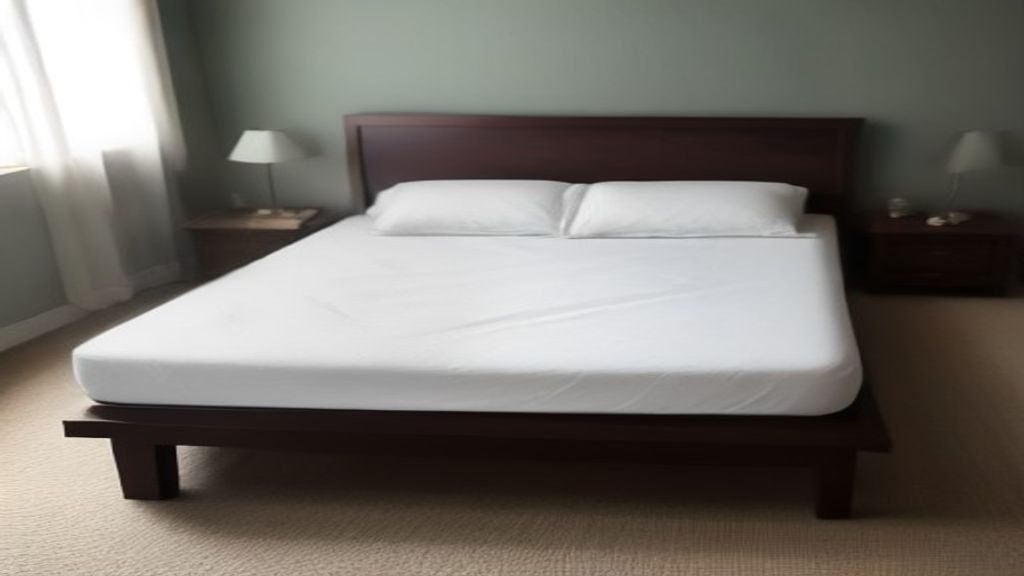
I slept on my stomach for thirty years. In my early forties, my neck started complaining, and my dentist said, "You're grinding your molars flat." So I switched to my back. That lasted two nights on my old plush-top spring mattress. I'd wake up with a hollow ache in my lower back, like I'd been doing crunches in my sleep. That's when I started a six-month, six-matress ordeal. This is what finally worked.
I'm not a mattress tester. I'm a guy with a tape measure and a bad back. But I learned some concrete things about what back sleepers actually need.
The measurement that changed everything
The problem with back sleeping is your lumbar spine needs support, but your shoulders and hips need to sink in just a little. On my old mattress, my hips sank way too deep, curling my spine into a C. The first thing I did was measure my "immersion." I laid a straight board across the mattress while I lay on it. Then I measured the gap under my lower back. If it's more than an inch and a half, your mattress is too soft. On my old mattress, that gap was 2.5 inches. No wonder I hurt.
My physical therapist told me to look for a mattress that keeps your spine neutral when you lie flat. But she also said firmness is personal. So I started testing.
Firmness numbers that actually mean something
Mattress companies throw around words like "plush" and "firm," but they don't tell you the ILD (indentation load deflection) of the foam. That's the number that tells you how soft the foam is. For back sleeping, you generally want a medium-firm feel, which in ILD terms is around 30–38 for the top layer. But ILD isn't printed on most boxes. So I had to go by feel and measurements.
The first mattress I tried was a 12-inch bed-in-a-box with a 2-inch gel memory foam top. The ILD felt around 25. I sank so deep my hips were at 2 inches. Returned.
Then I tried a firm hybrid with 1 inch of foam over coils. Too hard. My shoulders dug in, and I woke up with a sore shoulder. That one had an ILD around 45. I returned that after three nights.
The winner was a 10-inch latex hybrid: 3 inches of Dunlop latex (ILD about 34) over a coil base. My lower back gap measured exactly 1 inch. My shoulder dipped 1.5 inches, my hip dipped 1.5 inches. Even pressure. No more morning ache.
Edge support and other silent back killers
Here's something nobody mentions: if your mattress sags at the edge, you'll unconsciously migrate to the middle while you sleep, and that's a spine twister. I measured edge sag by sitting on the edge and having my wife measure how far down it went from the box spring. More than an inch is a red flag. My winner sinks 0.75 inches when I sit on the edge. The all-foam ones I tried sank 2 inches or more. That's why you want a hybrid with a solid coil border.
Also, don't forget the foundation. I have a Full Size Bed Foundation: The Mistake That Made My Mattress Sag in 11 Months story to tell. The wrong slats (spaced more than 3 inches apart) or a box spring with a worn center can make a good mattress feel bad. I swapped my foundation at the same time. No point in blaming the mattress if the base is shot.
The price tag: what $500 vs $1500 actually got me
I know a lot of people are on a budget. I tried a $500 foam mattress first, and it was a hammock by month two. Not a hammock for everyone, but for a back sleeper, it was a spine taco. Then I tried a $1500 innerspring hybrid. That one was okay, but it had a slight center sag after eight weeks. I returned it under warranty. The winner, a latex hybrid, cost me $1200 on sale. I've had it for a year now, and my morning back pain is gone. Sometimes you really do get what you pay for.
If you're looking for more price comparison, see my Best Foam Mattress 2022: What $500 vs $1500 Actually Buys You piece.
But price isn't everything. My friend bought the same mattress and hated it — said it was too firm. He's a side sleeper. So your size, weight, and sleeping position matter a lot.
What if you're a back sleeper and you are cheap or stubborn?
If you're a back sleeper and your current mattress is killing you, start with a foam topper that's firm, not plush. That's a cheap fix. But understand that a topper only masks a sagging base. Eventually you'll need a new mattress. And if you're over 200 pounds, you'll want a hybrid or latex with heavy-gauge coils. All-foam mattresses tend to bottom out for heavier folks. Also, if you're tall, look for a 12-inch or thicker mattress, because you need more support under your hips.
The skip list
If you're a back sleeper who weighs under 150 pounds, you might be fine with a softer mattress. My wife is 130 pounds and she loves our old plush-top spring. But she's also a side sleeper. And if you're used to a hard floor or futon, a medium-firm will feel like a cloud. That said, don't buy a memory foam mattress that's over 2 inches of memory foam on top. I've seen too many back sleepers end up with a "memory foam hug" that turns into a backache by 4am. If you absolutely must have memory foam, look for one with zoned support (firmer under the hips) or a mix of foam and coils.
Also, if you're a back sleeper who shares your bed with a restless partner, you'll appreciate motion isolation. Latex is great at that, but it also sleeps cooler than memory foam. My wife still complains about the heat though, so we use a cotton mattress pad.
This isn't the perfect mattress for everyone. It's just the one that fixed my back. I can tell you that after six returns, I'm done. My spine and I are on good terms now.
If you're still shopping, check out the Forty Winks Mattress: 60 Nights, One Honest Review for another perspective, or my 6 Inch Twin Mattress: What Fits, What Sags, and What to Measure First if you're outfitting a guest room. And don't forget to measure your room and your doorways before you order — my Dual Office Desk: The 65-Inch Reality Check That Saved My Back article has some measuring tips that apply to mattresses too.