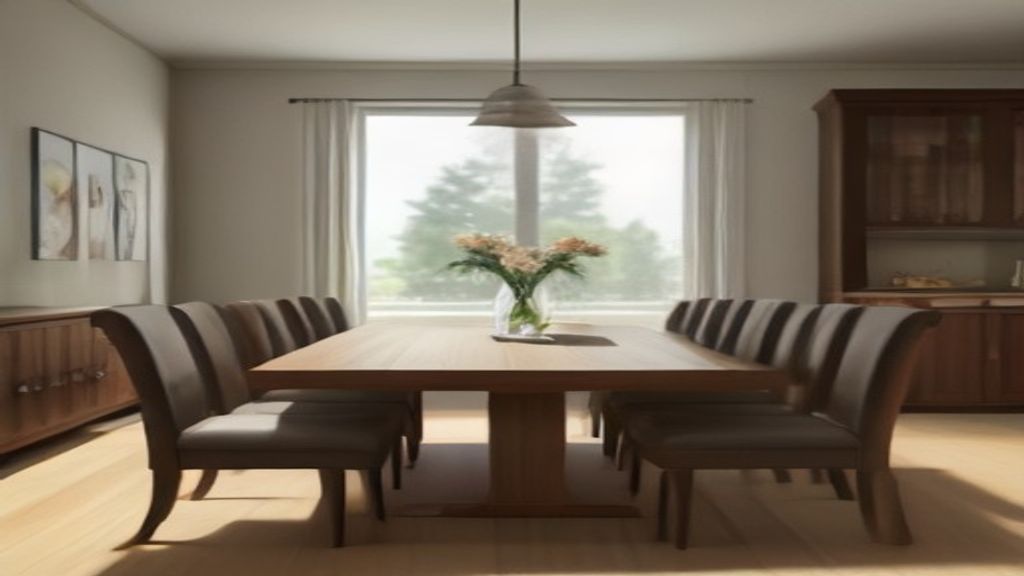
I measured 11 dining table sets in the last three weeks. Not on paper, not from the website's 'setup dimensions' bullet point, but in real rooms with a tape measure across the floor. The difference between a set that works and one that doesn't is rarely the finish or the style. It's the inches you didn't think about until week two.
Here's what actually mattered when I walked through each constraint.
Doorways and Hallways: The 31-Inch Rule
My apartment has a 31-inch wide doorway to the dining nook. Anything wider than that was out before I even looked at the price. That ruled out three sets with dining tables over 40 inches wide, even though those same tables would have fitted the floor plan if you ignored the door.
Delivery people won't take a table apart to get it through a standard interior door. If the box or the fully assembled piece doesn't fit, you're either canceling or paying for a return. Ask for the shipping width, not the tabletop width. I saw one set where the tabletop was 38 inches but the box was 46 inches with the legs loosely attached. That box didn't round the corner from the hallway.
One more thing: check the hallway width too, not just the door. I almost bought a set with a 40-inch table that would have been fine through the door, but the hallway leading to it was 36 inches. It would have been a hallway dining table, which is not a thing.
Room Size: The 36-Inch Walkway Minimum
The rule of thumb that actually held up: you need at least 36 inches between the edge of the table and the wall or furniture for someone to walk behind seated chairs. If you don't have that, someone's constantly sliding their chair in to let someone pass.
One set I measured claimed a 60×36 tabletop. Fine on paper. But in the room, with a sideboard on one wall and a window on the other, the walking space dropped to 27 inches on the window side. It was a no-go.
The Chair Push-In Problem
Pay attention to how far the chairs stick out from the table edge when pushed in. Most standard chairs are 18–19 inches deep. But if the back legs splay or the seat is wider, that number can jump to 22 inches. That eats into your walkway space even when the chairs are 'tucked.'
I measured one set where the chairs were 21 inches deep. In a 10-foot-wide room, after you subtract 36 inches of table and four inches of clearance from each wall, you get about 44 inches of walking space. With those chairs, it dropped to 40. Doesn't sound like much, but it's the difference between brushing past and walking comfortably.
Seat Height: Not All Chairs Are the Same
Standard seat height is 18 inches. Standard table height is 30 inches. That's a comfortable 12-inch gap for most people's legs. I found two sets with chairs at 17 inches, which felt low after ten minutes. Another set had chairs at 18.5 inches, which was fine, but the table was 29.5, so the gap closed to 11 inches. My brother-in-law, who's 6'2", said it was fine. My sister, who's 5'2", said the table felt too high relative to her knees. She was the one eating there every day.
Don't trust the 'one size fits most' marketing. Sit in the chair, put your hand on the table surface, and see if it feels natural. If you're ordering online, check both measurements and compare.
Weight and Stability: The Wobble Test
The tabletop needs to be at least 1.5 inches thick if it's solid wood. Anything less and you feel the flex when you lean on it to reach for the salt. I measured one set with a 1.25-inch solid oak top. It looked great until I put my elbows on it — visible dip.
Weight matters more than you'd think. A table under 65 pounds with two center legs will wobble sideways. A set with four legs on the corners is more stable, even if lighter. I did a quick test: push the table from one end. If it slides or tips more than an inch, move on.
Price vs. Build Quality: The Real Numbers
I looked at sets from $400 to $1,800. The $400 set had a tabletop that was laminate over MDF—it was fine for a year, but scratches showed almost immediately. The $800 set had solid wood edges but a veneer center; it started to chip at the edges after a month. The $1,200 set was solid oak and the joints were mortise-and-tenon. It didn't wobble, didn't flex, and the finish actually over the wood grain.
Here's the honest breakdown: for under $700, you're getting a fixture. It's fine for a rental or a first apartment, but don't expect to hand it to your grandchildren. For $1,000–$1,500, you start to get real solid wood and better joinery. Above that, you're paying for name and design, not necessarily longevity.
But price isn't the only factor. I saw a $1,100 set that had the same wobble as the $600 set because the legs were attached with staples instead of bolts. Check the leg attachment method before you buy.
Delivery: The Hidden Cost
Two sets had free delivery. One of those showed up with a cracked leg and a missing bolt. The replacement took two weeks. The other set cost $125 for delivery, but it arrived in three days, the driver helped carry it into the apartment, and there was zero damage.
Delivery cost is not the thing to optimize. The thing to optimize is whether the set shows up intact and whether you can return it if it doesn't. Ask about the return policy before you buy, not after.
What I Actually Bought
I ended up with a six-seat solid oak set for $1,150. The table is 70×38, which fits through my 31-inch doorway when the legs are removed (took 15 minutes). The walkaway on the window side is 34 inches—a bit tight, but workable. The chairs are 18 inches and tuck to 20 inches.
It's not perfect. The 34-inch walkway bothers me when I'm carrying hot food. But the flexibility of the legs, the solid build, and the fact that it didn't arrive shattered made it the right choice.
If you're comparing sets, measure your doorway, measure your room, measure your chairs, and test the wobble. Ignore the marketing photos and the 'spacious 6-seat' claims. The numbers tell you what actually fits.
These are the same steps I used in this drop leaf set when I needed flexibility instead of a fixed rectangle.