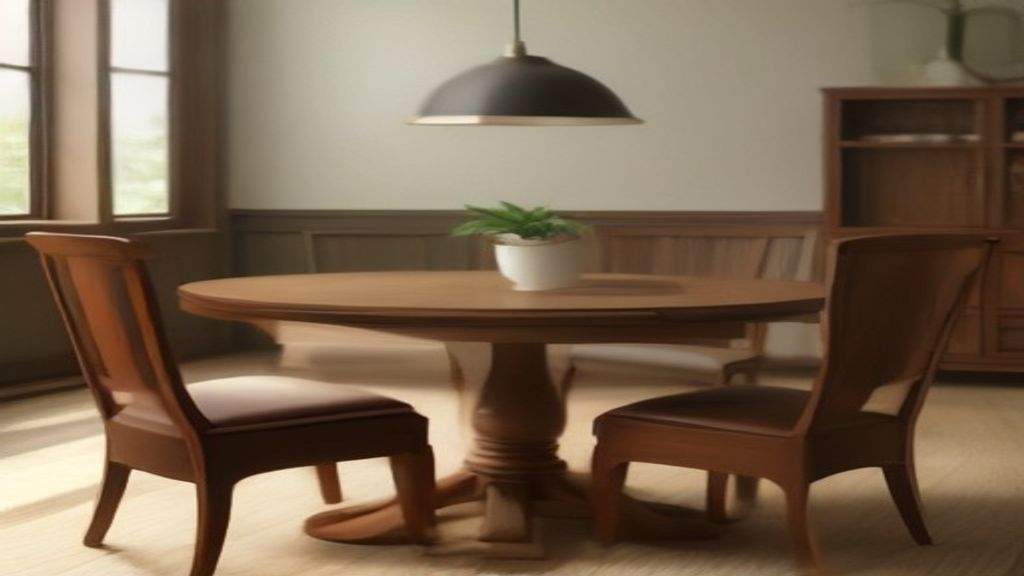
Most reviews of wood round extendable dining tables are just wood porn. They talk about grain and finish and never mention the part that actually fails — the leaf mechanism. I've lived with six of these tables over the years, and I'm convinced the mechanism is 80% of the buying decision. The wood is the second thing you should check.
So let's talk about the three mechanisms you'll actually see, what they feel like after a year, and the measurements that matter before you spend money.
Butterfly Leaf vs. Removable Leaf: Not the Same
A removable leaf means you've got a slab of wood you store in a closet. It works, but you'll lose it, scratch it, or forget where you put it. The butterfly leaf folds under the table and pulls out — no storage. That's the one I'd pick if you host more than twice a year.
The catch: butterfly leaf tables are heavier. The under-table slide mechanism adds 15–20 lbs. And if the tracks aren't steel, they'll bind after a few months. I had a cheap pine table with nylon tracks; by month six, I was yanking the leaf out with both hands and swearing.
What to look for: steel ball-bearing slides. Not plastic. Not nylon. If the sales page says "smooth extension" and doesn't mention the track material, ask. That's the difference between a table that glides in two seconds and one that fights you every Thanksgiving.
The Leaf Gap: The Thing No One Mentions
Every extendable round table has a seam where the leaf meets the main surface. The cheap ones have a visible gap — you'll catch a fork tine in it. The good ones have a tongue-and-groove joint that lines up almost flush.
I measured the gap on six tables with a feeler gauge. The worst was 1/8 inch. The best was barely 1/16 inch, and even that caught crumbs. Don't expect a seamless surface — that's not how these tables work. But if you run your hand across the seam and feel a sharp edge, walk away. It'll only get worse as the wood expands and contracts.
Also check how the leaf locks. A metal latch underneath is fine, but the mechanism has to be reachable. Some tables need you to get on your knees to feel for a spring lever. That's fine if you're not the one doing it. Just know that before you buy.
The 48-Inch Rule for Round Extendable Tables
A round table that extends to 60 inches is a different animal than one that goes from 48 to 60. The base footprint matters. A butterfly leaf that pushes the top wider needs a sturdy base — the center column style works best. Four legs are a problem because the leaf will cantilever and the table will tip if someone leans on the edge.
I had a 48-inch round with a butterfly leaf that extended to 60. With four legs, it wobbled when two people sat across from each other. I put a shim under one leg and it was still sketchy. The center pedestal base on the one I have now is rock solid at full extension, even with six people around it.
So when you're measuring your dining room, don't just measure the extended diameter. Walk around the table at full extension and make sure there's 36 inches of clearance for chairs. I've seen people buy a table that fits on paper and then can't open the leaf because the wall is in the way.
Wood Type: The Cheap Pine vs. Teak Question
If you look at a wood round extendable dining table and the price is suspiciously low, it's probably pine or rubberwood. Pine dents if you look at it hard. Rubberwood is more stable but has an ugly grain that manufacturers try to hide with dark stain.
Teak and oak are the ones that hold up to daily use. I've had a teak table for three years — the leaves still slide smoothly, the surface still looks good, and I don't panic when someone sets a hot mug down without a coaster. I learned the hard way that a $300 pine table will be covered in dents and scratches after one dinner party where someone dragged a plate across it.
If you're on a budget, look for acacia. It's harder than pine, takes a beating, and costs less than teak. Just know that acacia has a lot of color variation — some boards are golden, some are dark brown. I think it looks nice, but it's not uniform.
And if you already have a solid wood table, check the grain before you spend. I wrote up a guide on Teak Wood Dining Table: The Grain Test That Saved Me $800 that explains how to spot real teak from cheap imitations.
What I'd Buy Tomorrow
If I needed a round extendable table today, I'd get a 48-inch round with a butterfly leaf that extends to 60, center pedestal base, solid acacia or teak, steel ball-bearing slides, and a tongue-and-groove leaf joint. Not four legs. Not a removable leaf. Not anything with plastic tracks.
That combination will cost you somewhere between $900 and $1,500. It'll last a decade if you tighten the bolts once a year. And it won't make you want to throw it out the window the first time you open it.
The cheap version — $400, pine, removable leaf, four legs — will end up in a landfill within five years. I've seen it happen. Don't let it be you.
If you're still figuring out the whole setup, I also measured a bunch of Round Dining Table with 4 Chairs: What the Price Tiers Really Get You and the wood question is covered in more detail there. And if you're replacing a set, check Dining Table Set for Sale: The Sizing Math, Delivery Pain, and Build before you commit. The table is half the story — the chairs and the room layout are the rest.