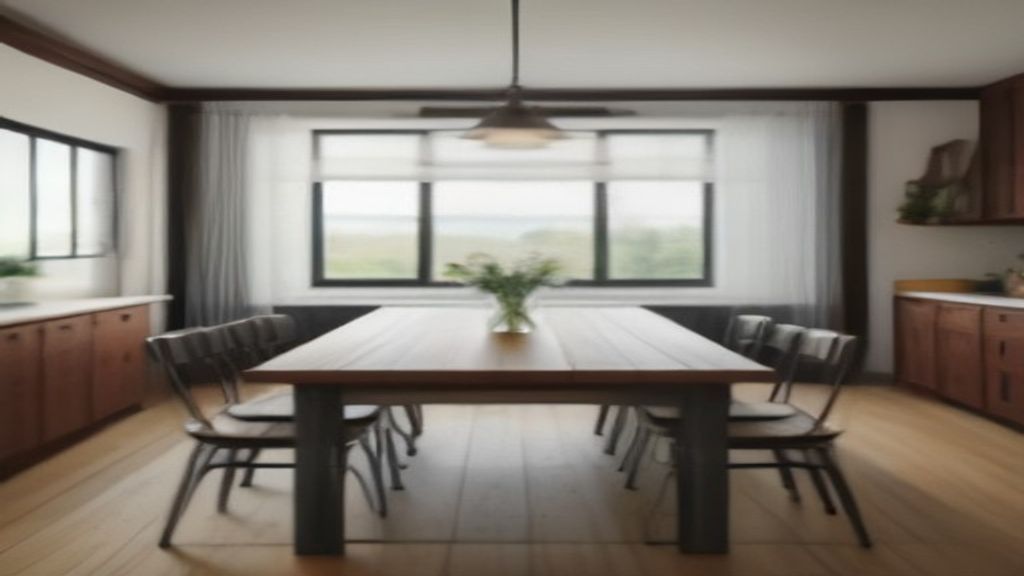
34 inches. That's the minimum width per chair if you want to actually sit down without elbowing the person next to you. I learned this after buying a 72-inch modern farmhouse dining table and realizing I could only fit five chairs—not six—unless I enjoyed being wedged against the wall.
Most listings show a table with six chairs pushed in perfectly. They don't show you the math. A 72-inch table with six chairs means 12 inches per chair. That's a lie. Real chairs take 18–22 inches of seat width, and you need breathing room between them.
The mistake: trusting the render
I ordered a 72-inch reclaimed wood table (the kind with a trestle base and chunky farmhouse legs, because that's what every catalog calls "modern farmhouse"). The photos made it look like six adults could sit comfortably. I didn't measure anything. I just hit buy.
When it arrived, I pushed it against the wall with two chairs on each side. The middle seat had maybe 8 inches of clearance—for a normal human? No. My friend sat there and her arms touched both neighbors. She moved to the end, but then her plate was practically on the floor.
What I should have done instead
The rule: measure your room first, then subtract the table. You need at least 36 inches between the table edge and the wall for chairs to slide out. That's not negotiable if you have a bench or a table with a leaf.
Second, count your seats. For a 72-inch table, plan for five chairs max unless you're feeding kids. If you want six real adults, you need an 84-inch table—bare minimum. I've seen 96-inch tables that still feel tight with six chairs because the chairs are bulky.
The leaf debate
I got a table with a leaf for holidays. The leaf made it 84 inches. Guess what? The chairs didn't fit under the table with the leaf in, so I had to store them in the basement. The leaf lived on the table for three weeks, collecting dust. I finally removed it because the chairs wouldn't slide in.
If you're buying a modern farmhouse table with a leaf, check the dimensions with the leaf IN. Not just the base size. Some tables get narrower in the middle with the leaf—the legs angle inward. That ruins the whole point.
The material trap
I also learned that "reclaimed wood" isn't always sturdy. My tabletop had a huge split after two weeks—the wood was too dry. I sealed it, and it's fine now, but it was a hassle. Look for kiln-dried wood. Ask the seller. If they don't know, that's a red flag.
And the finish? Matte or distressed? I went with matte because it doesn't show water rings. Distressed is worse—it picks up every scratch. But if you have kids, distressed hides the damage better. Your call.
A better pickup
My next table was a 60-inch round pedestal. I measured my space: 9x11 feet. I left 40 inches on each side. Four chairs fit comfortably. No elbows touching. That's the real goal.
Don't trust the listing photo. Don't trust the "seats 6" claim. Measure your room, subtract 72 inches total for clearance (36 each side), and count the chairs you actually own.
For more real-world sizing math, check out Dining Table Set for Sale: The Sizing Math, Delivery Pain, and Build. If you're looking at a round table, Round Dining Table with 4 Chairs: What the Price Tiers Really Get You is worth a read. And if you're stuck on bench vs. chairs, Steel Dining Table Set 6 Seater: What I Learned in the First Week has some notes on that.
Anyway, measure twice, buy once. Or don't. But your guests will hate you if they're eating off their laps.