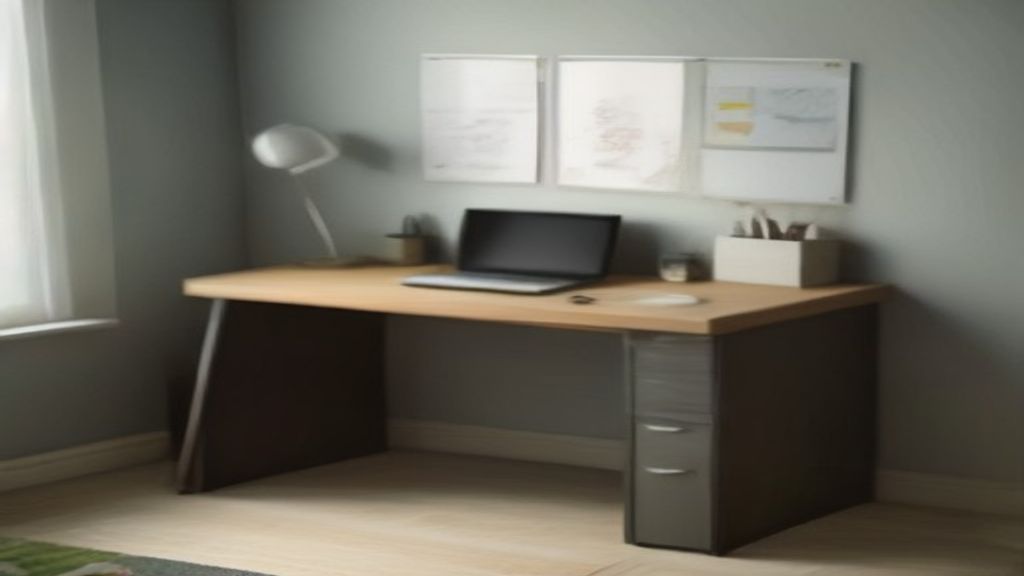
My old desk was a folding table I'd had since college. It wobbled if you breathed on it, the surface was stained, and the legs caught my knees every time I crossed them. I finally decided to get a real modern study desk, something that didn't look like it belonged in a frat house. I read all the lists, fell for all the photos, and ended up returning three desks before I got one I didn't hate. Here's what I wish someone had told me before I started.
The room I was working with wasn't big: 9 by 11 feet. It had a window on one wall, a door on the other, and a radiator that stuck out a foot. I had about 5 feet of usable wall for a desk. I measured that, but I didn't think about the radiator's depth—yeah, that was the first mistake.
The First Failure: The 55-Inch Shelving Thing
The first desk I bought was 55 inches wide, with a shelf on top like a secretary. It looked great in the studio photos—the shelves, the clean lines, the way it "anchored the room." In my room, it swallowed the wall. The radiator meant I had to pull it out 4 inches from the wall, so the total depth was 31 inches instead of 27. My room felt like a hallway. And the shelf? It was 15 inches deep, so every time I stood up, I had to duck. I hit my head twice.
The reviews never mentioned that. They just praised the "storage." I took it back after four days. Lesson one: measure the depth, not just the floor space. A desk that's 27 inches deep plus a shelf at head height is not a desk, it's a hazard.
Then I Overcorrected: A 30-Inch Floating Desk
Desk number two was a floating shelf thing—no legs, just a 30-inch-deep slab on brackets. Looked minimalist, exactly what I wanted. But here's the thing nobody warns you about: floating desks have zero cable management. I have a laptop, a monitor, a lamp, a phone charger, and a mess. The cords hung down the wall like spaghetti. I tried zip ties, adhesive hooks, a cable tray that I stuck on the underside—that tray lasted a week before it fell off because the paint on the wall wasn't clean enough.
Also, with no legs, your knees are free, but so is your everything else. I kept dropping pens and having to bend down to the floor. And the brackets: they were rated for 40 pounds, which sounds fine, but my monitor arm alone was 12, and the monitor was 15. The desk bowed, I could see it. Sold it on Craigslist within a month.
The One I kept (And What I Actually Use)
The third desk is a 48-inch metal and wood thing, nothing fancy. The key was it had a proper back panel—meaning it had a metal plate hiding the cables—and a drawer that actually closes. Depth is 28 inches, which is enough for a monitor arm without touching the wall. The legs are 1.5 inches square, so my knees fit underneath. I've had it for six months.
Is it beautiful? No. But it doesn't wobble when I type. The cable routing hole is a piece of plastic that presses into the metal—not great, but I fixed it with a grommet. The drawer is shallow, holds two notebooks and a charger.
What I learned: For a modern study desk, look at the leg layout first. That's why you see so many "U" or "T" shaped legs. Measure your own knee height and whether you cross your legs. That alone will rule out half the desks online. And don't trust the product dimensions—verify by looking at the photos of the back, ask the seller for the true thickness of the tabletop. My current one is 3/4 inch MDF with a plastic laminate—not oak, but it doesn't sag.
The first desk I returned also wasn't the right size for the room, and the second one was a cable nightmare. I should have read more about Modern Office Desk With Drawers: What $200 vs $1,200 Actually Buys and Modern White Office Desk: The 48-Inch Rule That Stops the Wobble before I started. The 48-inch rule? Minimum length if you have a desktop tower and a 27-inch monitor—otherwise your arms are at angles that hurt after an hour.
One more thing: the radiator. My desk now sits 6 inches away from it, and in winter it heats the desk from below. That's fine, but it means my laminate surface is warping slightly, which is why I'm already looking at How I Picked IKEA Study Furniture Without Wasting a Weekend. Because if it warps, I'm going to have to do this all over again.
Don't be like me. Measure your knee height, check the true depth, and assume the cable management is a lie until proven otherwise. You'll save yourself two returns.