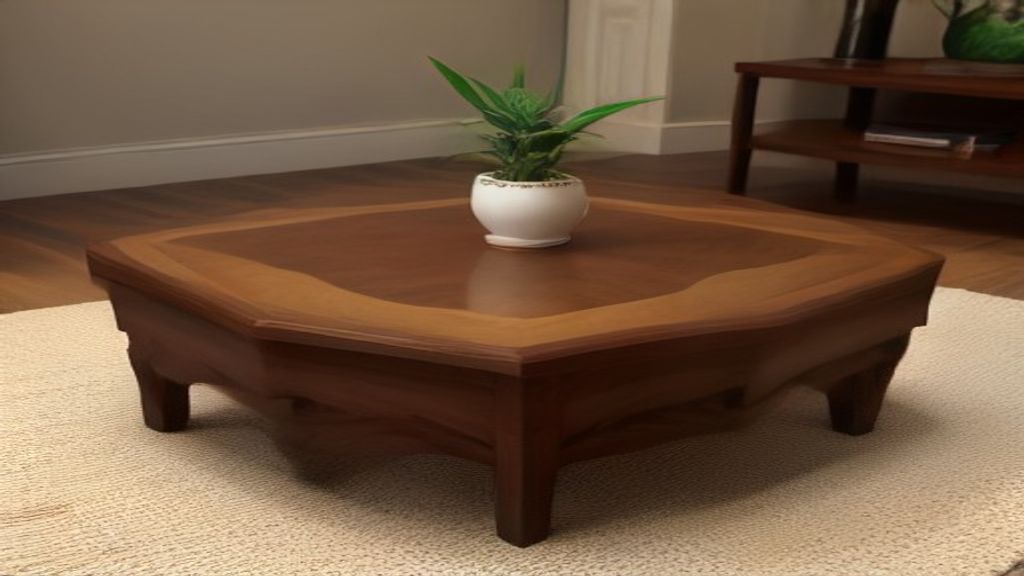
I bought an octagon coffee table on a Tuesday because it looked perfect in the listing photo. By Thursday it wobbled. Not a huge wobble, just enough to make a mug dance when I set it down. The corners hit my shins, and the surface was smaller than I thought it would be. My fault, honestly. I didn't measure anything but the space, and even that I did wrong.
The second time I measured the table itself. Here's what I learned.
Floor to apron: the clearance you actually live with
My first table had 5 inches under the apron. That sounds like a lot until you try to slide a dust mop under it. My mop head is 4.5 inches tall, so it fit, but only if I angled it. Every cleaning session I'd bump the trim and curse.
Measure the height of your vacuum or broom head first. Then subtract an inch for slop. If you're over 6'4" and can't crouch, you'll hate any table under 6 inches of clearance.
Legs: not all octagons are born equal
An octagon coffee table isn't just a top on legs. Some have the legs set wide, flush with the corners. Others tuck them under the center. Same footprint, but the leg layout changes everything.
My current table has legs that align with every other corner, so they form a square when you look down. The legs are 22 inches apart. My old one had legs hugging the center, which made the whole thing feel tippy when I leaned on an edge.
Measure the distance between legs. If your floor is uneven (I have a 1/4-inch slope in my living room), add those little round levelers or you'll be shoving cardboard under it forever.
Surface depth: it's the diagonal, not the width
Manufacturer lists the width as the longest distance across the octagon. But a coffee table is a place for drinks, books, remotes. The usable flat space matters more than the overall dimensions.
My first octagon had a width of 36 inches, but the corners cut in hard. The real shelf for a cup was only 10 inches deep in the center of each flat side. A dinner plate? Nope. A serving tray? Maybe, if it angled.
I now own one with a 40-inch width but a 14-inch "apothem" (that's the distance from the center to a flat side, if you remember geometry). That flat side is where my mug sits, and 14 inches fits a laptop and a glass without crowding. Don't just measure the longest diagonal; measure the flat side.
The corner rule: where your shins live
Every octagon has eight corners. If the table is low and the corners stick out far, they'll catch you. In a narrow living room where I walk close to the table, corners facing the walkway are a bruise factory.
My first table: corners pointed at the sofa and the TV. Every time I sat down, my knee found one. My current table is rotated 45 degrees so the flats face the sofa and walkway. That makes the corners point at the corners of the room, which no one walks through.
Before you buy, decide which edges face high-traffic routes. Those need to be flat sides, not points.
At the end of the day, the one factor that decides the buy is the distance between the flat sides on the octagon. That's the space you'll actually live on. Everything else—legs, corners, clearance—I can fix with a foam pad and a hex wrench. The flat-to-flat width is the thing you can't change after the box arrives.
I've written more about coffee table measuring failures that I learned the hard way. If you're shopping around, check out the brown coffee table mistakes I made and the Amazon coffee table regret story—both are basically me measuring twice after buying once.