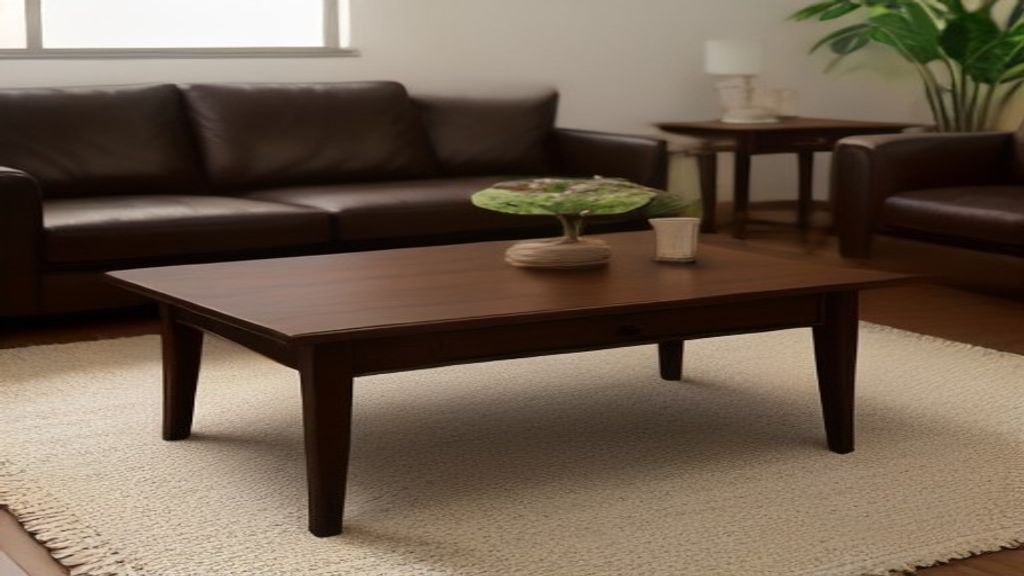
You've been staring at the same empty spot between the couch and the TV stand for three weeks. You typed "Mexican coffee table" into a search box and now you have eighty tabs open. Some are $150. Some are $1,200. They all look kinda the same — carved wood, maybe a tile top, rustic finish. So what's the real difference? I bought two. A $220 one (big mistake, returned it) and a $640 one I still have. I also helped a buddy pick out a $900 one for his place. Here's what I measured and what I'd tell you before you drop cash.
The $200 Range: Looks Fine in Photos, Warps or Splits Later
I ordered a "solid mango wood" coffee table from an online marketplace for $220. Delivery was the first red flag — it arrived on a pallet, wrapped in plastic, with one leg cracked at the joint from shipping. Not the seller's fault exactly, but it tells you something about the build. The wood was thin. Top measured about 10 mm thick — felt like a hollow door when I tapped it. The finish was a thin lacquer, already cloudy in spots. Within two weeks the top had a water ring from a coffee mug that sat there for an hour. The drawer (yes, it had a drawer) stuck every time you opened it past halfway.
What you actually get at this price:
- Wood: Either pine or rubberwood (which is a kind of hardwood but not great). Often marketed as "solid mango" but it's thin slices, not thick planks.
- Finish: Spray lacquer, maybe a coat of wax. Scratches easily, water will haze it.
- Joinery: Glue and dowels, maybe a few staples. Joints loosen within a year.
- Carving: Usually laser-cut and shallow, not deep hand-carving. Fine from across the room, blurred up close.
- Size: Usually runs small — like 36" x 18" or narrower. In a big living room it'll look like a footstool.
The same $220 piece was rickety. You could rock it side to side with a hand on the top corner. If you plan to put your feet up on it — and you will — it won't survive that much sideways force. The wood splits at the screws in about six months.
Is the $200 range ever worth it? Maybe if you need a cheap prop for a rental and you'll move in a year. But don't expect furniture that you'll keep for a decade.
The $600–$900 Range: The Real Deal, Mostly
My $640 table came from a local woodworker's storefront that imports from Mexico. Same basic look — carved base, rectangular top — but the difference was obvious the moment I picked it up at the warehouse (yes, you often have to pick these up yourself unless you pay a big delivery fee). The top was 25 mm thick solid wood, not laminated segments. The carving was deep — you could run your finger into it and feel the gouges. The finish was a hand-rubbed wood sealer, not glossy lacquer. Water sat on top for hours, beaded up, wiped off. No ring.
Here's what that extra money buys you:
- Thicker wood: Anything above $500 should be at least 20 mm thick solid hardwood. At $900, expect 25–35 mm. You can compare the specs listed, but always ask for photos of the edge.
- Better joinery: Mortise and tenon at the legs, not dowels. Screws are hidden. The table doesn't wobble, even when I lean on it heavily.
- Hand-carved details: Or at least deeper machine-assisted carving, which means subtler lines.
- Kiln-dried wood: Key point. If it's not kiln-dried, it can still warp or crack later. At $200, that's a gamble.
- Finish durability: Polyurethane or an oil blend that actually absorbs. Your shoes won't leave a mark when you decide to put your feet up after moving.
But there are costs besides money. Some warning signs I picked up:
1. The weight: My $640 table is heavy. Like 60 lbs. Moving it across a carpet is a two-person job, otherwise you'll scratch the floor. If you're in an apartment and hate carrying things, that's a real hassle.
2. Delivery: Many of these sellers don't offer white-glove delivery for $600–$900. They'll drop it at the curb, and you're on your own getting it up stairs. Double check the delivery step before ordering.
3. Returns are a nightmare: I had to send that $220 piece back (seller paid shipping, ironically it cost them more). If your $800 piece shows up damaged, expect a fight and a "customer service" chat.
4. Style mismatch: The deep carving is great for a Mexican-style room, but if your place is more modern and minimal, it'll clash hard. You can't just paint it or refinish it nicely because the grain and carving are central.
Quick Price-Guide Table
This is based on scanning dozens of listings and talking to two importers. Prices matter, but they're not the only thing.
| Price | What You Get | What You Risk |
|--------|--------------|---------------|
| $100–$200 | Thin wood, lacquer finish, small size | Splits, warps, finish clouds |
| $200–$400 | Slightly better solid wood, still mixed | Joints loosen, carving mediocre |
| $400–$700 | Good timber, stronger joinery, decent finish | Slightly too short or narrow for big rooms |
| $700+ | Thick hardwoods, hand-carved details, robust finish | Heavy to move, overpriced models exist |
Watch the log size — many Mexican coffee tables run low (35–40 cm tall) because they're meant for larger Mexican sofas. Standard couches have arms at about 60–65 cm, so if your sofa runs higher or your cushions are tall, pick a taller table.
What I'd Do Differently Next Time That I Didn't Do First
The biggest cost isn't the money you pay. It's the hassle of an item that doesn't fit your room. Last fall, I ordered a similar piece (for a friend, no, I didn't learn my lesson) and ended up returning it just because of the size. The table was way taller than I'd planned, and it didn't fit our sectional properly.
If you don't want to measure everything again, at least grab a measuring tape before you even scroll. But honestly, the measurement thing is a bigger deal than I ever thought. If you're afraid of a costly mistake, the lift-top style I tested might prevent your back pain. And if you're flirting with the idea of a budget piece just for the price, read my $150 vs $600 guide to round wood tables — the differences in seats of your pants will surprise you.
Also worth checking out: What I learned when I bought a brown coffee table by color alone — it's the same principle as style-matching a Mexican table. And a small white dining table taught me more about layout than any coffee table article.
Who Should Skip the Mexican Coffee Table Entitlement
If you spot a $150 "imported rustic Mexican-style" table and you think you can just sand it done and use it, I've told you the truth so you won't waste the money. You need at least $450–700 to get real wood that will still be flat in September.
Likewise, if your living room is tight (under 6 feet across from sofa to TV), think about going smaller or choosing the nesting style I measured before committing. A big carved runner will just become the obstacle course in front of your walkthrough.
And if you're the type who loves neat, clean lines and you'll cringe at every scrolled flower and painted accent, an authentic Mexican table is probably not you. Look for a plain white marble top table or a simple wooden one instead. No need to buy something you'll regret.
Bottom line: the $200 junk is not furniture. The gold starts around $450 and you're safe until $700. Bring a friend to move it, measure your sofa, and check the delivery details before you hit checkout. That's what you actually pay attention to, and it's what will stop you from having to deal with returns during your Netflix time.
Choose wisely — but also choose what fits your space.