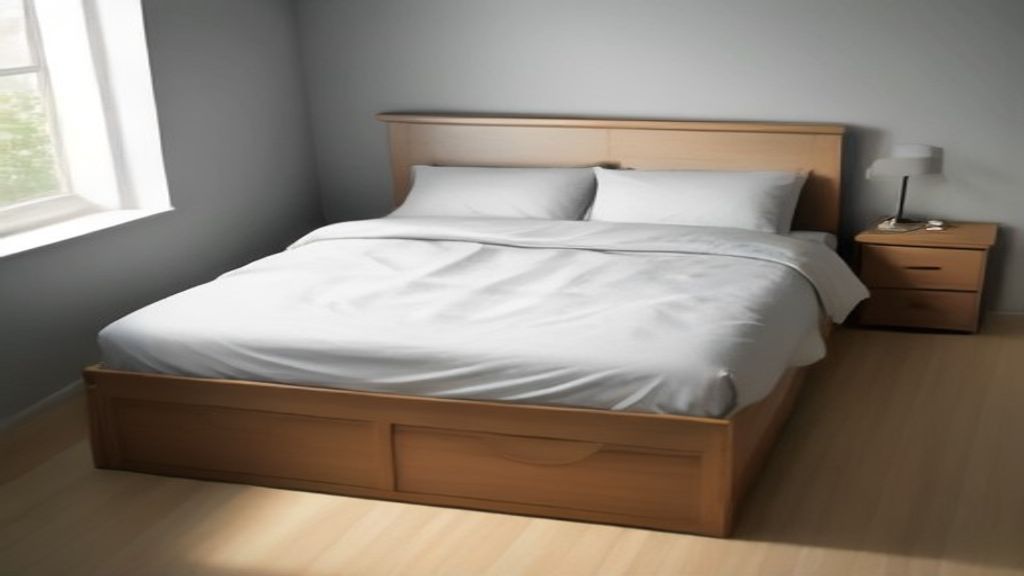
The first time I lifted the bed frame, I knew I was in trouble. The storage compartment was advertised as "spacious," but the mattress base weighed as much as a small fridge. I had to awkwardly hold it up with one knee while sliding a heavy tote underneath. My back complained for two days. If you're thinking about a single bed with storage, here's what I learned — mostly by trial and error.
First, the frame weight and lift mechanism
The whole point of a storage bed is to use the space underneath, but if the lift is stiff or the frame is heavy, you'll stop using it after a week. I tested one at a store that took two hands and a lot of effort to raise. That's a dealbreaker. Look for gas pistons or a spring-assisted mechanism that actually helps. At home, my frame has two gas struts, and even so, it's not effortless — but it's manageable. Ask for the weight of the base. If it's over 30 lbs and the lift isn't smooth, think twice.
Also, check the latch that holds the base up when you're digging inside. Some cheap ones rely on friction, and if you let go, the base slams down. I've got a bruise to prove it.
Mattress depth and slat gaps
Most single beds with storage have a shallow frame, meaning your mattress depth matters a lot. Standard mattresses are around 8–10 inches. If you have a thicker one (12+ inches), it might sit too high or make the bed look weird. Measure your mattress before buying. Also, check the slats — are they solid wood or cheap MDF? I had a slat break after three months because it was a thin particle board. The replacement cost $40 and took an afternoon. Not fun.
If the slats are spaced more than 2.5 inches apart, a foam mattress might sag. So bring a tape measure to the showroom or check the spec sheet.
Door clearance and hallway routes
The bed frame comes in a big box. I didn't measure my hallway turn, and the box wouldn't make the corner. I ended up unwrapping the whole thing in the hallway and carrying pieces in. That's fine if you have room to work, but if your apartment has tight turns, measure the box dimensions (they're usually in the specs) and compare to your routes. Also, check if the bed disassembles easily. Some have glued joints that are a pain to take apart if you move.
My box was 78" x 28" x 6" — barely fit through the door, but the corner in the hallway was the issue.
What about the storage itself?
Single beds with storage usually have either a lift-up base or side drawers. Drawers are easier to access if you have space at the foot or side of the bed. But they take up floor space when open. I have a lift-up, and it's great for bulky stuff like winter bedding and off-season clothes. But it's not a quick-access solution. If you want to grab something every day, drawers might be better.
Also, look at the interior height. Mine is about 8 inches, which is fine for flat bins but not for tall boots. Measure your tallest item.
Who should skip this
If you have a back problem, a lift-up bed is not your friend. Even with gas struts, you'll be bending and lifting. Consider drawers or a platform bed with under-bed bins instead. Also, if your mattress is very heavy (like a hybrid), lifting it every time to access storage gets old fast. I do it maybe once a week, and it's fine, but if I needed daily access, I'd hate it.
For more on bed setups that might save you trouble, check out how a folding double bed setup solved a different problem, or read about cheap beds with mattress and what I learned moving twice. If you're considering a guest bed, the sofa bed mattress guide is worth a look.
A single bed with storage is a good investment if you measure first. I got mine from a local store, and after a year, the lift still works fine. But I wish I'd known about the weight and the hinge safety before I bought it. Measure your mattress, your hallway, and your back — then you'll be glad you did.