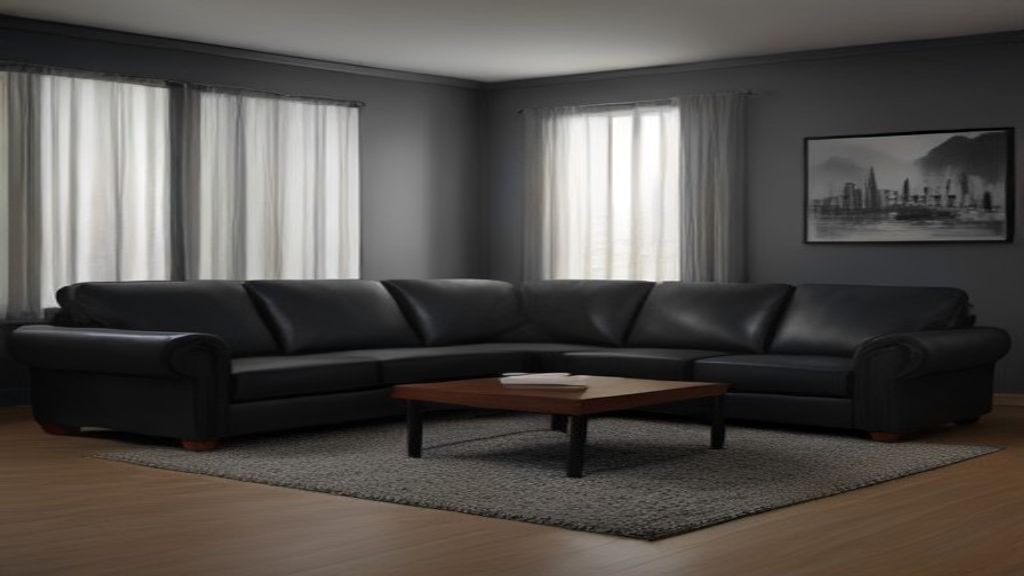
I bought my first dark grey leather sectional when my oldest was two. The catalog photo showed a sleek, low-profile sofa that would anchor a magazine-worthy living room. Eighteen months later, I was wrestling a replacement through a doorway that the old one barely cleared, cursing the dimensions I'd glossed over.
The second one? Better. Third one—the one we still have—I got it right by measuring everything, not just the wall. Here's what I wish someone had told me.
The First Major Hurdle: Getting It In
You're not just measuring your room. You're measuring your front door, your hallway, your elevator (if you have one), and the stairwell. I learned this the hard way with a 98-inch wide sectional that had to be turned sideways to get through the entry, and even then it scraped the frame. Check the fully assembled dimensions, then add an inch on every side for turning.
Modular sectionals are easier—the Wallingford 7-Piece Leather Modular Sectional breaks into pieces that fit through standard openings. But if you're eyeing a fixed piece, measure the width of your door frame and the hallway width, and compare it to the sectional's depth when it's turned. If the depth is greater than the doorway width, you're going to have a bad day.
The Second Hurdle: The Room Layout
Once it's in, you need to move around it. A 92-inch L-shaped sectional might fit on one wall, but if it blocks the path to the balcony or makes the TV viewing angle awkward, it's not the right piece.
For a small living room, a right-arm facing (RAF) or left-arm facing (LAF) configuration changes everything. I spent a week with a chaise that jutted into the walkway before I flipped it into the opposite configuration and gained a clear path. If you're ordering online, read the return policy and the build-it-yourself instructions carefully. Many retailers let you choose the orientation, and it's a hell of a lot easier to swap before the delivery truck leaves.
The Third Hurdle: Daily Living
Dark grey leather is forgiving—it hides the dirt that lighter leathers show, and it's got a nice matte finish that doesn't shout "look at me." But leather is not indestructible. My kids have spilled juice, milk, and marker on the seat. Dark grey doesn't show most of it, but the marks are there if you look at the right angle.
Cleaning is a damp cloth for most stains, but for anything oily or stubborn, you'll want a leather cleaner. A friend bought a bonded leather sectional (the stuff that's mostly polyurethane with a thin top layer of real leather) and it started peeling after a year. I've got top-grain, which costs more but has held up for three moves and five years of traffic. The Aniline and Pigmented leather debate is worth a glance, but know that full aniline stains easier than pigmented—my dark grey is pigmented and it shrugs off most things.
Hurdle Four: The Daily Reality
That's the seat cushion sag I didn't expect. Most sectionals have cushions that you rotate and flip regularly to even out wear. The first one had a low-density foam core that lost its spring after two years. The second had a feather blend that I was always fluffing. The third—still in use—has high-resilience foam wrapped in a down alternative, and it's stayed firm enough that a 100 lb dog and a 200 lb guy (me) don't make a permanent dent.
The price difference for a better cushion core is real. You'll pay $200–500 more for a sectional with high-density foam, but you'll replace the filling after three years on the cheap ones, which costs $400–800 if you hire someone. I'd rather put it upfront.
Sectional or Not?
If your room is under 12 feet long, a sectional can crowd out the rest of your seating. A regular sofa plus a couple of accent chairs gives you more flexibility and often a slightly larger seating area—a three-seater sofa plus two chairs is about the same footprint as a 90-inch L-shaped sectional, but you get six seats instead of four.
A sectional is the answer if you want to actually stretch out. For movie nights, the chaise is unbeatable. For parents, it's a landing pad for reading to a toddler. For my family, the sectional wins—but only because we know the layout and the dimensions first.
If all this sounds like work, that's because it is. But the payoff is a sofa that's actually comfortable and looks good. I wish I'd read a few guides like A Plain-English Look at Grey Microfiber Sectional before I set my heart on navy blue, and I definitely wish I'd looked at Gray Leather Sectional: The 4 Measurements That Decide If It Actually before the first purchase.
If you're in a tiny apartment with doorways under 30 inches wide, skip the full-size sectional. Stick to a loveseat or a modular that you can carry up. And if you have a cat with claws? You might want to leash-test the upholstery before you commit—leather and claws don't mix, and dark grey doesn't hide the scratches.
The dark grey leather sectional is a solid choice for a family that lives hard but wants something that looks like an adult made the decision. Measure first. Sit on the cushions. Confirm the wood frame is actually hardwood and not particleboard. Then buy. Your lower back and your floors will thank you.