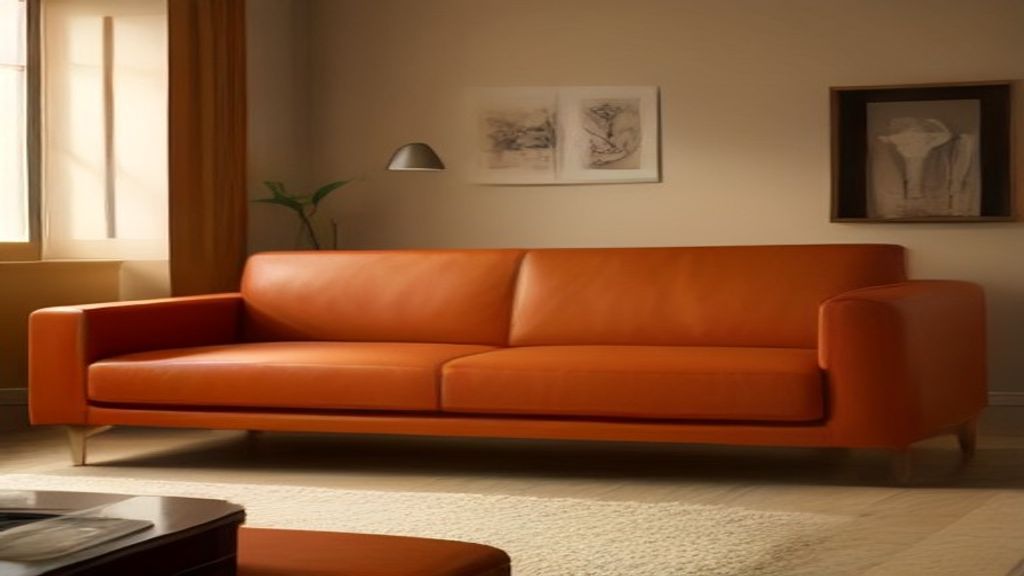
I've owned an orange leather sofa for eight months now. It's the first thing people notice when they walk in, and half of them say it looks amazing. The other half say nothing, which I've learned to read as "that's a bold choice." But here's the thing: I almost bought the wrong orange. I was two clicks away from ordering a burnt sienna nightmare that would have clashed with everything I own. So let me save you the mistake.
The mistake I almost made: falling for the 'orangest' orange
When you search for orange leather sofas, the photos that pop first are usually saturated, almost neon oranges. They look stunning against white walls and concrete floors in a studio. Problem is, most of us don't live in a design studio. I live in a regular apartment with oak floors, a gray rug, and a blue throw blanket. The super-saturated orange would have screamed at all of it.
I learned that leather sofas in "orange" actually range from reddish rust to golden amber. The color you see on screen is not the color you get. The same sofa can look totally different under your living room lights versus the showroom's. My advice: order swatches. Not just one, but three or four pieces in different shades. Put them on your floor, against your walls, next to your other furniture. Live with them for a week. That's how I ended up with a saddle-orange leather that looks warm but doesn't fight with everything.
What the color does after six months
Here's what nobody tells you: orange leather changes color. Not dramatically, but enough to notice. The areas where you sit, where your arm rests, they start to darken and develop a slight sheen. That's the leather absorbing oils. On a tan or brown sofa, it looks like patina. On an orange sofa, it can look... uneven. I've had to rearrange the cushions every couple weeks to even out the wear.
Also, orange shows scratches differently. A light tan leather hides a lot. A dark brown hides even more. But orange? A scratch stands out. I have a cat, so this matters. I've had to accept that the sofa will have some character marks. If you're someone who panics at the first scuff, orange leather might not be for you. I've learned to see them as part of the story.
How to pick the right orange (shade matters more than you think)
Before you fall in love with a particular orange, ask these questions:
- What's the undertone? A red-orange reads more "autumn centerpiece"; a yellow-orange reads "sunny breakfast nook." Your room's lighting will pull these out.
- How does it look at night? That vibrant orange at 10am can look almost brown by 8pm under lamps. I tested my swatch at different times of day.
- What's the leather finish? A semi-aniline (the most common at mid-price) will age and soften, which means color changes. A pigmented leather (heavier coat) holds color better but feels less like leather.
- What's the leather thickness? Thicker hides (2.0-2.5mm) take longer to break in and feel more durable in a kids-and-pets house. Thin leather (under 1.5mm) can feel buttery but shows every wrinkle and can tear easier.
I know this sounds like a lot. But a sofa is a big purchase. I spent two months researching before I ordered mine. And I still got caught off guard by the length of the delivery window, the fact that it took three weeks to lose that "new car" smell, and that one of the legs arrived scuffed and customer service was closed on weekends.
So yeah, buying an orange leather sofa has been a journey, but not in the "transform your space" Pinterest way. More like "I need to rotate the cushions again" way. It's a great piece of furniture, but it has its quirks. If you can handle real leather doing real leather things, you'll probably love it. Like I do.
Want more furniture honesty? Check out More guides in Sofas & Sectionals. Or read about Curved Leather Sectional Sofa: What I Learned After Paying $3,200 to Learn It. If you're considering a lighter color, read White Leather Desk Chair: What I Learned in the First Week — same lessons, different color. And for a total reality check on color fastness, see Leather Power Sectional: The First-Week Setup Mistake That Cost Me a Doorframe.