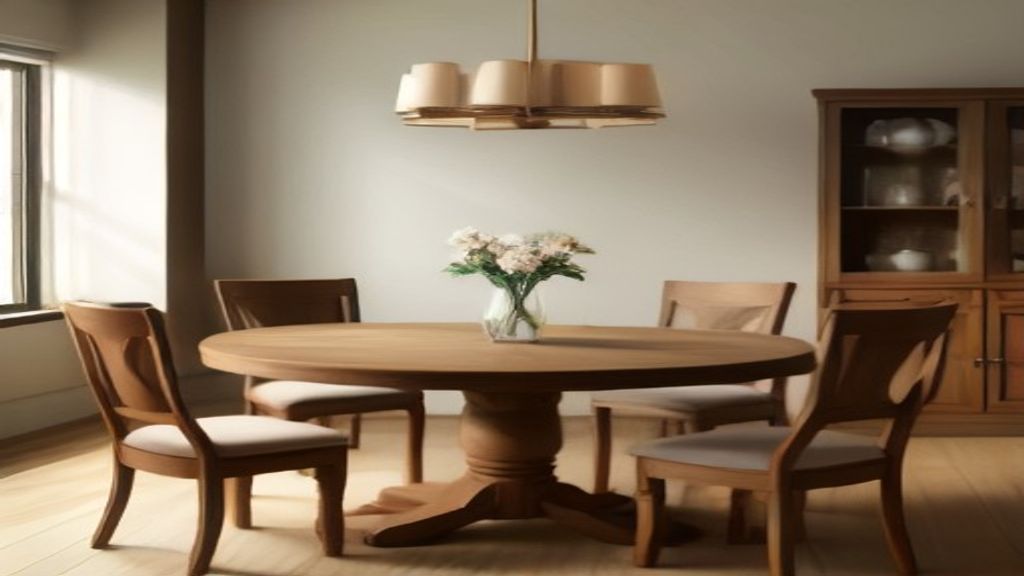
I still remember the day my round table delivery guy called and said, "You sure this is the right spot? It's not going to fit." I'd measured the room. I'd measured the doorway. I didn't measure the fact that chairs need to slide back and that the leaf inside the table adds a foot you never see. That was a $70 return fee and a week of my life.
If you're looking at a natural wood round dining table, you're probably after the warm, space-saving look. But a circle is sneaky. It takes up more floor space than you think, and the chair swing is the thing that trips you up. Let me walk you through the constraints I wish I'd thought about first.
The room constraint: walkways are the real test
A round table needs a full circle of clearance. You can't shove it against a wall and call it a day like a rectangular table. I measured my dining area at 11 by 9 feet, and the 48-inch table I had my eye on looked perfect on paper. But when I drew a 48-inch circle and then added 24 inches for chairs pulled out, I had barely 6 inches to walk behind a chair that was in use. My kitchen doorway opened right there, which meant anyone going to the fridge had to do the sideways shimmy. That's not living; that's apologizing to your guests.
Rule of thumb: measure at least 36 inches from the table edge to any wall or furniture. That lets a chair slide out and you still squeeze past. If you can't get that, you either go smaller or you live with the problem. I went down to 42 inches, and it works, but it's tight. Don't trust the online room visualizer—it loves to place chairs with no legs.
Also, measure the path from the entrance to the spot. My delivery guy had to carry the table through a 29-inch hall, and the box was 54 inches long. He turned it on its side, but the legs scratched the wall. Protect the floor and the walls. Ask the seller for the box dimensions, not just the table diameter.
The body constraint: leave room for elbows and chairs
A round table seems efficient, but it's not magic. For four people, you want at least 42 inches in diameter, but 44 or 48 is better if you have broad shoulders or like to spread out. I'm 6'1", and at my 42-inch table, my knees hit the pedestal base. That's something else—the base. A central pedestal is great for legroom at the edges, but the base itself eats into the under-seat space. If you're tall, sit at the table and check where the post lands. Some bases are too wide and you'll be straddling the column.
And chairs. My mistake was buying chairs with arms. They don't tuck under the table, and with four chairs around a 48-inch round, I had maybe two inches of clearance between the chair arm and the table edge. You want chairs that slide fully under when not in use, or you'll be tripping over them. Test the chair-to-table fit at the store, or measure your chairs' seat width and add an inch on each side for the tuck.
The schedule constraint: the leaf changes everything
I bought a round table with a leaf because I wanted to seat six. But when the leaf is in, the table is no longer a circle—it's an oval. That means the room needs extra clearance along the long side. In my 11x9 room, I could only fit the leaf if I moved a sideboard. And when the leaf is stored inside the table, it adds weight and can dull the table's sound if you knock on it. My table has a metal mechanism that clunks when I pull the leaf out. Takes ten seconds, but the stored leaf also means the center of the table is slightly domed—you feel it when you wipe it.
If you plan on using the leaf, measure the full oval dimension: diameter plus leaf length. Add that to your walking clearance. If not, you might be better off without the leaf and using a smaller table. That's what I ended up doing, actually. I stopped using the leaf except for holidays, and now the table is just a 42-inch round that fits three people comfortably and four if we're polite.
The extension plan: when you think you'll host, but you don't
Be honest with yourself about how often you have six people over. My wife and I entertain maybe twice a year. The leaf lives inside the table for 363 days, and every time I vacuum, I curse the extra pounds. If you're in the same boat, skip the leaf. Or buy two separate tables—one small and one larger for parties. I know someone who keeps a 30-inch round in the basement and brings it up for Thanksgiving. That's cheaper than a leaf mechanism.
The wood reality: natural doesn't mean indestructible
Natural wood is the whole reason you're here, but it's not a piece of furniture you can ignore. I spilled a glass of red wine on mine within two months. The oak table had a matte finish, and the wine soaked into the grain before I wiped it. The stain is faint, but I see it every single day. "Natural" can mean no protective coating. Ask what the top coat is—polyurethane, lacquer, or oil. Oil looks amazing but needs reseasoning every few months. Polyurethane is more practical but can look a little plasticky. Weigh that against how much you actually enjoy maintaining furniture.
Who should skip this table
If you have kids under five who use crayons, or if you're the kind of person who eats cereal over your laptop every morning, a natural wood round table might not be your best friend. A darker wood or a laminate might survive your life better. And if your dining space is a 7 by 7 foot box, a round table is going to make it feel like a closet. I saw a friend try a 36-inch round in a corner booth and, sure, it fit, but the only way to seat four is to have two people sit at a right angle, which is weird for conversation. Also, if you live on the third floor with no elevator, the delivery guys will hate you, and you'll pay extra. I haven't even mentioned the price—natural round tables run $400 to $1,200 at typical furniture stores, and the cheap ones wobble after a year. I paid $580 for mine, and the wood is decent, but the base is slightly off-center. I had to put a felt pad under one foot to stop the wobble.
So, measure the room, measure the chairs, measure your life. Then make the call. I still love my natural wood round table—the oak grain is beautiful, and it shrank the room visually. But I wish I had measured the leaf and the chair swing before I committed. Do that, and you'll save yourself a return. For more dining table pitfalls, I wrote about natural oak dining table first week and the truth on black wood dining table measurements.