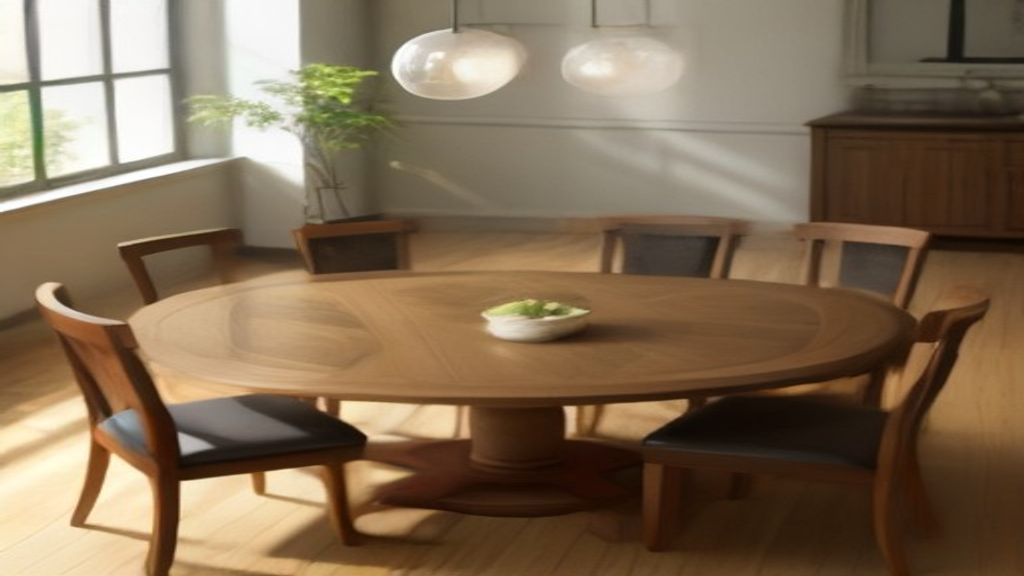
I grabbed the edge of the leaf and pulled. The tabletop split with a scrape that echoed off the showroom floor, and behind it sat a slab of wood as long as my arm. That’s the moment I realized the circle extendable dining table isn’t a dining table at all — it’s a secret rectangle with a round disguise. The leaf was heavier than my coffee table. The store listed it as a 42-inch round. Nobody mentioned the extended length until I pulled that thing out and nearly hit a display lamp.
If you’re looking at one of these, skip the polished product photos. The dimensions that matter are the ones you have to dig for. Here’s the real checklist.
The Leaf Gap Is the Whole Story
When the table is closed, it looks like a modest circle. Nice, right? But open it and you get an oval that’s usually 30–40% longer. I measured one at 42 inches round that stretched to 60 inches. That’s a foot and a half of extra table appearing in the middle of your room.
So before you fall for the roundness, ask for the extended length. Then measure your room with the table open. Walk around it with a chair pulled out. If the gap between the chair back and the wall or buffet is under 36 inches, you’ll be squeezing past it every time someone stands up.
I’ve seen people buy these for a 10×10 dining nook and end up pushing the table against the wall just to walk through. The round closed shape tricks you — it looks small, but the leaf turns everything into an obstacle.
Where Does the Leaf Live When You’re Not Using It?
This was the real surprise. Some models store the leaf inside the table — you pull the ends apart and there it is, nested underneath. But cheap ones make you store the leaf separately. Meaning you prop it against the wall or slide it under the buffet. That’s fine until you need to open the table and realize the leaf is behind the couch.
Check the mechanism too. The self-storing types have a butterfly or a sliding track. The cheaper sliding track has a habit of jamming if you bump it. My neighbor’s table has a butterfly leaf that takes two people to operate. She says she’d rather eat in shifts than deal with it.
The Gap When Open Actually Counts
Even with the leaf in, some tables have a visible seam where the top meets — a gap that catches crumbs and looks like a frown line. Run your finger across it. If you can feel it, you’ll feel it every single dinner. Solid wood tables have the seam but it’s tight. Particleboard or MDF with a wood veneer? The seam is often a millimeter wide. You’ll be fishing peas out of it.
And the pedestal base — the single center pillar — is the one that wiggles. Four legs are more stable for extension. I put my hand on the edge of a pedestal model and it rocked a quarter inch. That’s enough to spill a glass of water during Thanksgiving.
What It’s Actually Like Living With One
I’ve had mine for three months. It’s a 48-inch round that extends to 72. Closed, it seats four comfortably. Open, it seats eight — but I don’t. I open it to six and leave the two ends for serving dishes. That’s the reality. The extension isn’t a magic trick, it’s a squeeze.
For everyday meals, it’s just a round table. Nice. No corners to bump your hip on. But if you live in a long narrow room, think about how the oval will orient. It goes lengthwise, so you’re trading a circle that fits anywhere for an oval that demands the room be wider than the extended length. I had to rearrange my whole dining corner to make it work.
And the leaf storage — mine self-stores, but it weighs close to 15 lbs. When I open it, I have to lift that slab out of the slot and flip it over. It’s not a one-hand operation. So if you’re doing this every Sunday dinner, you’ll get tired of it.
One more thing: the shipping. These things are heavy. Mine came in a box that barely fit through the door. The delivery guy and I had to tilt it. If you live in an apartment with narrow hallways, ask the seller for the shipping dimensions. A 48-inch round top might need a 55-inch box.
If you’re still weighing round versus rectangular, think about what fits your room. A Dining Table Set for 8: Measure the Room, Not Just the Table is a different animal. And if you’re after a specific look, the Beige Dining Table: Match It to the Room, Not the Trend piece might change your thinking. But the circle option is its own thing.
The One Thing That Decides the Buy
It’s not the wood or the finish or the brand name. It’s the extended length plus your room width. If that oval doesn’t fit with chairs pushed out, you don’t have a dining table — you have a conversation piece that blocks your hallway.
Measure the extended length with a tape measure before you buy. Not the closed circle. The extended. Then tape that length on your floor and walk around it. If you can’t pull a chair out comfortably, walk away. The table isn’t the problem. Your room is.
The circle extendable is a honest compromise — round for everyday, long for holidays. But only if the room has the inches to take it. That’s the whole game. Nothing else matters.