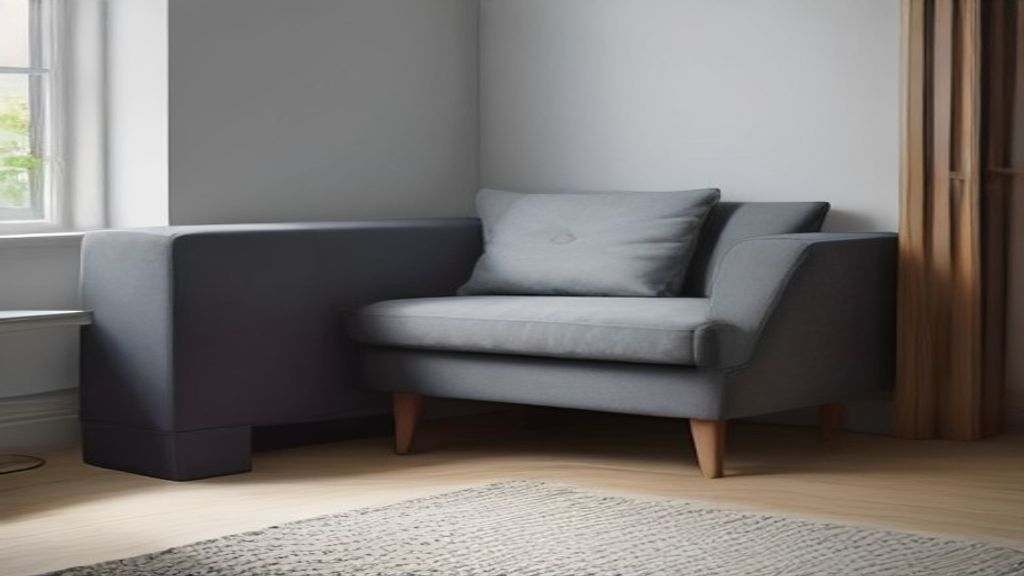
I saw the listing: "L-shaped accent chair, compact footprint, perfect for small spaces." It looked great in the stock photos — tucked neatly into a corner, not eating the whole room. I clicked buy.
Three weeks later, I'm moving it from my bedroom to the dining room because it doesn't fit the corner I planned for. The problem wasn't the seat depth or the back height — it was the actual shape. An L-shaped chair has two sides that meet at a right angle, and that geometry takes up more floor space than the width and depth numbers suggest.
Here's what I wish I'd measured before I spent the money.
The corner is never 90 degrees
I assumed my corner was a clean 90 degrees. It's not. My wall corner is 88 degrees — a 2-degree skew that I didn't notice until I put a square against it. The L-shape chair sits flush only if the angle matches. If it's off, one side will rock or leave a gap you can see.
Measure your corner with a protractor or a carpenter's square. If it's not 90, you'll either need a wedge or a different chair. That's not something you can adjust after the fact.
"Compact" is a lie
My chair's product page said "21.5" W x 20" D." But that's the footprint of one side, not the whole L. The actual floor space, measured corner-to-corner, was 36" x 36". That's double what I expected.
I measured it in my garage after it arrived: 36 inches along the long sides, the diagonal from corner to corner was 48 inches. In a small dining area, that's not compact; that's half the room.
I should have drawn the shape on the floor with masking tape before ordering. That would have shown me — in two minutes — that the chair would block the walkway.
Delivery reality
Forget the fancy photos. The chair came in a box that was 48" x 30" x 28", weighing 67 pounds. I had to carry it through a narrow interior door. If you're buying for a dining room, measure the door framing too — and take the chair's assembled dimensions, not the product page's "packaging size" (which is bigger).
It took me 20 minutes to assemble the L-shape connection because the bolts were misaligned — typical of mid-priced furniture. That's another thing to budget for: your time, and maybe a drill if the holes don't line up.
The build itself is okay for the money. The fabric is a tight weave that I've wiped clean twice — kids spilled juice and some coffee. That's the kind of thing you learn in the first week. But I'll be real: the cushion will sink a bit by month three. For $300, that's expected.
What you're actually paying for
$150 L-shaped chairs from discount stores: The fabric is thin, the foam is 1.5 inches, and it'll sag after two months. I bought one at that price once for an office corner. I sat on it, the back wobbled, and within two weeks, every bolt needed retightening.
$300–400 gets you a sturdier frame (solid wood instead of particleboard) and thicker foam. My current one is that price range, and it handles daily use in my dining area. The difference is 40 pounds vs. 25 pounds — you feel that stability when you sit down.
$500+ — that's for branded designer stuff. You're paying a premium for a name, not structural leaps. A $500 chair will last a bit longer, but the footprint is the same. The shape doesn't change with price.
If you're leaning toward a cheap one, at least check the weight. Anything under 30 pounds for an L-shaped chair is probably going to tip over when you shift to one side.
The one thing that decides it
Before you buy, do the masking tape test: measure the distance from the corner you're targeting to the nearest doorway or walkway. If that distance is less than 24 inches — unless you live alone — you'll be climbing over the chair every day. That's the factor that decides the buy.
Don't trust the "fits in small spaces" line. The shape always eats more than one side's width. I measured, drew, and it still surprised me.
If you're shopping for dining room seating in general, I've got more notes: Emerald Green Dining Chairs: First-Week Setup and the One Decision and The 34-Inch Wide White Dining Table That Taught Me to Measure Chairs. While you're at it, if you're also looking at desk seating, I compared Office Chair at Work: Why the First Week Decides Everything, and it covers similar fitting lessons.
And for the record, I'm keeping this chair. It fits a spot in my kitchen where it only blocks half a hallway. But that's only because I moved the bookshelf. Measure first.