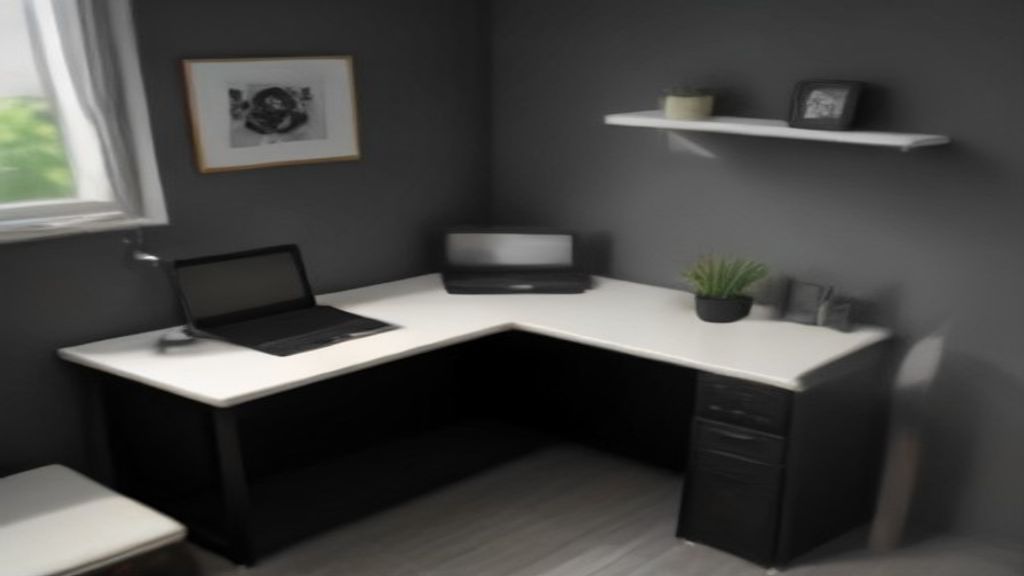
I've had three small black corner desks in my own 7×9 home office over the past two years. The first cost $120, the second $210, the third $350. All three were black, all three were corner-shaped, all three promised to fit tight spaces. Only one survived my daily use without driving me insane.
Here's what the money actually buys — not the marketing copy, but the stuff you notice after week two.
Under $150: Fine for a laptop, not for a monitor arm
The $120 desk was a particleboard and paper-laminate combo. It weighed 28 pounds and came in a box that was somehow both too heavy and too flimsy. Assembly took me 40 minutes with a power drill I had to borrow because the included Allen wrench stripped after the fourth bolt.
The surface was smooth enough for a mouse, but the edge banding started peeling at the front corner by day ten. I didn't even use it hard — just a laptop, a coffee mug, and my elbows. The drawer (one, small) had a plastic track that jammed whenever I put more than two notebooks in it.
Wobble wasn't terrible because it was shoved into the corner, but when I tried to clamp a monitor arm to the back edge, the particleboard just crumbled. The clamp left a dimple I could push my thumb into. So if you're planning to mount anything — a monitor, a lamp, a headphone hook — skip this tier.
What you do get: a cheap way to fill a corner for light, occasional work. If it's a secondary desk or a student's homework station, it'll do. But my desk creaked when I leaned on it, and the fake wood grain pattern doesn't fool anyone.
$200–$250: The sweet spot for most people
The $210 desk was a big jump. It was still particleboard, but with a melamine coating that didn't peel. The edges were wrapped properly, and the whole thing felt more solid when I shook it. Assembly took 25 minutes, and the instructions actually made sense — the parts were labeled, the bolts went in without fighting.
This one had a sliding keyboard tray. I read reviews that said those trays cheapen the desk, but I found it useful. It's 26 inches wide, which fits a full-size keyboard and mouse pad with room left over. The downside: the tray adds about 3 inches to the desk's depth, so if you're in a really tight corner, measure twice. My room had 56 inches of corner space, and this desk just barely allowed me to pull out the chair without hitting the wall behind me.
The surface held up better than the $120 model. After a month, no scratches from my keyboard feet, no white rings from a coffee mug. I still wouldn't set a hot pan on it, but for everyday use, it was fine.
Price difference from the cheap one: about $90. What did that buy? Better materials, fewer annoyances, and a desk that didn't feel like it would give up after a year. If you're on a budget and need a daily driver, this is the tier I'd point you to.
$300+: What the extra money actually gets you
My $350 desk was the only one with a solid top. Real wood veneer over a plywood core, not particleboard. It weighed 52 pounds and came in two boxes. Assembly took an hour because the legs were heavy and the instructions were printed on black paper (seriously, any manufacturer who does that should know better). But I didn't need to borrow anything — the included tools didn't strip.
What I noticed first: no wobble. Even with a monitor clamped to the back, even when I typed aggressively, the desk didn't move. The grommets for cable management were actually placed where my cables wanted to go, not just decorative holes in the wrong spot.
I also got a bigger drawer. This one was 18 inches wide and rode on steel tracks. It didn't jam, even with three power bricks and a bag of pens inside. The surface resisted a spilled splash of coffee without swelling, which I can't say for the cheap ones.
But here's the honest part: the desk looks nearly identical to the $210 one. Same black finish, same L-shaped footprint, same basic layout. The differences are things you feel, not see. If you're on a budget and don't plan to move your desk or mount heavy equipment, that extra $140 might not be worth it.
Where the money goes — and where it doesn't
Let's break it down simply:
- Materials: Cheap desks use particleboard with a printed wood grain. Mid-tier uses melamine or a better laminate. Expensive uses a real veneer or a solid wood blend. You can tell the difference when you tap the surface — cheap sounds hollow, expensive sounds solid.
- Assembly: I've assembled all three. The cheap one felt like it was designed by someone who never had to put it together. The mid-tier and expensive ones had better labels, better hardware, and fewer steps. That's a real cost difference.
- Wobble: In a corner, the cheap desk is stable enough unless you lean on it. But can you use a clamp-on monitor arm? Usually not. Mid-tier and up, yes.
- Durability: After two years, the cheap desk had stains I couldn't remove and the laminate was bubbling where my hands rested. The mid-tier still looked like new, except for a small dent where I dropped a book. The expensive one had a tiny scratch I got from dragging a metal lamp across it, but that's my fault.
- Price: $120 vs $210 vs $350. That's the range. You're not getting a different desk at each tier, you're getting a slightly better version of the same thing.
What I'd buy with my own money
If I had to replace my small black corner desk today, I'd go with the mid-tier $210 model. It's the best balance of price and performance for most home offices. The cheap one is tempting if you're in a bind, but you'll probably replace it within a year. The expensive one is nice, but unless you've got the budget and want the peace of mind, you can skip it.
The one factor that decides it for me: whether you use a monitor arm. If you do, you need at least the $200 tier. If you're just on a laptop, save the money and get the cheap one — just know you'll hear the creaks.
If you're still measuring your corner, check out my notes on Built In Corner Desk: My 6×7 Fit and the One Cost That Caught Me and L-Shape Stand Up Desk: How I Fit One in a 5×5 Corner — I messed up the measurements on my first try, and I don't want you to do the same. For a different style, I covered White Farmhouse Desk: Why the $200 One Won't Stop Squeaking. And if you're also dealing with a cluttered entryway, I've got a piece on Small Entryway Shoe Storage: First Week Setup and the One Decision that might help.