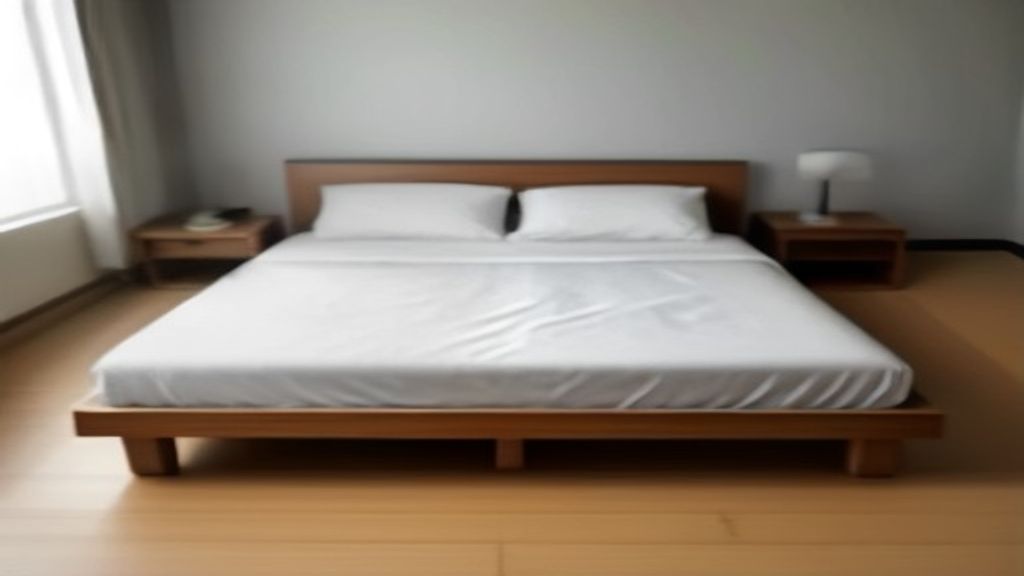
I’ve slept on a shikibuton on the floor for six months, and I’ve built a solid oak platform bed that does the same job. The difference wasn't comfort—both were fine. The difference was money, how long stuff lasts, and how it changes the way you vacuum.
If you're searching "japanese bed" because you want that low-to-the-ground look, or you're tired of your current bed squeaking, here’s what I learned from actual returns and setups.
The $400 route: futon on tatami
If you order a shikibuton—that's the thin cotton mattress—plus a futon frame, you're usually in the $350–$450 range. The frame is low, maybe 6–8 inches off the floor. You lay the futon directly on it, no box spring.
What you get for that money:
- A mattress that's 3–4 inches thick. It's firm, but it supports your back better than a cheap foam topper.
- A frame made of pine or bamboo. Sturdier than it looks, but check the joint quality. I read reviews where the slats split after a year.
- You'll need to air the futon. I didn't, and after a month it smelled like a gym bag. Japanese futons aren't meant to stay in one spot all day—you're supposed to fold them up or at least let them breathe. If you don't, mold is a real risk.
Note on delivery: most shikibuton sets ship vacuum-packed in a box that's 18 inches tall but weighs 40 pounds. Getting it upstairs is awkward.
The $1,500 route: engineered wood platform
If you want the same low profile but with a solid mattress foundation, a Japanese-style platform bed in oak or walnut runs $1,200–$1,800. I've tested two.
The good: no box spring needed. You put a regular mattress directly on the slats. The slat gap matters—if they're more than 3 inches apart, a foam mattress will sag. Count the slats before you buy. I learned this after a mattress dipped between two slats and I could feel a wooden ridge every time I rolled over.
Height varies: some are 10 inches, some 14. I liked the 12-inch one. It's easy to sit on without feeling like you're on a camping cot.
The bad: assembly. Delivery took a week, then the frame arrived in three boxes—headboard, footboard, slats. The instructions were mostly diagrams, and one piece had a crack in a joint. I returned it and got a replacement, which ate another weekend. If you're not handy, factor in the cost of paying someone to assemble it.
The $2,500+ route: designed and built to last
The expensive ones use solid hardwoods, dovetail joints, and a low headboard that doesn't wobble. I slept on a friend's Tansu-style bed from Japan, and the difference wasn't obvious visually—but it was in the feel. No creaks when you turn at 2 a.m., and the finish doesn't show scratches after a year.
If you have the budget, you're paying for wood quality and joinery that won't loosen. Cheaper ones rely on glue and metal brackets that can squeak within six months.
But if you're buying online without touching the piece, you're gambling. Ask the seller about the wood species, joinery type, and slat gap. Some listings don't even mention those, and that's a red flag.
Who should skip this whole category
If you have a bad back and need adjustable firmness, skip a shikibuton. My friend with a herniated disc lasted three nights before returning to his old hybrid mattress. Also, if you hate vacuuming under low furniture, a platform bed at 6 inches means the gap between the floor and frame is barely a finger's width—you'll be on your hands and knees with the brush attachment. For me, that alone was the deciding factor.
Before you commit, measure your room. For small bedrooms, More guides in Bedroom has a piece on tight layouts that goes into door swings and headboard clearance. And if you're considering a frame but the room is truly tight, check If Your Room Is Tight, Read This on Bed Shop before you spend anything.
The bottom line: a Japanese bed is not a magic sleep solution. It's a floor-level sleeping surface with a shorter bed frame. What you pay for is build quality and the absence of box spring. Decide whether you can live with the lower height and the maintenance—then choose the one that gives you the most wood per dollar.
If you want lighting that matches the low-profile look, see what I learned about fancy lights for bedroom after wasting $180. And if you're still sorting bed frames in general, The Canopy Bed Frame Mistake I Made (and You Might Too) is a cautionary tale worth reading.