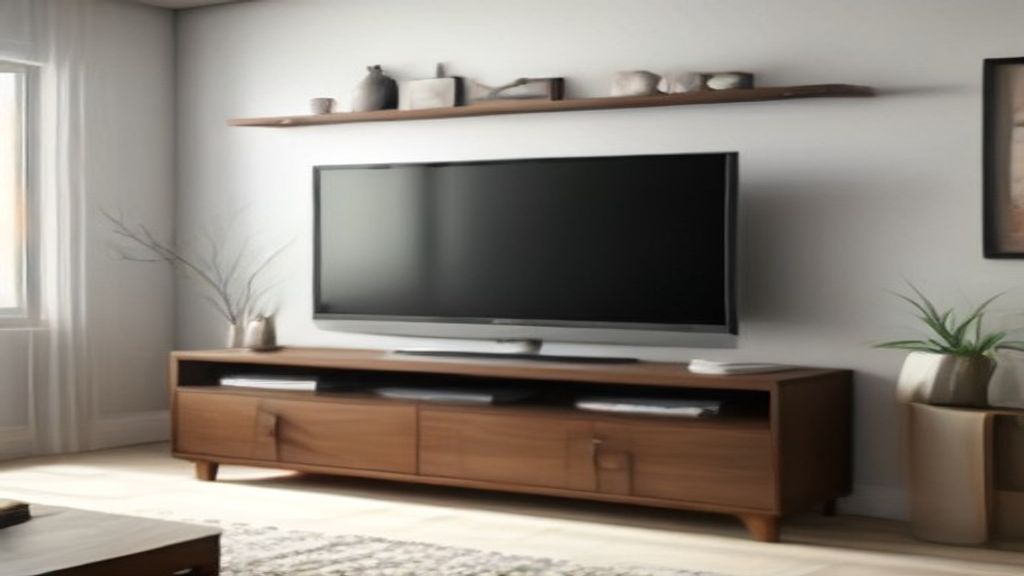
I’ve mounted exactly one wall-hanging TV stand in my life, and I learned more from that afternoon than from every YouTube video I watched beforehand. The internet loves to talk about VESA patterns and tilt angles, but the real issue is your studs. If your wall studs are 16 inches on center, you’re probably fine. If they’re not, you’re in for a bad time. I’ll tell you what to check before you even look at a stand.
The Stud Spacing Math That Actually Matters
Your stand’s mounting bracket has holes that need to line up with studs. Most brackets are what, 24 to 30 inches wide? Mine was 24. So the two outermost holes were 24 inches apart, and my studs were 16 inches apart. That meant the holes didn’t match. I ended up using only one stud and a bunch of drywall anchors. Guess what? It worked, but I’m not proud of it.
Measure your studs first. Use a stud finder, tap the wall, or measure from a corner. If they’re 16 or 24 inches apart, you’re good. If they’re something weird like 19, you might be stuck with a stand that only bites into one stud. Don’t trust the bracket to span the gap—steel doesn’t bend, but drywall anchors do.
Weight Limits Are a Lie (Sort Of)
Listen, the stand says it holds 100 pounds. That’s the bracket’s rating, not what your wall can take. A single stud can hold a lot vertically, but when you hang a cabinet with a TV on it, you’re pulling outward. The leverage is the problem.
My stand holds a 55-inch TV, about 30 pounds. I mounted the bracket with four lag bolts into studs, and I still check the gap between the stand and the wall every few months. If you only get one stud, halve the weight limit. And don’t put heavy books on the shelves—this isn’t a bookshelf.
Drywall Anchors Are for the Bottom Piece, Not the Whole Thing
Some stands have a top rail that carries the weight and a bottom piece that keeps the cabinet from tipping away from the wall. That bottom piece can absolutely use drywall anchors—it’s not holding the weight, just preventing forward motion. So don’t be an idiot and use anchors for everything. Read the manual. If it says “this bracket must attach to studs,” it means it.
The One Thing That Decides the Buy
Before you buy any wall-hanging stand, measure your wall and find those studs. If you can’t get at least the top bracket into two studs, pick a different stand—one with a wider bracket, or a floor console. Because the stand itself is just wood and metal; the studs are what keep your TV from becoming a floor decoration. I learned that the hard way when my first mount sagged two weeks in.
And when you measure, don’t forget about the cables. I had to drill a hole in the wall for mine, which was fun, but that’s another story. You can also read about how I measured the wrong wall for my shoe rack and why I now measure twice. Or check why a table top TV stand might save you if the studs aren’t cooperating. And if you need to know the VESA mount screw lengths for your TV, I wrote that up too.
Just measure first. That’s the whole trick. Everything else assembles how it should.