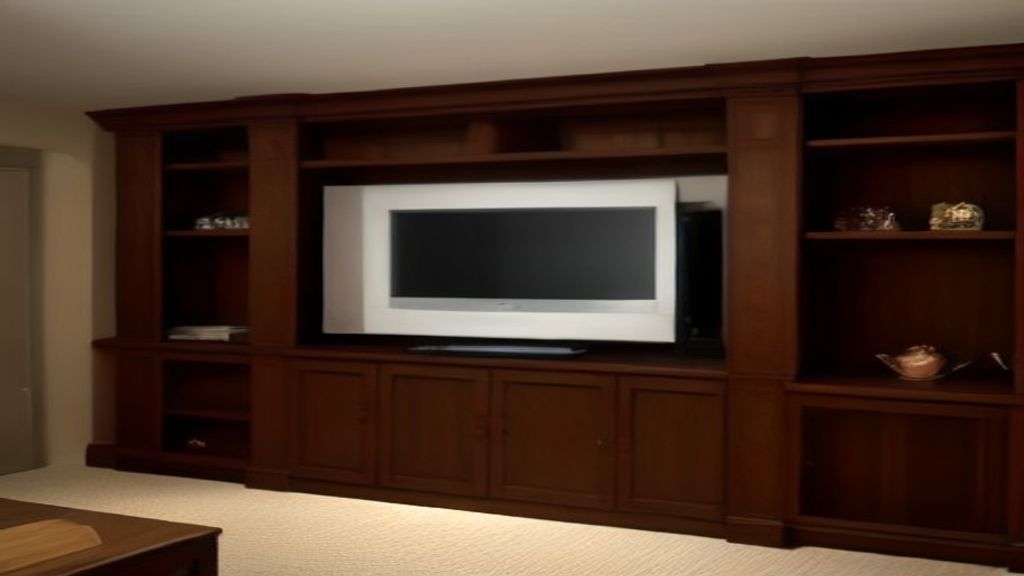
When I measured my living room wall, I had 34 inches of width to spare. Every narrow media cabinet I found online claimed it would fit. Then I checked the depth: 23 inches. For a "narrow" cabinet, that's absurd. My walkway to the balcony dropped to less than a foot. I didn't buy that one. But I've seen the same mistake in half the setups I've helped friends fix.
If you're shopping for a narrow media cabinet, depth is the number nobody mentions in the title. Width gets all the attention. But your room's depth constraints are what actually matter — for walking past, for the TV's air vents, for the outlets behind the unit.
Let me walk you through the real constraints I hit in my 11-by-13-foot living room, and how I finally picked something that didn't ruin the flow.
Start With the Floor Space, Not the Product
My wall was 40 inches long, but I only had 34 usable inches because the radiator jutted out on one end. I measured that twice. Then I measured the depth of the walkway behind the sofa: 36 inches. That meant any cabinet deeper than 18 inches would leave me squeezing sideways.
Manufacturers love calling anything under 24 inches deep "narrow." But 20 inches is still a lot when you're trying to keep a walkway clear. I helped a friend pick a media cabinet that was 16 inches deep, and it felt a foot slimmer than my 20-inch one, even though the width was almost identical.
That 16-Inch Unit I Nearly Bought
The one that almost worked was from a big online brand — 50 inches wide, 16 inches deep, and 32 inches tall. I did the virtual room preview and it was fine. What I didn't account for was the power cable for my TV. The outlet was behind the cabinet, but the TV's plug stuck out three inches past the wall. The cabinet edge touched the plug and I couldn't push it flush. I had to move the whole thing four inches to the right, which destroyed my centered layout.
Next time, I'd measure the outlet location and the cable clearance before ordering. I've written before about what to measure before buying a corner media cabinet — the same logic applies here, just add "depth of TV plugs" to the list.
Airflow Is a Real Thing, Not a Marketing Term
My old media cabinet was a fortress. No gaps. My receiver cooked. The vents on the sides got blocked by the walls of the cubbies. When I bought the narrow unit, I looked for one with an open back or at least a 2-inch gap above the electronics shelf.
The one I settled on has a cutout in the back panel, about 4 inches tall, that runs the full length. You don't see it from the front. But it's exactly what my receiver needs after two weeks of daily use — the surface under the receiver stays cool to the touch.
If the cabinet has solid doors, that's another airflow trap. Closed cubbies trap heat. I keep my door fronts almost closed but the back is open, and that's enough. If you're putting a gaming console in there, you want at least 4 inches of clearance on the sides, not just the top.
Where the Narrow Cabinet Actually Shines
After three weeks, I can say a narrow media cabinet (under 20 inches deep) is absolutely worth it if the walkway matters. My balcony path now is 14 inches wider than it used to be. That's the difference between bumping my elbow every Sunday vs. walking past with an armful of laundry.
It also forced me to declutter. With less shelf depth, I leave fewer decorative do-dads. That's not a bad thing. But if you have deep media components — like a big AV receiver that's 17 inches deep from front to back including its dials — you'll have it hanging off the back. Some people don't mind that. I did mind, so I got a receiver that's only 12 inches deep.
What I'd Buy Again — and the Spec That Matters Most
If I had to buy again tomorrow, I'd pick a cabinet with the same footprint: 48 inches wide, 17 inches deep, no doors over the center shelf, and a back cutout. I read the spec sheet on this one: "17.5 inches depth." I assumed that was the body depth, not including the back panel. It wasn't. The back panel itself was 0.75 inches thick, pushing total depth to 18.25 inches. Still okay, but I had to re-measure after assembly.
So measure the assembled depth, not the advertised one. Add an inch for trim or feet. And always check the doors — when open, they add 3 to 4 inches on the front, but if a wall backs right up to the side, a drawer can't open.
For what it's worth, I looked at the cheaper $200 units first. One had a particleboard back that was 0.4 inches thick and flexed easily. I ended up spending $580, not because the cheap one was awful, but because the cheap one's depth was smaller — 15.5 inches total — and that turned out to be too shallow for my receiver. The extra $380 bought real solid wood sides and an inch more depth, which made the difference.
I've also seen what what $200 vs $800 TV cabinets actually get you — don't expect the $200 one to have a soft-close hinge that stays soft after a year.
Who Should Skip the Narrow Media Cabinet
If your TV is bigger than 65 inches, you might be tempted by the wall-hanging route — and that's worth considering if your studs align. I don't bother with a wall-mount. My narrow floor cabinet is fine because my TV is on a swivel stand that I'm not trying to hide.
But if your living room is genuinely short on floor space and you're about to give up walking room to accommodate gear, don't buy a narrow media cabinet. Go for a wall-mounted unit where you mount the TV and run cables through a conduit you won't end up hating later. Or, if you have to keep floor furniture, reconsider the layout entirely — sometimes the answer isn't narrower furniture but no furniture on that wall.
Skip this style if you insist on keeping the A/V receiver, soundbar subwoofer, and game consoles stacked on one shelf. The narrow depth will make an absurd pile that sticks out. And if your walkway is already under 30 inches, adding a piece at 18 inches deep leaves you no path. That's when the narrow coffee path guide becomes a real rabbit hole, and not the fun kind.
For most people in a tight space, the 16-to-18-inch-deep unit works. Measure depth, measure door swing, measure what you'll sit on top. Twice. Then order.