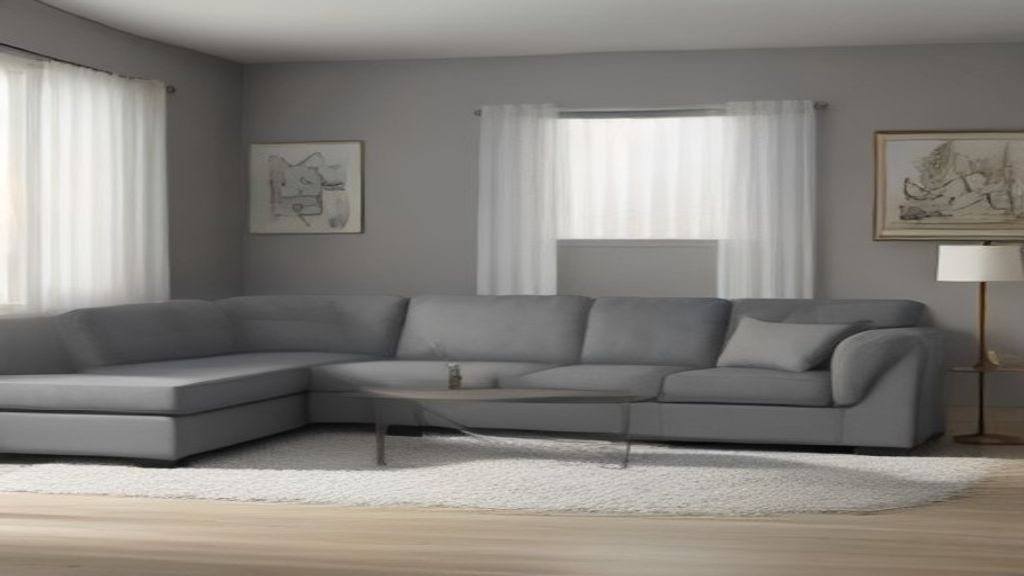
I spent $1,200 on a grey microfiber sectional last spring, and the first thing I did when it arrived was measure it. Not because I'm obsessive—because the listing said "98 inches wide" and the chaise was supposed to be 'deep enough to nap on.' Both turned out to be half-true. My actual dimensions: the chaise was 72 inches long, which sounds great, but the seat depth up front was only 21 inches. My 6'1" frame did not nap comfortably. That's the kind of detail the spec sheet buries.
Price Tiers: What $800 vs. $1,500 vs. $2,500 Actually Buys
I looked at close to twenty grey microfiber sectionals across three price points before I bought, and measured most in-store when I could. Here's what the money really gets you.
At $800–$1,000, you're getting a frame of pine or particleboard, foam cushions in the 1.8 lb density range, and a polyester microfiber that's been brushed to feel suede-ish but is really just synthetic. The fabric stains if you don't treat it within a minute, and the cushions will sag visibly after six months of daily sitting. I've seen it happen to a friend's. For a guest room or a dorm, fine. For a primary couch, you're buying a disposable.
At $1,500–$2,000, you step up to hardwood frames (usually rubberwood or eucalyptus), higher-density foam (around 2.5 lb), and a microfiber with a tighter weave that's been treated with a stain guard that actually works. My own couch is in this tier, and the fabric has handled a red wine spill with only a quick blot—no lasting mark. The cushions have kept their shape after a year, though the seat depth on the main seats is still only 23 inches, so I don't lounge sideways like I'd want.
Above $2,500, you're paying for either a brand name or a deeper seat. Some sectionals in this range offer 26–27 inches of seat depth, which is the difference between sitting up straight-ish and actually sprawling. The fabric also gets thicker, sometimes with a double-brushed finish that feels more like cashmere than plastic. But I tested a $2,800 West Elm piece and the chaise was still too short for my legs to fully extend. No amount of money fixes a design flaw.
Fabric: The Real Test Is Six Weeks In
The biggest myth about microfiber is that it's indestructible. It resists water better than cotton, true, but it's not stain-proof. The ad photos show a glass of red wine knocked over on a grey cushion with nothing happening. In my living room, I spilled a glass of red wine on the cushion and it was fine because I blot it immediately. But last month I forgot a wet mug with coffee for a good two hours. There's a light brown ring I haven't gotten out. The fabric is dark grey so it's not obvious, but I know it's there.
Oily stains are worse. A dab of salad dressing left for an afternoon will leave a dark spot that no cleaner has fully lifted. The manufacturer says to use a solvent-based cleaner, but I've found mild dish soap mixed with water works better, as long as you don't rub too hard—you'll wear the nap down and make a shiny patch.
The 90-Day Perspective: What I'd Change
After three months, here's what irks me daily. The seat cushions are reversible, but the no-slip fabric on the bottom is useless—they slide around on the frame every time someone gets up. I've added a layer of non-slip shelf liner under them. Also, the back cushions are feather-blend, which sounds luxe but means I'm poking them back into shape every morning because they flatten overnight. I'd swap them for solid foam in a second if I could do it again.
The chaise is also only 72 inches long, which means if I'm five feet away on the main seats, I can't lay flat. The listing said "extra-long chaise" but didn't state the measurement. Measure the inner width of your room, subtract 6 inches, and that's your actual chaise length limit.
Who Should Skip Grey Microfiber
If you've got kids under five or pets that shed a lot, skip it. The grey hides lint beautifully but shows every bit of nail scratch and drool stain. My sister's grey microfiber sectional got a permanent whitish mark where her dog's nails scraped the armrest from week one. You can't spot-clean that.
Also, if you're over 6 feet tall, look for a sectional with at least 25-inch seat depth and a chaise over 80 inches. My own couch is a good example of what not to pick: at $1,200, it's decent for the price, but I wouldn't buy it again. I'd rather pay $2,000–$2,500 for deeper seats and a chaise long enough for a full stretch.
Before you commit, spend twenty minutes in the showroom sitting the way you actually sit at home—legs crossed, knees up, sideways. And measure the tape on the floor, not the outside width. The ads never show you the 8 inches of lost space from rounded arms and a gap between the seat and wall.
If you're comparing brands, check out how the Sofia Vergara Sectional in a Real Living Room: What Fits and What holds up, or a Costco Reclining Sectional: The First-Week Setup Decision That matters. For smaller spaces, I've read up on Small Sectionals for Small Spaces: Skip the One That Eats Your Room. And if you're tempted by a leather option, I Bought a Light Grey Couch and It Showed Every Stain Within a Week might surprise you.
I've included my exact measurements here because that's what I couldn't find online before buying. If a listing won't provide inner seat depth, walk away. You're not being picky—you're just avoiding a $1,000 mistake.