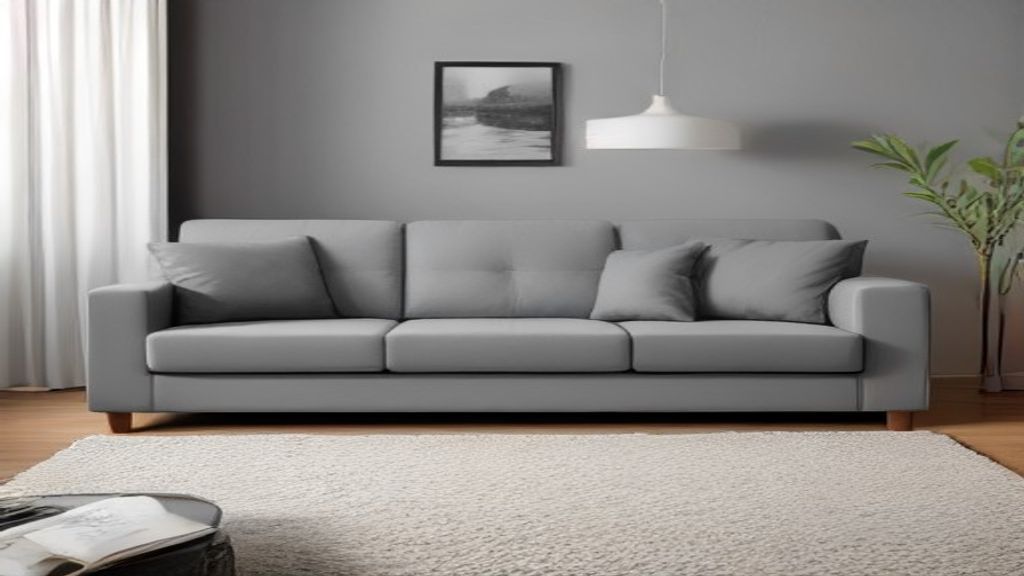
I've owned three contemporary sofas in the last five years, and the total bill came to $8,600. The cheapest was $1,200, the mid one $2,800, and the most expensive $4,500. Here's what I learned about where your money actually goes, and where it gets wasted.
When I bought my first $1,200 sofa, I thought I was being smart. It looked sleek, had clean lines, and the fabric felt fine in the showroom. Eight months later, the seat cushions had lost their shape — not just sagging, but the foam had broken down to the point where I could feel the plywood seat base through the padding. The frame creaked every time I sat down, and by month ten, one of the wooden legs had actually split.
What $1,200 Gets You
At this price, you're paying for a look, not longevity. Typically, you get:
- Hardwood frame? No. Usually a mix of particleboard and softwood like pine or poplar. Not terrible for light use, but it won't handle daily sitting.
- Foam density: Usually around 1.5 lbs per cubic foot — that's low. It'll soften noticeably within a year.
- Fabric: Polyester or polyester blends, often with a low rub count (around 15,000 on the Wyzenbeek scale). It'll wear unevenly, especially on the arms.
But here's the thing — not everyone needs a sofa to last 15 years. If you're renting a studio and you'll move in two years, a $1,200 sofa might be the right call. Just know you're renting the furniture, not buying it.
What $2,800 Gets You
This middle tier is where I found the sweet spot for most households. At $2,800, you start to get real improvements:
- Frames: Kiln-dried hardwood like beech or birch, with dowelled and glued joints. Solid.
- Foam density: Around 2.0 lbs, sometimes with a foam-wrapped coil seat. Much better support, and it holds up for years.
- Fabric options: Higher rub counts (30,000+), and you can often choose between performance fabrics or natural blends. The difference in feel is immediate.
My $2,800 sofa is now three years old. The cushions have softened a bit, but they still spring back. The frame is as solid as day one. The fabric has faded slightly in the sunniest corner, but that's on me — I didn't rotate the cushions regularly.
The other advantage is serviceability. Mid-tier brands usually sell replacement cushions or covers, so if the cat claws the arm, you can fix it. At the low end, you just live with it.
What $4,500 Gets You
At this level, you're paying for design, customization, and often better materials:
- Frames: Excellent hardwoods, sometimes with metal reinforcement at stress points.
- Foam density: 2.5 lbs or higher, plus pocketed coil springs and down-blend wraps. The sit feel is plush but supportive — it doesn't bottom out.
- Fabric: Premium options like full-grain leather or high-quality wool blends with rub counts of 50,000+. These wear beautifully over decades.
But here's the catch: for many buyers, that extra $1,700 doesn't translate to a better daily experience. The sit isn't twice as comfortable as my $2,800 model, it's maybe 20% more refined. The real difference shows after ten years — the cushions flatten less, the frame stays straight, the fabric doesn't pill.
I've seen friends spend $4,500 on a statement piece and then keep it in a room they never use. That's a waste. If you have kids or dogs and you're going to beat the sofa up anyway, the extra money is better spent on professional cleaning or just saving for a replacement.
Where Prices Don't Tell the Whole Story
One thing I've learned: brand names often inflate the price. A $4,500 sofa from a luxury brand might have the same frame construction as a $2,800 from a direct-to-consumer company. The premium goes to marketing and the showroom rent. That said, some luxury brands do use truly better materials — you have to look at the specs, not the logo.
Another hidden cost is delivery. Some companies charge white-glove delivery on top of the price, and it's worth it for large pieces. My first sofa came in a box and required assembling the legs myself — the legs broke because I overtightened them. With the $2,800 sofa, delivery included full setup and haul-away of the old one. That peace of mind has value.
Who Should Skip Buying a Pricier Sofa
If you're moving in the next two years, if you have pets that will shred the fabric, or if you just don't care about the material for more than a few years — skip the high-end. The $1,200 sofa will be fine for that phase, and you'll save a lot of cash. On the other hand, if you're settling into a long-term home and you want a piece that's still comfortable and presentable in ten years, the $2,800 tier is the smart money. The $4,500 tier is justified only if you're buying a centerpiece you'll love for decades — for most of us, that's not the case.
Before you spend anything, measure your doorframes and stairways. I learned that the hard way with my Mid Century Sectional Sofa: Don't Buy Before You Check the Chaise Side — the chaise wouldn't fit around a corner. And if you're shopping for a set, check the aisle space like I didn't with my Sofa Set Table: The Mistake I Made and the Measuring You Should Do.
More in Sofas & Sectionals.