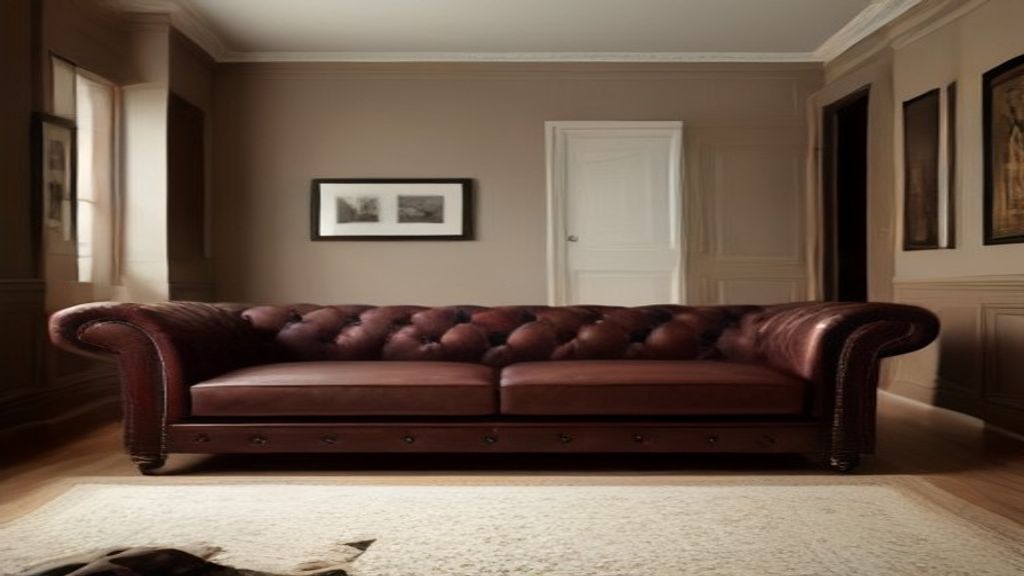
I ordered a 92-inch leather chesterfield once. The delivery guys got it off the truck, took one look at my hallway, and said, "Nope," then drove away. Two weeks of phone calls to get a refund, and I learned the lesson: chesterfields are not like other sofas. They're heavier, taller, and the rolled arms do you no favors when you're trying to squeak around a corner.
So before you click buy, walk through your place with a tape measure and a piece of string the size of the sofa. That's the real test. The specs on the site only tell you the footprint; they don't tell you if the backrest clears your door frame.
Measure the turn, not just the room
Most chesterfields run deep—that's the look, that bold rolled arm and high back. But those proportions are exactly where the stairs and doorways bite. A 38-inch depth felt fine in the showroom, but in my 36-inch hallway, it wasn't fitting straight. And if you have even a slight angle at a landing, you're into advanced geometry.
The trick I learned: measure the height of the back, plus the thickness of the arms, and compare that to your hallway width at the narrowest point. If the sofa's height (minus the legs) is under that width, you can often tip it vertical and pivot. My 38-inch backrest on 2-inch legs—so 36 inches without lifts—squeezed through a 34-inch gap once I took the door off. But the arms? They added four inches on each side. That's where it stuck.
Most chesterfields have stocky, overstuffed arms. Remember, removing arms is rarely an option on this style (the good ones are built as one solid piece). So you're moving the whole thing, or you're sending it back.
The weight: a chesterfield is not a gym mat
A 3-seater chesterfield typically runs 110 to 160 pounds. Maybe more, if it's hardwood and eight-way hand-tied. I had two movers and still watched them grunt. If you live alone and the couch has to go up two flights, think hard about that. A helper is usually fine, but there's a difference between lifting a mid-century low-profile frame and a big, ponytailed beast.
Also, your floor. I've got oak floors and the back of the sofa scratched them when we pivoted it through the entrance. You'll want moving blankets before this thing crosses your threshold.
The turn: what worked for me
Our path: front door, through a 32-inch-wide vestibule, right turn into a 36-inch hallway. The sofa's depth prevented a straight-in approach. So we did this: we took the door off the stripped the sofa of the toss cushions and loose-back ones. Then we turned it on its side, with the back facing the door. That's the standard trick—the back is typically flatter than the seat. We lifted the front arm up, walked the base through, and only then did the height clear the opposing wall.
But if your sofa is over 87 inches long, a single pivot may not cut it. That's when you need to measure the diagonal: the length from the back of the sofa's arm to the front of the opposite arm, at the widest point. My 92-inch version had a diagonal of around 94 inches. If that diagonal is longer than the space between your landing and the ceiling, you run into a height issue.
Honestly, if you've got a tight corner, a chesterfield over 86 inches is going to hurt. The I read about for regular sofas didn't help here. That's for two-seaters, not for grand dames with big arms.
The tilt: when it just won't fit
Sometimes you can't get it in. My friend had a castle of a house and bought a huge chesterfield; her solid stone walls meant no chance. She had to get a custom-made — and it still needed a window removal. If you're in an old building with narrow stairs, don't assume you can "just make it work." Check the spec sheet for the exact dimensions and the shipping route. One vendor told me, "Oh, we ship it in two pieces"—but it was a one-piece frame. Liars.
There is an alternative: get a chesterfield-style sofa that has removable arms. Some modern iterations let you unscrew the arms and detach the back. That solved my delivery. But you'll lose that seamless, rolled look if that was the draw.
What I actually chose
After the failed delivery of that 92-inch battle-ax, I went with an 84-inch chesterfield with narrow cushion arms—still that tufted back with the nailhead trim, but 33 inches depth instead of the typical 38. It weighed 95 pounds. It fit through my 34-inch doorway because the arms were removable on this model. It's less dramatic, less hotel-lobby. But now I can watch the Doberman channel on the weekend, and the cats have their spot.
If you've got the space and the path, a 96-inch chesterfield will be the centerpiece of your living room. If you're in a rental with a narrow hall, look before you leap. And please—do the string test before you pay. Save yourself the hump of a return.
Some people skip this style altogether for apartments. If you know your building has a load-bearing wall right at the landing and there's no sightline for a pivot, save yourself the trouble and look at sectionals that break down into pieces that can snake through a hallway. Or consider a Serta sleeper sofa that at least has a slim profile for standard openings. But if you're set on the button-tuft, rolled-arm look, at least measure your back width and height, and your wheelbase, before you sign.
This isn't ruin-the-fun advice, it's get-the-furniture-in-the-door advice. The first test is always the string. The second is the mover's estimated delivery time. If they say "maybe," it's a no.