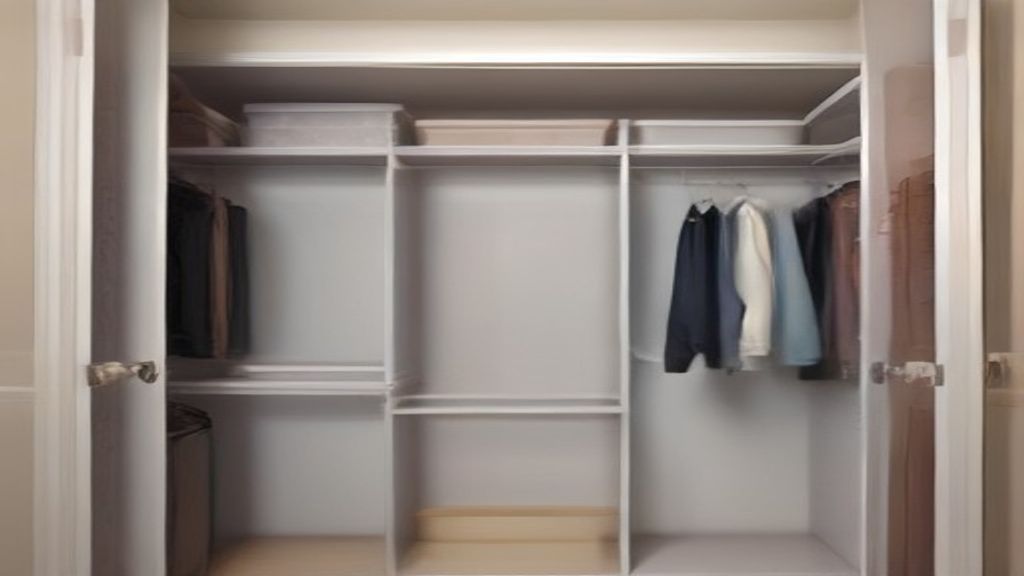
Rubbermaid closet storage looks like a bargain, and it is. But I see the posts: “bought a closet organizer, now it’s a shelf museum.” The real issue is you measured the closet and forgot the room.
The first mistake is width. The box says 72 inches, you measure the closet at 72.5, and you think you’re fine. Then you read the instructions: you need 4 inches of clearance on the sides for the brackets. Suddenly your 72-inch unit is 80 inches total, and your bedroom wall blocks it. I measured the door swing last, but you can’t slide a 24” deep shelf unit around a bed if your hallway is 26 inches. That’s the real estate problem nobody talks about in the listing.
Measure the walls, not just the closet
Walk the path from your front door to the closet. Tape measure in hand, write down every turn. I brought a 72-inch Rubbermaid unit into my apartment, and it fit the stairwell perfect, then stopped at the last turn because the wall stuck out 3 inches. That was a Sunday and I paid $35 for a hand truck and lost my deposit.
Also check the wall construction. Rubbermaid’s top track needs to hit a stud. I found studs 24 inches apart, fine, but the bracket screws go into drywall if you don't line up. The unit I bought mounts with three tracks—top, middle, bottom—and if you miss a stud, you're either moving a shelf or dealing with sag. Don't assume your walls are square. I used a level on the ceiling track, and the floor was off by half an inch, so the brackets on one side were tight against the wall while the other side wobbled.
What rubbermaid actually does well
Once it’s up, it holds. I loaded sixteen winter sweaters, two vacuum cleaners, and a toolbox that weighs more than my dog. The steel shelves didn’t bow. The wire shelf coating didn’t crack under the weight. For a budget system, the structure is solid.
The drawers are not drawers. They’re fabric bins that slide in and out. That works fine for shirts, but if you stack jeans six pairs high, the bin loses shape and starts to sag. I ended up using the bins for off-season blankets and bought a separate set for actual everyday clothes—more money, but I learned.
Install takes an afternoon if you have two people and a drill. One person holds the track while the other screws. The directions are fine, not detailed, but not impossible. Solo install would be a mistake unless you own a laser level and a prayer.
Room shape matters more than shelf depth
You might be tempted to buy the 18-inch deep system because the closet is small. But my closet is 30 inches deep, so I bought 24. Problem: the closet door opened inward, and the hinged side hit the shelf edge before the door was halfway open. A narrower shelf would have let the door clear. Measure your door swing first, then decide on depth. Typical bedroom closets handle 16 to 18 inches; you only need 24 if you’re doing long coats or you have the wall space.
My lesson? Draw your room to scale, mark the door arcs, then slide a cardboard box along the path. You’ll avoid the insult of trying to hoist a 70-lb shelf over a bed full of winter blankets.
The budget real talk
Rubbermaid costs about half of elfa or IKEA’s PAX. You’re paying less because the shelves are wire and the brackets are steel powder-coat. It doesn’t look custom, but it’s dependable. If your closet is a narrow 60 inches and you have tricky angles, spend a bit more on a system like elfa Closet Systems: What I Learned Measuring, Installing, and Living that lets you cut the track to fit. Rubbermaid makes a couple of sizes, but you’re stuck with what’s in the box.
If your ceiling is over 8 feet, check the maximum rod height. I’ve seen people build a double hang and forget they can’t reach the top shelf without a step stool. That’s not ’Maids fault—that’s just physics.
Who should skip Rubbermaid and who should buy
If your closet is a weird shape—slanted ceilings, pipes crossing, uneven plaster—look elsewhere. Wire shelves won’t bend to you. A under stairs closet storage post from a friend convinced me that a customized wood solution made that awkward space useful. Rubbermaid also doesn’t handle heavy loads near the top. A metal shelf rated for 250 lbs per shelf will sag if you load a tote of boots on the very end; spread the weight.
But if you have astandard 5-foot closet in an apartment you don’t own, and you need to organize between work shifts, Rubbermaid is the best low-pain fix. Measure the path, check the studs, and put the bracket screws where they belong. Then a Rubbermaid closet will quietly hold your life together—like that friend who always shows up with snacks and a drill.