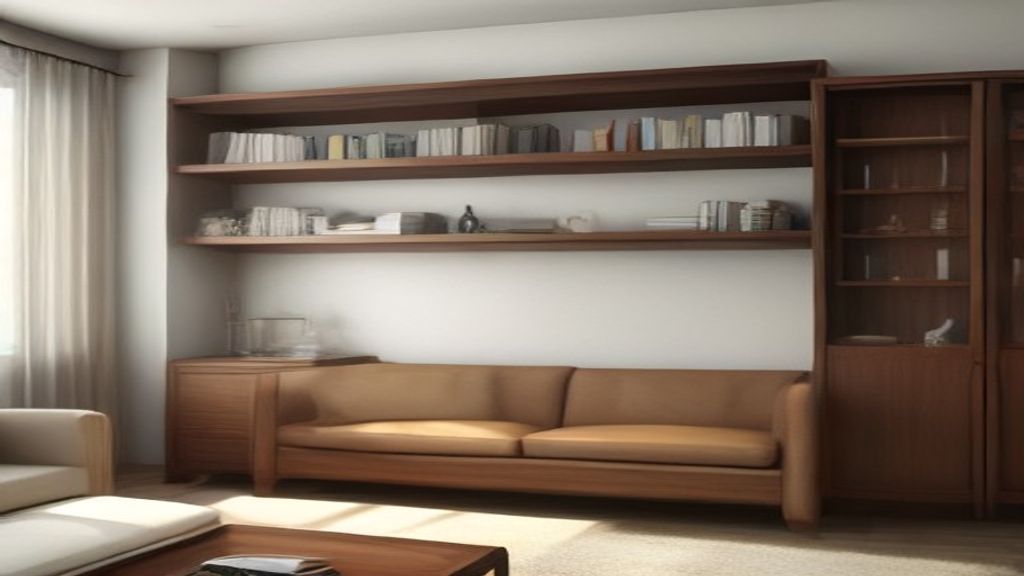
I've hung 14 large floating shelves in the last two years — in my own apartment and helping friends. Most of them are still up. Two are not. The difference wasn't the wood or the finish. It was the mounting system. If you're about to buy a big floating shelf, stop and read this, because the product photos never show what's behind the wall.
The Mounting Hardware Is the Shelf
Every large floating shelf I've installed came with either a steel bracket that slides into a routed slot, or a set of threaded rods that you anchor and then slide the shelf over. The brackets are easier if you have a stud finder and a drill. The rods are more forgiving if your studs are in weird places, but they need a specific installation order or you'll end up with a wobbly shelf that sags after a month.
I measured the gap between the shelf and the wall on my own installs. With a good bracket system, you get maybe 1/8 inch gap. With the rod system, if the wall isn't perfectly flat, you can get 1/4 inch or worse. That gap is where dust builds up, and it looks sloppy if you have any light on it.
Weight Limits Are Optimistic at Best
The spec sheet will say "holds 100 lbs" and then the fine print says "when properly anchored into studs." I've tested shelves on drywall with anchors vs. studs. With a proper stud mount, I've loaded 80 lbs on a 30-inch shelf and it didn't move. With drywall anchors, same shelf, same weight, and it pulled out within a week. The anchors held for a few days, then the leverage from the shelf's depth did the job.
So ignore the weight rating and instead ask: Are my studs where I need them? If not, either move your shelf location or accept you're going to have a much lower real-world capacity. For most living rooms, a large floating shelf is for books and plants, not a home theater receiver. Keep heavy items on the lower shelves or near the brackets.
Don't Trust the Level on Your Phone
I used a 4-foot bubble level for every install. The bubble levels were consistent. The phone app said I was level when I was off by half a degree. On a 60-inch shelf, half a degree means one end is 1/4 inch higher. So get a decent level, or at least check with the same app but calibrate it against a known flat surface first.
Also, measure the shelf itself. Some cheaper shelves are bowed before you hang them. If the shelf is not flat, no amount of leveling will fix it. I had a walnut shelf that was cupped 1/8 inch across its width. I had to sand the back to get it to sit flush.
What I'd Do Differently
The first shelf I hung, I used anchors because I was in a rental and didn't want to deal with patchwork. It fell and cracked my coffee table. In my own place, I cut drywall, added a 2x4 blocking between studs, and mounted the bracket solid. That shelf is still up with 50 lbs of books.
If you're renting, get a mantel mount that hangs over the top of the shelf and uses hidden screws into the bracket behind. That's a trick I've seen on Floating Glass Shelves: First Week Setup and the One Decision That Decides Everything and it gives you a solid mount without needing to hit studs perfectly.
Who Should Skip Large Floating Shelves
If your walls are plaster over metal lath, or if you're not comfortable with a stud finder and a drill, buy a shelf with visible L-brackets instead. Floating shelves look clean, but they're a pain if you can't find solid mounting points. I've helped two friends who ended up returning their floating shelves and going with a bracket shelf because their walls were too finicky.
Also, if you're planning to store heavy items like records or a soundbar, your best bet is a shelf with a lower profile but a rated capacity—check out Industrial Wall Shelves: What $60, $180, and $400 Actually Get You for what different prices get you. Or, if you need more depth, look at Large Writing Desk — Measure This Before You Click Buy for a workspace that doesn't rely on wall mounting.
For more shelf real talk, head to the More guides in Shelving section.