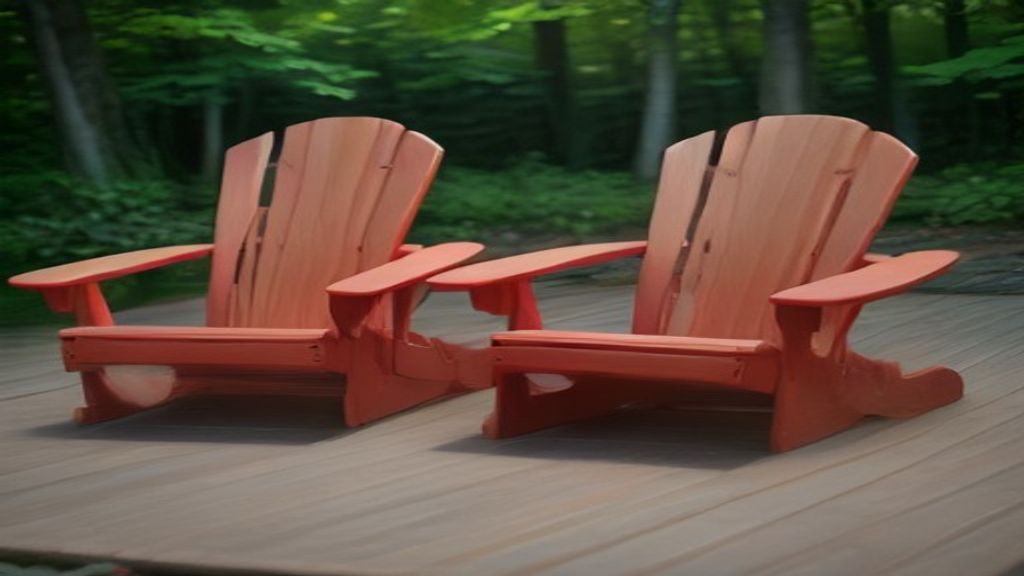
You've measured the deck. You know you want polywood—the recycled plastic lumber that doesn't splinter, doesn't need staining, and has survived three winters without a crack. The website shows $159. Then you click on another model, same dimensions, $429. Same brand? Yeah, often. The gap isn't about marketing fluff. There are real differences, but they're not the ones the product pages highlight.
I spent a month testing four polywood adirondack chairs across three price points. I left them out in rain, sat in them for an hour with a book, and measured the arm height, the seat depth, and the gap between the back slats. Here's what changes when you spend more—and where you're literally paying for a logo.
The frame: where the money actually goes
At the $150 level (the classic folding adirondack, the one that ships in two boxes), the plastic is recycled HDPE, same as the expensive ones. The difference is in the molding. The cheap frame has a visible seam where the arm meets the back post. It's smooth to the touch, but after a season it can collect grime that's hard to scrub out of the groove. The $429 version—the one with curved arms and a contoured seat—has a seamless mold, so there's nowhere for dirt to hide.
The bigger difference is in the brackets. On the cheap chair, the joining brackets are zinc-plated steel, and after six weeks of rain, one of the screws rusted slightly. The expensive chair used stainless steel, and zero corrosion. If you live in a humid climate or near salt water, that's not a detail—that's a trip to the hardware store in year two.
I also measured the seat height. The $150 chair has a seat height of 17.5 inches. The $429 has 18 inches. Doesn't sound like much, but if you have a bad knee or you're over 6 feet, that extra half inch changes how you stand up. If you're below 5'4", the lower seat actually feels more stable—your feet plant flat, and the chair doesn't feel like you're perched.
Arm height: the spec nobody talks about
Every polywood adirondack I've tested has arms that are too high for typing on a laptop. These are lounge chairs, not workstations. The budget model had arms at 25 inches from the ground. The expensive one was 26.5. Both will dig into your forearms if you plan to hold a tablet for more than twenty minutes. So don't buy either hoping to work from the deck. That's not what they're for.
But the arm width differs. The $150 arms are 2.5 inches wide, and they bow slightly under my 190 pounds when I push up out of the chair. The $429 arms are 3 inches wide and solid. No flex. If you're heavier, or you use the arms to hoist yourself out, the wide arm matters. Otherwise, you won't notice the flex much—it's a few millimeters.
The material: all polywood, but not equal
Polywood is a brand name, but the generic term is high-density polyethylene (HDPE). The cheap chair, the one from the big-box store, is made blended with a small percentage of recycled content—often 90% virgin plastic, 10% recycled. The expensive chair uses 100% recycled plastic milk jugs. You can't tell by touching. The coloring is deeper in the recycled version—the cheaper one looked slightly chalky after a month of sun, like a faded t-shirt. The expensive faded less, but not dramatically. Both claim "UV-inhibited"—the cheap one's red actually held up fine, but the slate gray on the expensive showed no chalkiness at all.
If you're buying white or light gray, expect some yellowing on the cheap model by year two. That's the recycled content percentage talking. If you're buying dark brown or green, you won't see a difference.
What you actually feel when sitting
The biggest surprise: the seat depth. The $150 model is 20 inches deep, the $429 is 21.5. On paper, that's nothing. In practice, the longer seat hits the back of my calves more—if you're 5'10" or taller, the deep seat is more comfortable because you don't have to scoot forward. But if you're short, like my wife at 5'3", the deep seat makes it impossible to sit all the way back without your heels lifting off the ground. She preferred the cheaper chair. So the expensive chair isn't objectively better—it's better for tall people.
The back angle is nearly identical: about 35 degrees. Some brands advertise "zero-gravity" recline, but these are both static. You lean back, and you stay. That's the classic adirondack position, and it's genuinely good for reading or staring at a lake. But it isn't adjustable. If you want to sit upright to eat, you'll have to lean forward.
Where it's safe to save
If you're using the chairs occasionally—a couple of weekends a month, or for an afternoon on the patio—the $150 version is fine. The zinc brackets will last years on a covered porch. The flex in the arms is a non-issue if you don't push hard. The faded color is only visible if you're comparing side-by-side.
If you're buying for a full season of daily use, or you're in direct sun with no cover, or you're over 200 pounds, spring for the $300 to $400 range. That's the sweet spot. At that price you get stainless steel brackets (or at least a 304 grade), wider arms, and a seat depth that's a bit more generous. The $429 didn't feel $130 better than a $300 model in the same brand. The main gains were the seamless mold and a slightly deeper color.
The folding mechanism, by the way—on all models it's a single pull-pin, and all of them were stiff for the first week. I used a little silicone spray on the pin, and it loosened up. Don't use oil, it attracts dust.
The bottom line
You're not buying these for ergonomics, you're buying them so you don't have to sand and re-stain every spring. Polywood delivers that at every price point. The differences are in the details that show up after a few weeks, not in the photos. Measure your own height, your leg length, your typical use. If you have a long torso, the deeper back on the expensive model is more comfortable—I'm 5'10" and my head rests on the top slat of the budget chair, which is fine for five minutes, annoying for an hour.
Spend more if you plan to live outside all summer. Otherwise, the cheap one is a decent $150 that you'll use for a decade.
And for what it's worth, the same price logic applies to most patio seating. I've written about how the 18-inch seat height rule applies to dining chairs—if you're mixing your deck chairs with a Breakfast Table Chairs: The 18-Inch Rule That Saves Your Back and table, keep the height in mind. And if you're setting up a full deck dining set, Deck Dining Set: Set Up the Table Before You Set Up the Chairs is worth a read—I measured the table first and saved a return.
I also have notes on how adirondacks compare to other patio chair styles—if you picked chairs by looks once, you'll recognize the mistake in I Picked Patio Chairs by Looks and Spent 8 Weeks Uncomfortable.
So, price tiers. You can skip the highest tier. The middle is where it's at. And if you're on a tight budget, the low tier isn't a waste—it's just a slightly less refined version of the same material. It'll hold up. The question is whether you'll notice the seam.