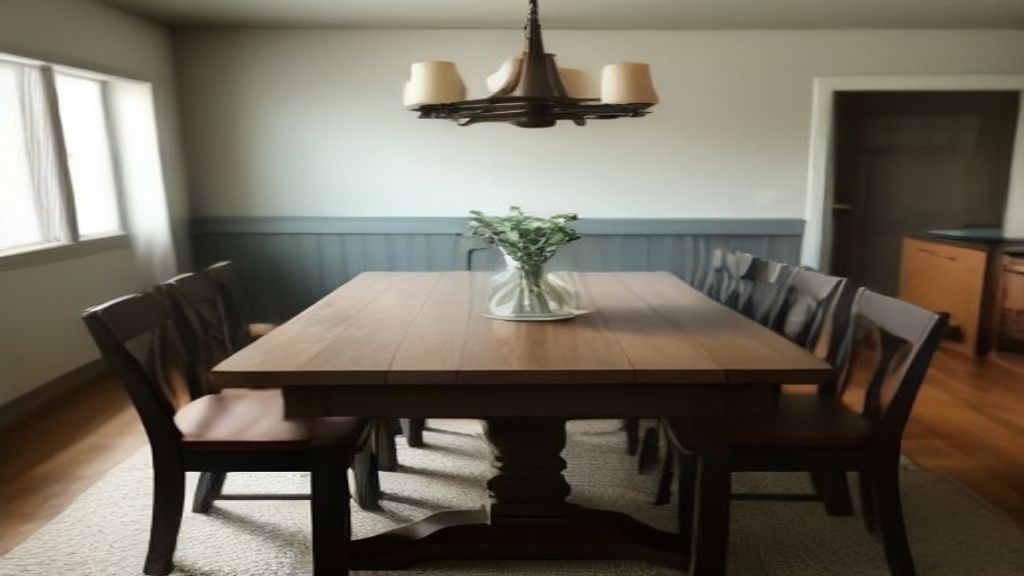
I almost bought a $2,000 farmhouse table last year. Good thing I didn't.
A farm style table is just a wood table with visible grain and a bit of rustic character. But the label adds a premium to anything. So before you pay for the word "farmhouse," here's what I learned after living with mine for six months.
Measure the legs, not just the top
Every ad shows the top. Nobody shows the legs. That's a problem.
Most farmhouse tables have thick aprons and splayed legs. That means the actual leg footprint is wider than the top. I've seen tables that look 40 inches wide online but the legs eat 12 inches on each side. My dining room is tight. I needed a table that could fit chairs pulled out, and I didn't want to trip over a leg when walking around.
So measure the base, not just the top. Ask for the max width at the floor. If they won't tell you, skip it.
And check the leg-to-tabletop gap. Some designs have a crossbar that hits your knees. I sat at one in a store—legs hit the brace. Deal-breaker.
Look for solid wood, but don't obsess over "reclaimed"
Reclaimed wood looks cool. But it's often inconsistent. Nail holes, cracks, rough patches. That's fine if you want that look. But it's not automatically better.
I went with solid pine from a local maker. Cost me $600. It's soft—I won't lie. It dents if you drop a fork. But it's real wood, and I can sand it down in five years and it'll look new.
You don't need white oak or walnut. You need wood that's sold as solid, not veneer. Check the underside. If it's a photo of wood on MDF, it's not a farmhouse table. It's a sticker.
Know how you'll actually use it
We eat on it, yes. But we also do homework, pay bills, and occasionally use it as a staging area for packages. So I needed a table that didn't show every smudge.
A matte finish hides fingerprints better than a shiny one. Our pine table has a matte polyurethane. Coffee cup rings? They wipe right off.
And think about the bench vs. chairs thing. Benches look great and store more people. But if you've got kids or older folks, chairs are easier to get in and out of. We went with a bench on one side, chairs on the other. Compromise.
Skip the "farmhouse" label if the price is insane
Here's the thing. I found a table at a big box store labeled "farmhouse." Same dimensions as mine. It was $850 and made of rubberwood with a distressed finish that was painted on. Mine is solid pine, made by a guy who runs a small shop, and cost less.
The label adds money. The wood doesn't change. So look for solid construction, not the buzzword.
If you're on a budget, check out What $300 vs $800 Gets You on an eBay Dining Table before you buy. That'll give you a reality check.
Don't buy a farmhouse table if you don't have the space
Honestly, a farmhouse table is not for every room. If your dining area is less than 10 feet wide, a massive 8-footer will make you feel like you're in a cafeteria.
I almost bought a 7-footer. My dining room is 11 feet. It would've been a mistake. I went with a 6-footer. That's enough for six people, and I've still got room to walk around.
So measure your room first. If you've got a small space, maybe look at a round table instead. I wrote about that in Round Farmhouse Table and Chairs: My First-Week Setup Notes.
And if you're replacing an old set, don't assume the same size works. Chairs with arms take more space. I learned that the hard way after reading The 34-Inch Wide White Dining Table That Taught Me to Measure Chairs.
Bottom line
If you want a farm style table, buy one. Just don't pay for the word. Solid wood, simple design, and a base that doesn't wreck your knees. That's all you need.
And if you're the kind of person who needs a table that stays pristine forever—no dents, no scratches, no character—skip the farmhouse. Go with a glass top or an engineered wood. You'll save money and keep your sanity.
For more real-talk on table shopping, check out More guides in Dining Tables and What a Dining Table Set Actually Costs (and Where the Money Goes).