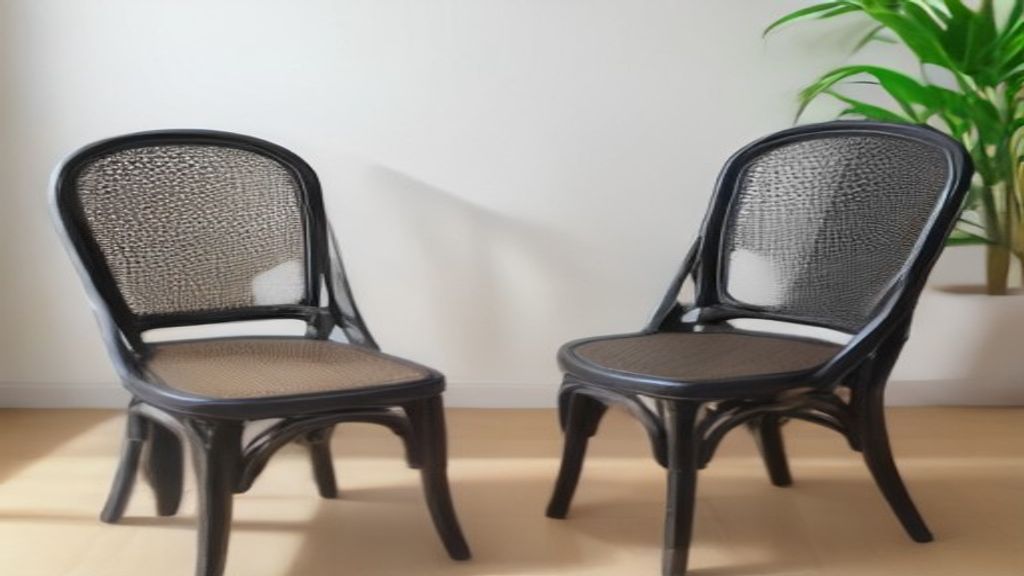
I’m going to say it: most black and rattan dining chairs look identical in the product photos. Same dark frame, same woven seat, same vague promise of "coastal modern." But the price range is wild—I’ve seen sets of two go for $150 and single chairs push past $700. So what’s real? I ordered from three tiers, lived with them for a month, and measured everything I could. Here’s the honest breakdown.
The $150 Range: Fine for Looks, Weak on Build
First set: two chairs, $149 each on sale. The rattan looked great from three feet away. Tight weave, even color, nice contrast against the black frame. But the frame was hollow steel tubing—light, like 12 lbs light. I flipped one over and the crossbar was spot-welded, not even a full weld. After two weeks of daily dinner use, the seat began to shift. Not a dramatic wobble, but a subtle creak when I leaned back. The rattan itself held up, but I could see the cane starting to fray at one corner where the seat met the frame.
Measurement check: seat height was 18.5 inches, which is fine for a standard 30-inch table. But the seat depth was only 16 inches. If you’re taller than 5'10", your thighs will hang off the front. I’m 5'9" and it was borderline.
What you gain: the look, for cheap. What you lose: durability, and peace of mind.
The $350 Middle: The Sweet Spot for Most Homes
Second set: $349 each. Same silhouette, but the frame was solid beech wood, painted matte black. Heavier—about 18 lbs. The rattan was still natural, but the weave was tighter, and the seat was actually wrapped around the frame, not just glued. I sat in one and immediately noticed the difference. No flex. The seat height was 18 inches, and the seat depth was 17.5—more forgiving.
After three weeks of use, zero creaks. I even had two people sit on one chair (don’t ask). The finish held up to the usual spills—coffee, red wine, a toddler’s juice. The black paint did show a small chip on the back leg where it banged into the table base. Touched it up with a Sharpie and you can’t see it.
What you gain: solid construction, better proportions, a chair that’ll last years. What you lose: a week’s worth of groceries in cash.
The $700 Chair: Marginal Gains, Big Price
Third: a single chair, $720. This one came from a designer brand. The rattan was hand-woven—you can see slight variations in the pattern, which is supposed to be charming. The frame was solid oak, and the joinery was visible: mortise and tenon. It felt like furniture you’d pass down.
But here’s the kicker: after a month, the experience wasn’t dramatically different from the $350 chair. The seat was slightly deeper (18 inches), and the backrest angle was a bit more reclined. I did notice the cane didn’t creak at all under heavy leaning, and the finish was more tactile—duller, not glossy. But would a guest know? No. Would I know if I sat in it blindfolded? Maybe, if I concentrated.
The real difference was in the details: the chair didn’t move an inch on hard floors (rubber feet), and the rattan had a subtle honey tone that the cheaper ones lacked.
What you gain: perfectionist details, heirloom quality. What you lose: $700 for something you might not fully appreciate.
What Actually Matters
After all this, here’s what I’d tell a friend: don’t buy the $150 chair unless you’re renting or expect to replace it in two years. Don’t buy the $700 chair unless you have specific aesthetic standards and the budget. The $350 chair is the one most people should settle on—and honestly, it’s not a compromise.
But there’s one thing that overrides price: fit. I measured my table height wrong before ordering my first set. My table has a 31-inch height, and I ended up with a chair that was too low—made my knees feel like they were under my chin. Check your table’s under-desk clearance, and aim for a seat height about 11-13 inches below the table top. And leave at least 18 inches between chairs for armroom, or you’ll bump elbows.
Also, think about how you actually sit. If you lean back to reach for things (like I do), get a chair with a slight recline, not a straight back. And if you have kids, skip the natural cane—it’s softer and absorbs stains. Go with a darker rattan or a synthetic weave.
One more thing: the delivery. The cheap chairs came in two flat boxes, easy to carry. The $700 chair came in a huge crate, and I had to pay extra for white-glove. Factor that into your price.
Next Step
Measure your table height and your seat-to-table clearance right now. Write it down. Then order a set in the $300–$400 range from a place with free returns. If you have a weird table size, you might need to look at adjustable-height options, but for standard tables, that’s the sweet spot.
And if you’re still wavering on style, remember: black frames hide dirt, rattan adds warmth, but the shape matters more than the color. I’d take a $400 chair with good ergonomics over a $700 stunner that kills my back.
For more on picking chairs that fit your table, check out More guides in Dining Chairs. I also learned the hard way about armrest clearance with Swivel Dining Chairs with Arms: My Table Width Mistake and What to Do. And if you’re comparing sets, this breakdown of Retro Dining Chairs Set of 4: What $200 vs $800 Actually Buys covers similar ground.