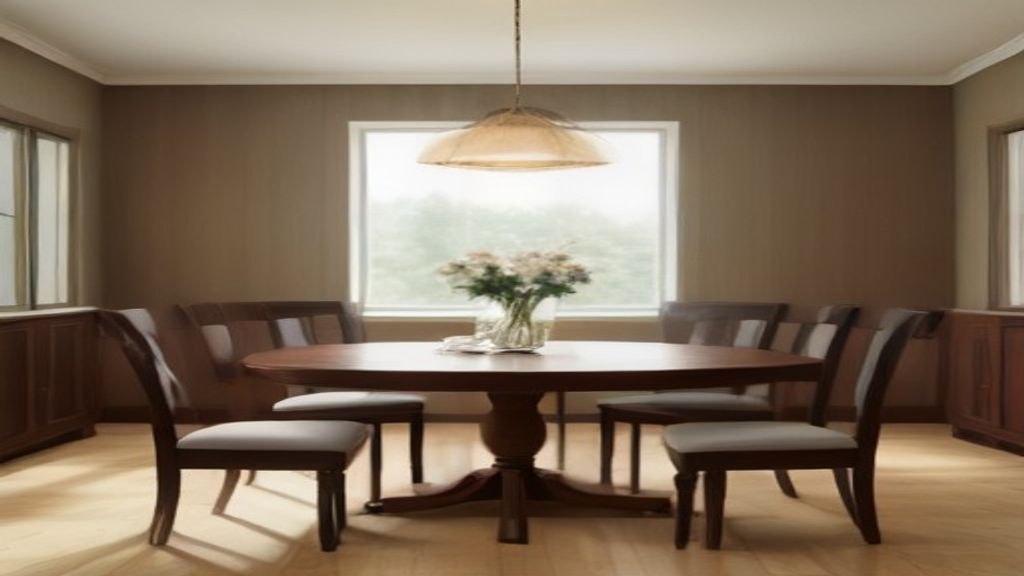
The box weighed eighty pounds. I know because the delivery guy and I dragged it up two flights of stairs, and he said, 'What's in this, a body?' It was the tabletop for a set I'd bought online after staring at a render for an hour. The first thing I did when I got it inside was grab my tape measure. Because if there's one thing I've learned buying three dining room sets in a year, it's that you cannot trust 'seats 4-6' or 'compact' or 'solid wood' until you've measured it yourself.
Here's what I actually found. Not from press releases. From my dining room.
The $500 Set: The Particle Board Trap
My first set was a six-piece, table plus four chairs, from a big online retailer. Price: $512. The photos showed a warm oak finish and cushions you could sink into. The reality: the tabletop was a printed vinyl wrap over particle board. Four months in, the corner peeled up where a glass of ice water sat. The chairs wobbled after a month because the bolts stripped the screw holes—they're just glued into the wood composite.
I measured the table: 60 inches long, 36 wide. It looked fine in the photos, but when I put it in my 10x12 foot dining space, I had less than 30 inches of clearance behind the chairs. You need at least 36 to slide a chair out and sit down comfortably. I found that out the hard way when I cracked my elbow on the wall.
The good news? It was cheap. If you're renting, or it's a temporary setup, a $500 set works—assuming you never spill water. But don't expect it to last past a year of dinner parties.
The $1500 Set: Real Wood, Real Problems
My second set cost $1,480. Solid acacia table, chairs with upholstered seats, the works. The difference was noticeable the moment I lifted the tabletop. Real wood has heft. You can knock on it. I measured the table: 72 inches long, 40 wide. In the same room, it dominated. I had to push it against the wall to get around it, and the bench I bought to go along didn't fit.
But here's what really got me: even at this price, the chairs were not fantastic. The wood was real, but the seats were thin foam over plywood. After three months of daily use, one chair developed a dip. The legs were bolted with metal brackets you could see under the seat, and one of those brackets stripped a bolt—I fixed it with a drywall anchor, which is not a long-term solution.
So what did $1,500 actually buy me? More weight, a slightly better tabletop, and the illusion of quality. The 'solid wood' was actually solid in parts, but the whole thing still had wobble at the joints if you bumped it hard. I measured the chair seats: 17.5 inches deep, 17 inches wide. That's less than my $50 folding chair. They're not comfortable beyond forty-five minutes.
The $700 Set: The Sweet Spot, Sort Of
The third set was closer to $700. It was a smaller round table, 48 inches, with four chairs. I almost skipped it because the price made me suspicious. But the build was better than the $500 set. The table legs were solid poplar, not particle board. The chairs had real plywood seats, not just cardboard. I measured the clearance: with the chairs pushed in, I had 38 inches behind them—just enough to slide out.
But here's what I measured that wasn't in the specs: the table wobbled. Nothing catastrophic, but a quarter-inch play in the center leg. I fixed it with a rubber furniture pad under one leg. It took me an hour. And the finish—it's a matte lacquer that scratches if you look at it wrong. Within a week, I had marks from a hot plate. A cheap hot plate, too.
So what should you actually spend? It depends. If you're planning to keep it for a year or two, $500 is fine. If you want something that holds up for a decade, you might need to spend $2,000 or more, but don't assume the price alone guarantees it. I've seen $2,000 sets that had the same particle board drawer glides.
Before You Buy: My Three Non-Negotiables
Now, before you click "Add to Cart," here's what I check every time:
1. Reinforced joints — Look for screws that go into solid wood, not particle board. If you can see a screw hole edge at the joint, it's probably crap. Ask for photos of the underside.
2. Seat depth — Sit on the chair for at least ten minutes in the showroom, or measure the seat depth. Anything less than 18 inches is a risk.
3. Clearance — Measure your room. Add the table length and the depth of the chairs when pushed in. Then add 36 inches for each side you need to walk. If that doesn't fit comfortably, it doesn't fit.
I also learned to look for the word "solid" in the product description. "Solid wood" means something. "Wood" alone means nothing.
The table arrived in three boxes. I spent an hour assembling it with an Allen wrench that gave me a blister. That's not a complaint—that's just what happens. Every set I've bought came with the same deal: you save money on shipping, you spend it in time.
I still use the $700 set. It's not perfect. The wobble is manageable, the scratches are mine, and the chairs are just okay. But it's the first one I didn't need to replace after six months. And that's about the best you can hope for at this price.
If you're shopping for a set and you're on a tight budget, I'd say this: skip the $500 one. Spend a little more. You'll feel the difference in the first week when you sit down and the chair doesn't shift. And if you have room, reconsider the material. A tabletop that doesn't peel, legs that don't strip—that's what you're really paying for.
But if you don't intend to eat at it, or you eat standing up, maybe don't care about any of this. Just buy the cheapest thing and move on. There's no shame in that either.