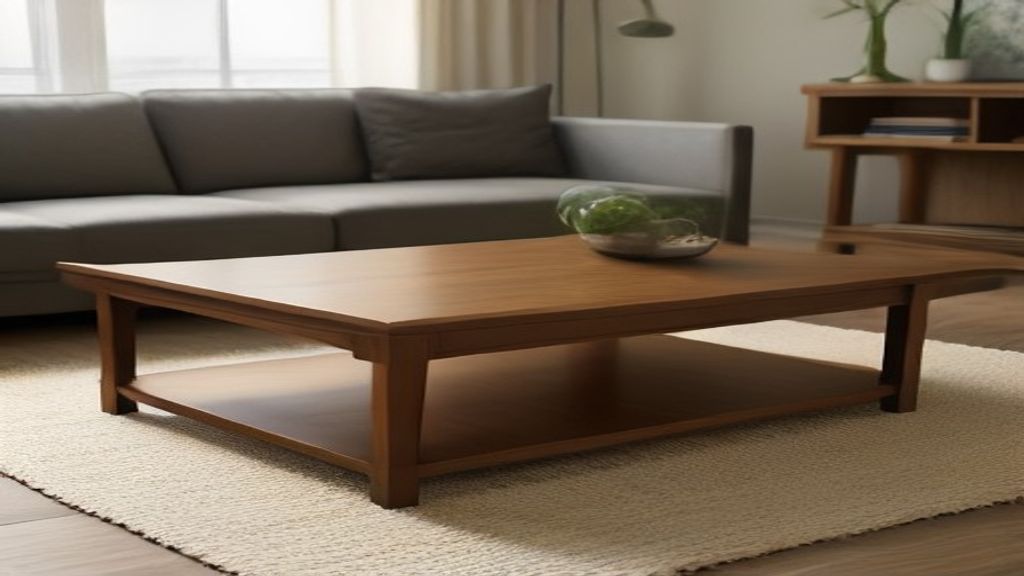
The box landed on my porch with a thud that made the cat jump. I cut the shrink wrap, and the first thing I noticed was the smell — that sweet, sawdust-and-varnish scent you get when something's actually made of wood, not just printed MDF. That was the good moment. The second thing I noticed was the weight. I lifted the top slab and thought, okay, this is substantial. Not heft-up-and-carry-youraway substantial, but enough that you won't knock it over with your shin.
I ordered the usual — the rectangluar model in the tan oak finish, around the 48-inch mark, because that's what fits my couch. Paid $600 with shipping. Took about three weeks to arrive. Urban Barn's not a cheap brand, but they're not furniture-museum expensive either. So the question is, what does that $600 actually buy you, and where do they quietly take shortcuts?
The wood story: it's veneer, but decent veneer
Let's be real. At this price, you're getting a hardwood frame topped with thick oak veneer, not a solid slab. What that means in practice is you get a uniform grain that looks nice from four feet away, but don't go scratching it with your keys to test. I did, once, on a corner where I figured it wouldn't matter — thin whitish line, still there. The upside? The veneer's thick enough that the top doesn't feel like printed plastic. It has a bit of texture, almost a tooth, and it doesn't show rings from a cold beer mug. I left a drink sweating on it all evening, and morning came, nothing. No cloudy stain.
Where the veneer thins out is the edges and any routed profiles. Run your finger along the perimeter and you'll feel the transition — slightly sharper than the center field. Not bad, just something you don't notice in the showroom photos. And the color, the tan oak, is yellower than the web photos suggest. My unglamorous chair, the one you never photograph near the couch, suddenly became a warm khaki. Keep that in mind if you're matching.
Delivery: the box is the enemy
Delivery took three weeks but the process was straightforward — they called the day before, gave a four-hour window, and the guy helped me haul it through the narrow hallway. That was the smooth part. The pain part is inside the box. These tables come in the flattest possible packed state: the top slab, four legs, a bag of bolts that you feel aren't quite enough. Assembly took me forty minutes, most of it spent on the pedestal base. The instructions are an exploded diagram on a glossy sheet, which is the usual, but they skip one useful detail: you have to loosen the top screws to seat the base plate correctly. I tightened everything, stood back, and the table wobbled. Then I went back, loosened, re-seated, retightened, and it was rock solid. So there's that — loosen to seat.
And the box, oh, the box. It became a permanent fixture in my hallway for a week because I was too busy to break it down. They use cardboard that's equivalent to two refrigerator boxes taped together, full of styrofoam peanuts and foam blocks. You'll want a hammer and a strong back to break it apart for recycling. Not a big deal, but logistics.
Four legs vs. pedestal: pick your fight
The URban Barn coffee tables come in two basic shape configurations: four straight legs, or a central pedestal. I tried both in the store before ordering, because I'm obsessive. Four legs means easier to clean under — you can push a vacuum head under and only hit the legs. Pedestal means no corners to stub, but you've got that thick column that eats a bit of footroom if your couch is low. And if you have kids or an idiot dog like mine, the pedestal is actually safer; they ain't gonna knock it over. But the four-leg version is lighter, surprisingly, and easier to move for cleaning. Heft the leg version and you'll find it's about 30 pounds; the pedestal is closer to 46. The weight difference is because of the thick base plate. I went pedestal.
The real comfort rule I learned the hard way: measure your clearance. If your couch seat is 18 inches high, a coffee table top that sitts 17 inches is perfect for reaching a mug. If your couch is taller, you'll want a table that's either the same height or an inch under. I didn't check before I bought my first one (from another store, sadly), and ended up with a 22-inch table that made me lean over without touching the floor with my butt. That's the uncomfortable lean. So measure your sofa first. Now, the Urban Barn table, the one I got, is 17 inches even, and it matches my theater seat perfectly. Hallelujah.
Where they cut corners: the hiddn stuff
The visible stuff is fine, veneer edges notwithstanding. The sneaky bits:
The glide fasteners on the bottom of the legs are those little plastic circle pads. They bent on the one move I had to do — I dragged the table from the living room to the bedroom, not even far. Two of them popped off. Replaced with felt pads, took five minutes. You could scold me for dragging, but a coffee table gets dragged eventually.
There's a central metal cross-brace underneath the pedestal, meant to stop racking. Half the people who assemble this will leave the screws loose, and then the table develops a shimmy when you lean on a corner. Tighten everything, all of it, and she's stable. The brace itself is metal, not wood, so it's not going to snap, but it'll rust if you live somewhere humid. I notice a little surface corrosion on mine already, after about two years of coastal air. Not structurally bad, but if you see it, wipe the whole indoor area with a dry cloth now and then.
And the finish on the top wears with heat. A hot mug — not a pot, just a mug of fresh coffee with the window open — left a faint white ring. I buffed it out with a damp cloth and it vanished, but if you want it gone forever, you'll need a furniture repair kit. That's the catch: the top is treated with a low-VOC lacquer that's a bit soft. Clean spills fast and you'll be fine.
The price spread: what you're paying for
People ask me why not just get a $300 table from Wayfair and call it a day. You can, and you'll get a table. The difference at the $600 mark is mostly in the wood and the joinery.
At $300, you're buying MDF with a paper-pulp photo print that looks like wood from across the street. It'll start peeling that outer layer off the edges within a year, and one clumsy chair push leaves a dent that mats in. The Urban Barn table has real oak veneer over a hardwood core; you can scratch it with effort. The base is hefty, and the legs won't flex vertically under load.
What you don't get at $600 is anything you'd call heirloom. The veneer will eventually wear through if you treat it badly, and the metal brace will require a swipe of WD-40 every once in a while. But for six hundred, you're getting something that looks legitimately good in a natural-light room and won't embarrass you when friends come over.
So is the extra $350 worth it? Depends. If you need a coffee table this weekend and it's going to have beer can rings and cat claws every night, pony up for a cheap solid-wood table from an outlet. If you're furnishing a space you actually like, and you want something that reads as a warm wood surface instead of a digital print, the Urban Barn table nails that. It also comes with a decent finish that's not sticky or dull.
Worth the pain? Here's the honest sum
Mine has lasted two years of daily use — laptop mornings, board game nights, bare feet on top during movie naps. The veneer's fine, the structure's still square, no squeaks. The only real wounds are the two scuffs where my goldendoodle tried to get under and got his claw caught. Those just live there now, like the white outline of a rug that refuses to be fixed.
Go measure your couch height. That's the step too many people skip. Then order the pedestal if your floor's uneven or the legs if you plan to move it monthly. And take your time with the assembly screws. That'the whole trick. Then you can buy it without second-guessing, and go back to the thing that matters: actually sitting around it with a drink.,"
What I'd do differently next time
If I'm being overly critical: I'd check the exact dimensions of the top vs. the clearance for your favorite armchair. I wanted a 36-inch round one, but the width of my walk-around was just shy of 2 feet, so the 48-inch rectangulr made more sense. And I'd swap the included glides for felt pads the moment I unpacked. And I'd tighten those cross-brace bolts a second time after a week — wood compresses.
But the look? I still catch it when I walk into the room and think, "That's a damn good piece of furniture." Actually. Without the brochure adjectives. Just does its job.
Now go measure your couch. That's the move. Everything else is details.
For more sizing and finish lessons, I went through the same battles with a Duncan Phyfe Coffee Table: Don't Buy One Without Checking These 3, a Grey Oak Coffee Table: Don't Buy One Before You Measure These 4 Things, and a Multipurpose Coffee Table: First Week Setup and the One Decision That. If your living room's cramped, the If Your Room Is Tight, Read This on Dark Oak Coffee Table is the one I wish I'd read sooner.
There's a lot of overlap in this category. Read those, then decide. Seriously.
And for more coffee table options across the board, head to the More guides in Coffee Tables.