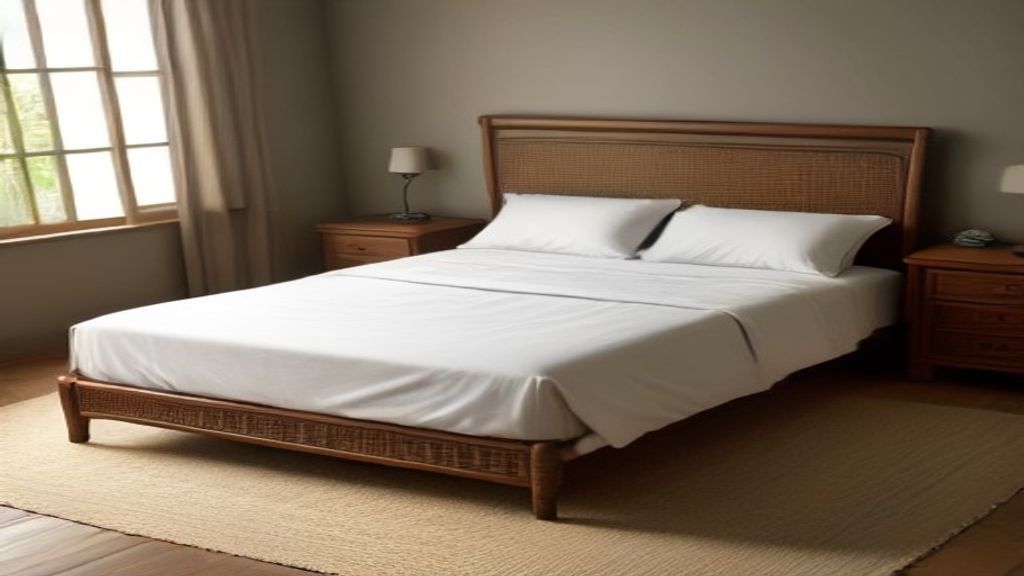
First wicker bed I bought looked like a dream in the catalog. Rattan weave, natural, the whole Bali vibe. Delivery guy dropped it at my door, and within a week I was picking fiber splinters out of my forearm. Don't get me wrong — a wicker bed can look stunning. But the word "wicker" gets thrown around for a lot of different materials, and you don't find out what you actually bought until it's too late. I've now returned two wicker frames and kept one, so here's the breakdown from my living room floor and my mattress moving experience.
What I Learned About Wicker vs. Rattan by Rubbing It
First thing to know: wicker isn't a material. It's a weave. You've got real rattan (which is a specific vine), you've got willow, and you've got the synthetic stuff that looks like splinter-lined bamboo. My second attempt was synthetic wicker, which looks right until you get close. It felt weirdly plastic against bare skin, and it didn't let the mattress breathe like real rattan does. Check if the package says PE rattan or seagrass — those are different materials completely. If you want something that doesn't rust or crack when you're moving, poly has its place, but I'd test what it feels like on your forearms before you commit to years of sleeping on it.
Sizing and Delivery: The Part Pictures Lie About
Photos never show how much space a wicker headboard eats up. My delivery person measured the doorway before I did, which was embarrassing. I'd checked the window dimensions but not the hall width — a 60-inch frame is not the same as the box that hauls it. The actual bed was 6 feet long without the headboard, and the box itself was a beast to maneuver up my stairs. If you live in a narrow hallway or apartment with tight corners, get the exact box dimensions before you buy, not just the assembled size. And when they bring it, ask for the return policy in writing — because my first twist was the 30-day window from the delivery date, not the day you open it.
How the Bedroom Belly Sits: Bed Slats, Freight, and Your Back
My first wicker frame stayed loud when I put a foam mattress on it. The slats weren't spaced evenly, and every move made a thud like a baseball hitting a plywood wall. I measured the gap: 5 inches on one side, 3 inches on the other — enough to cause flex in my mattress. That causes sag over months, sure, but it also woke my partner every time I rolled over. On the frame I kept, the slats are 3.5 inches apart and solid — no knock, no squeak. That's worth checking before you offer up cash.
What Actually Happened After 3 Weeks of Use
Any wicker bed has the same wear pattern: weave presses down where your headboard rests, you pull sheets up, and you inevitably bump against something if you roll too far at night. My laminate. Synthetic skins started rubbing on the base rack after a week, leaving a visible rub on the fiber. I fixed it by putting furniture felt on the bare beam. I've slept better under the kept one for 60 nights so far; lighter sheets don't catch, and I've stopped thinking about splinters. Oh, and the headboard wobbles slightly if you lean on it hard — noted that on both.
What To Do Before You Even Look at Models
Most of this pain is avoidable if you measure twice and play with reality in your own head first. If the frame doesn't slide over your rug without slowing you down, it won't slide either for your back. I'd say the honest next step: grab a $7–15 tape measure, find your door swing path, and stand where the bed will be. Stand with your hands on your hips. Imagine the mattress. Imagine dragging a heavy cart over the sill. If that thought bugs you, move on.
Look at the room dimensions after you move in — not just on a phone screen. That's what turned the first frame into a return: I hadn't accounted for the 4-inch headboard protrusion blocking a dresser drawer, so the bed had to sit sideways. Let me tell you, planning ahead beats bending your furniture to prove a point.
In short, get a tape measure, ask about slat gap and the box size, and go with your eyes open about what wicker actually means for your allergies. The pretty photo doesn't squeak — but the slats underneath sure do. For more on avoiding my mistakes, check out Full Size Upholstered Bed: The One Measurement That Decides Everything or The 54-Inch Mistake: What I Learned Buying Cheap Double Beds. Or if you're weighing another frame, I tackled the steel bed wobble in I Bought a Black Metal Bed Frame and It Squeaked by Night Three—What. After delivery, get the carpet staples in the corner and pull the frame against an interior wall for support. That's the one thing I'd redo from scratch.