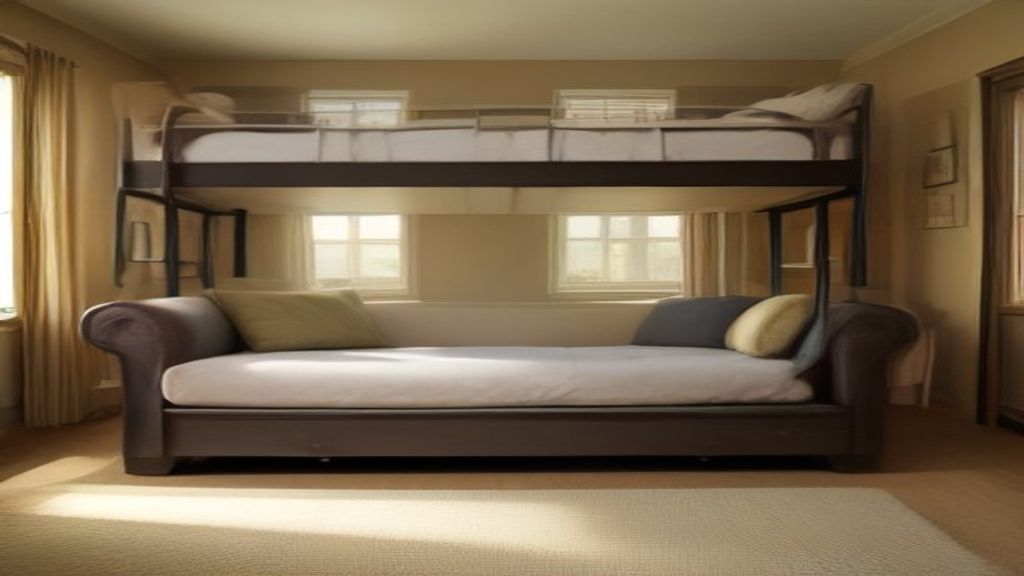
I measured my living room three times before ordering a double decker couch. Still almost got stuck in the hallway.
My living room is 14 feet by 12 feet, with a 36-inch door opening and a 90-degree turn into the room. I ordered a 96-inch double decker (that's the bottom bunk width) and assumed the top would slide right up. It didn't.
The Dimensions That Actually Matter
A double decker couch is a bunk bed with a sofa underneath—or sometimes a sofa on top and the bottom is just a lounging pit. Either way, you're dealing with height. Most are 60 to 72 inches tall. That's the killer. My ceiling is 8 feet, so that wasn't the problem—the door was.
I measured the bottom width at 96 inches, but the top is narrower. Still, the whole unit had to come in as one piece unless I wanted to disassemble it. The delivery guy said, "We can't make the turn." I had to pay $150 extra to have them take it apart and reassemble it inside.
If you're planning for this, measure:
- Door width (not just the frame, the actual opening)
- Hallway width and any turns
- Ceiling height where the couch will sit
- Floor to window sill if it goes under a window
Body Constraints: Who's Actually Climbing Up There?
The top bunk on a double decker couch isn't a real bunk bed. Most have a weight limit around 200–250 lbs, and the ladder is steeper than a kid's bunk. I'm 5'10", 180 lbs, and getting up there is fine, but rolling over at 2am feels like you're on a boat. If you're over 6 feet or 230 lbs, the top is not for sleeping—more like a lounge spot for afternoon naps.
My kids (7 and 9) love it. They use the bottom as a fort and the top as a reading nook. But if you're a couple and one of you is a restless sleeper, the top will not work. The mattress is 4 inches thick, and you can feel every spring.
Delivery Pain: Plan for the Worst
I thought I was smart because I measured the door. I didn't think about the staircase or the turn from the elevator. My building's elevator is 36 inches deep, which barely fit the 30-inch-deep couch after tilting. If you live above the ground floor, measure the elevator and any stairwells.
Also, the couch itself is heavy—like 250 lbs. Two delivery guys struggled. They asked me to help carry it, and I said no. That cost me an extra tip.
What You're Actually Getting
I've seen double decker couches in three price ranges:
- Under $500: Particle board, thin foam, and the ladder wiggles. Fine for a kid's room, not for daily adult use.
- $500–$1,000: Solid wood frame (usually pine), decent foam, but the fabric is cheap. I bought in this range and after 3 months, the bottom seating has a sag in the middle.
- $1,000 plus: Proper hardwood, high-density foam, and a real mattress option. If I had to do it again, I'd save for this.
The one I have now—let's call it mid-tier—the top bunk sags if you sit on the edge too much. You have to remind kids not to jump on it.
Room Layout: The Couch Takes Over
A double decker couch is not a compact solution. It's a statement. In my 14x12 room, it eats up one full wall. The bottom sofa is 96 inches wide and extends 40 inches into the room. That leaves about 6 feet of walkway, which is okay, but you can't put a coffee table in front of it without making the path tight.
I ended up using a Lift Up Coffee Table IKEA: What I Learned After Measuring My Couch Gap to keep the area flexible, but I still have to squeeze around it.
If you have a narrow room (under 10 feet), skip the double decker. The depth is just too much. I tried my friend's 84-inch double decker in a 9-foot-wide room, and it was a tunnel.
The bottom sofa is more like a deep lounger than a sit-up couch. You'll be reclined whether you want to or not. If you want to sit upright, you're better off with a Couches for Sale: What You Actually Need to Measure Before You Click.
The Ladder and Safety, For Real
The ladder on my unit is attached to the side, and it's 14 inches between rungs. My 7-year-old can climb it, but my 5-year-old niece had trouble. There's a gap between the ladder and the top bunk—about 3 inches—and she slipped once. No fall, but I added a foam guard.
Also, the guardrail on the top is only 6 inches high. That's low. If you have small kids, you need to side with the top bunk against a wall or add a bed rail.
Don't skip reading reviews for safety complaints—I found several about railings and weight limits.
What I'd Do Differently
If I were buying again, I'd:
1. Order a custom-sized one so the width fits my room exactly. Standard sizes are usually 84, 96, or 108 inches.
2. Request white-glove delivery that includes assembly and placement. It's worth the extra $100.
3. Skip the top bunk for sleeping if you're an adult. Use it as a lounge or guest spot for kids.
The Next Step: Measure Before You Even Look
Take a tape measure to your doorways, hallways, and the room itself. Write down the numbers. Then look at the product dimensions—don't rely on the photos. If the couch is 96 inches wide, but your door is 36, you have a problem.
I thought I was being careful, but I wasn't careful enough. Save yourself the $150 delivery fee and the headache. Measure everything, then order.
If you're still stuck on what fits, check out this Pull Out Couch With Chaise: First Week Setup to see how a different style works in a similar-sized room. But first, measure.