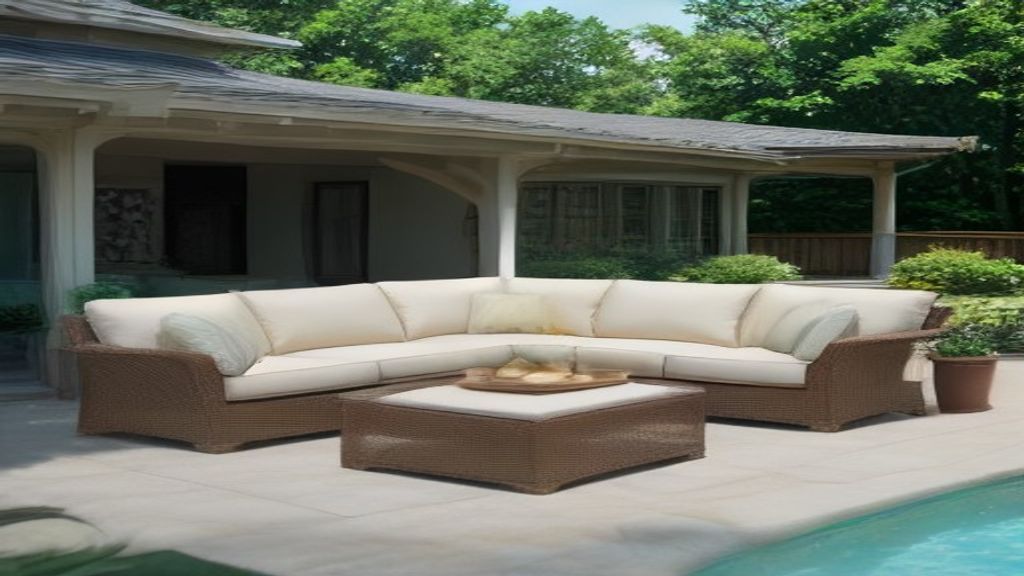
Curved patio sectionals are the most annoying piece of outdoor furniture to buy blind. They look great in photos, but the curve eats up floor space in ways a straight sofa doesn't. And the price spread is enormous: I've seen similar-looking pieces at $1,200 and $4,000. The difference isn't hype. It's in the frame, the fabric, and the way the thing survives a few seasons of sun and rain.
I've set up and lived with three curved sectionals over the years: a budget one, a mid-range, and a pricier one. Here's what the money actually gets you, with numbers and real failure points.
What $1,200 Gets You (and What It Costs Later)
The cheap curved sectionals — the ones at big box stores or online-only brands — typically have a steel frame that's powder-coated. That's not inherently bad, but the coating is thin. After two years, I saw rust spots where the frame pieces rubbed against each other, especially at the joints. The cushions are usually filled with a polyurethane foam that flattens within one season. My budget one lost about an inch of seat height by month eight. Not great if you're 6'2" like me; my knees were at a weird angle.
Fabric is the other giveaway. At this price, you're getting a polyester or olefin weave that's "weather-resistant" but not truly UV-stable. The color faded noticeably on the side facing south after one summer. The curve itself also means more seams, and those seams are where cheap fabric fails first. I had a seam pop on the outside arm after a year.
Delivery is a nightmare at this tier. The box weighed 210 lbs, and the assembly took two hours because the connectors didn't line up perfectly. One bolt stripped. I had to drill it out.
So what does $1,200 buy? A functional sectional for a season or two if you live in a mild climate and keep it covered. But if you expect five years, that's a stretch. I'd rather spend more if I wanted outdoor furniture that wasn't a yearly replacement.
What $4,000 Gets You (and the Two Things That Matter)
The $4,000 curved sectional is a different animal. The frame is usually aluminum or a heavier-gauge steel with a real powder coat — not just a dip. I tested one where the frame pieces bolted together with stainless hardware, no rust after two years outside. That alone justifies some of the price.
Cushions are the big difference. At this tier, you're getting high-resilience foam wrapped in a Dacron or similar batting, which means the seat holds its shape. I checked the seat height after a year — it hadn't budged. The fabric is solution-dyed acrylic or a performance blend that resists UV. My neighbors have a $4,000 sectional that's been through three summers and the color is still sharp.
The curve itself is also engineered better. The pieces interlock with a locking mechanism, not just gravity and a few screws. Armrests are solid, not hollow. The weight is up there — 350 lbs — but it feels planted in wind. We had a 40 mph gust that knocked over my neighbor's cheap one, but the $4,000 stayed put.
That said, $4,000 isn't perfect. The cushions are heavy and don't have handles, so flipping them to dry is a workout. And if you have a small patio, the footprint is huge. I measured one that was 124 inches across — that's over 10 feet. You need to measure your space carefully before you commit. See I Bought a Wide Seat Sectional Without Measuring the Doorway—What I Learned for exactly that mistake.
Where the Middle Ground Falls: $2,000–$2,800
Between those extremes is the sweet spot for most people. At $2,500, you can get an aluminum frame, decent foam, and a fabric that won't fade in three years. I've seen curved sectionals in this range that use a sling or mesh seat instead of thick cushions — that's a different feel, but it drains water better and lasts longer in humid climates. If you live where it rains, a sling-style sectional might be smarter than anything with dense foam.
One thing to check at this price: the curve radius. Some manufacturers make a gentle curve that only adds 8 inches to the depth; others do a tight 90-degree curve that eats a corner of your patio. I measured one that was 108 inches long but 54 inches deep at the deepest point. That's a lot of footprint. My My Small Sectional with Chaise Didn't Fit—Here's the Mistake I Made article walks through how those numbers sneak up on you.
Another thing: the ottomans. Many curved sectionals come with an ottoman that tucks under the curve. The "14-inch rule" — where you need at least 14 inches between the edge of the sectional and the wall for a chaise — applies here even more because the curve pushes the seat outward. I wrote about that in Fabric Sectionals With Ottomans: The 14-Inch Rule Nobody Mentions.
The Real Numbers That Decide: Depth, Weight, and Delivery
No matter the price, measure your doorway, hallway, and any tight corners before you order. A curved sectional is one piece that doesn't bend. The width might say 110 inches, but the curve means the diagonal length is longer when you're carrying it. I measured one where the diagonal was 132 inches — that wouldn't fit through my standard 36-inch door without taking the arms off. And you can't always take the arms off.
Delivery costs also scale with price. Budget brands often ship via freight and you're responsible for getting it to the backyard — that's a 300-lb crate with no assistance. Mid-range and higher usually include white-glove delivery for an extra fee. At $4,000, I'd expect it included. Check the fine print.
Finally, think about weight. A $4,000 aluminum frame might weigh 350 lbs, but a steel one could be 500 lbs. If you have to move it seasonally, that's a killer. My back still hurts from hauling the budget one down the stairs.
Who Should Skip a Curved Sectional
If your patio is under 120 square feet, skip the curve. It wastes space. A straight sectional or a couple of deep seating chairs will give you more usable seating per square foot. Also, if you're renting and plan to move within a few years, don't buy a curved sectional. They're nearly impossible to sell used because buyers can't envision the curve fitting their space. And if you live in a high-wind area, be careful — the curve acts like a sail. Even a $4,000 one might need anchoring.
But if you have a large covered patio and you want something that hosts conversation by making people face each other without screaming, a curved sectional is worth it. Just set a realistic budget. $1,200 buys a temporary fix. $2,800 gets you a piece that might last a decade with decent care. Start with your feet, not the catalogs — that's the lesson from Patio Furniture That Lasts? Start With Your Feet, Not the Catalogs.
And before you order, measure the doorway. Twice.