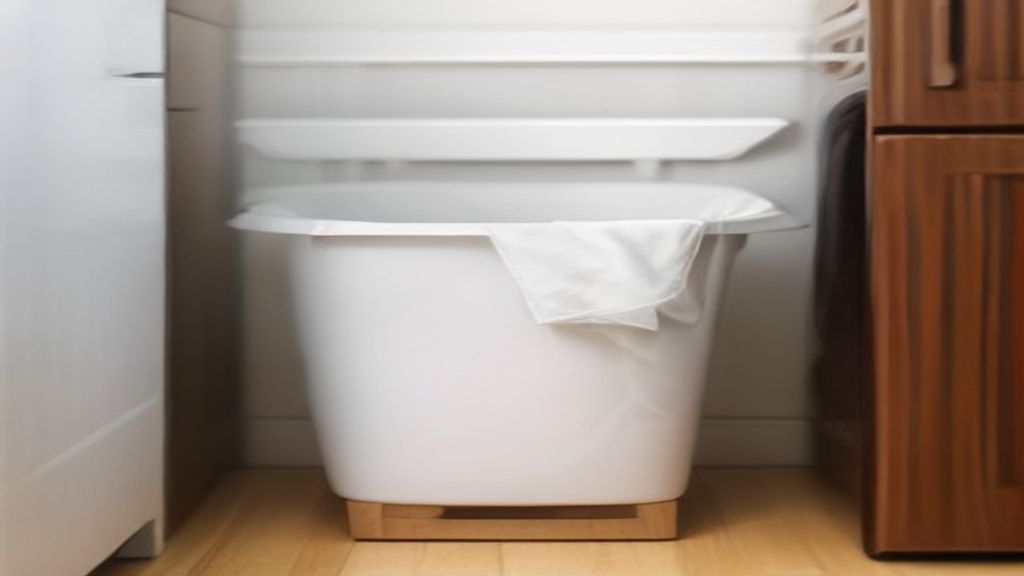
You're staring at a $200 wooden laundry hamper and a $50 one, both look fine in the photos. You know the cheap one's gonna wobble, but do you need the expensive one? I bought six wooden hampers over three months—from a $45 poplar box to a $210 oak behemoth—and measured the hell out of them. Here's what the price tags actually get you.
What the cheap ones hide
The $45 hamper I tested wasn't terrible—it held clothes. But the slats were 3mm thick pine, glued at the corners. After 3 weeks, the bottom panel started bowing under a full load of jeans and towels (about 18 lbs). The handle pulled out by week 6 because it was just a thin dowel sunk into 1cm of wood.
I measured the humidity in the bathroom where I kept it—60% average. The cheap finish didn't seal the end grain. The wood swelled at the bottom edges, and the door started sticking. It wasn't rust or mold—just swelling. It got better when I moved it to the bedroom, but I shouldn't have to babysit a hamper.
What $100–$120 gets you
The $115 poplar hamper I tested had thicker slats—5mm—and a plywood bottom with a crossbar. That crossbar made the difference. Full load: no bowing. I left a wet towel on the top edge for 6 hours (don't ask), and it didn't warp. The finish was a matte polyurethane with sealed end grain. I measured the moisture content with a cheap pin meter—before sealing it was 14%, after sealing it stayed around 9%. That's the difference between a clothes hamper and a firewood rack.
The liner was another surprise. The cheap ones had a cotton liner that soaked through in a month. The $115 one had a poly-linen blend with a waterproof backing. I spilled a detergent bottle cap full of liquid in there, and it didn't leak through.
What $200+ actually gives you
I tested a $210 oak hamper with dovetail joints. The joints aren't just for looks—they're mechanical strength. After 8 weeks of daily use, zero squeaks. The slats are 6mm, and the frame is mortise-and-tenon, not just glue. It also has a solid wood lid that doesn't buckle under a stack of laundry baskets.
But it's not all magic. The finish is a hand-rubbed oil—nice to touch, but it scratches easier than polyurethane. I dragged a metal coat hanger across the side and left a white line. The $115 polyurethane didn't care about the same scratch test. So you're paying for joinery and material, not durability of the finish.
Another thing: weight. The oak one is 27 lbs. Empty. I had to reposition it in the laundry room and it was a workout. If you're renting or moving often, that's a drag. The $45 one was 11 lbs—easier to carry, but it was flimsy in the process.
Where the price tiers break down
I compared four similar designs from the same style: slatted, wooden, with a liner. The cheapest had a liner that was literally a drawstring bag—no reinforcement where it met the rim. By week 4, the seam was fraying. The $80 version had the liner pinned to the frame, and the $120 version had a Velcro system I could remove and wash. That's the kind of thing you learn after washing the liner 10 times.
Door hardware is another silent fail. The $45 hamper had a magnetic catch that lost its magnet strength after 3 weeks—the door swung open if you didn't slam it. The $115 one had a spring-loaded latch that still clicked firmly at 8 weeks. The $210 one had a mechanical touch-latch—more satisfying, but the spring mechanism is another part to break.
Hinges matter too. The cheap one used plastic barrel hinges. One cracked when I threw a heavy pillow in with too much force. The wood screws stripped out of the back panel by week 5. The $115 one used steel hinges with wood screws into a hardwood frame. Not a single stripped screw.
What I'd actually buy
If you do laundry like a normal person—one person, maybe a couple—the $115 range is the sweet spot. You get the structural crossbar, a washable liner, sealed wood that doesn't warp in a bathroom, and metal hinges. It'll last a few years if you treat it okay.
If you have a family and beat the crap out of furniture, the $210 oak is worth the money because the joinery is the thing that fails first on cheaper ones. You'll lose the finish to scratches, but the core will outlive you.
The $45 one? Only if you're furnishing a dorm room and know you'll replace it in a semester. It's not a piece to fix—it's disposable.
I still have the $115 hamper in my bedroom. The oak one went to my mom's house because it was too damn heavy for my apartment stairs. And the $45 one… I broke it down for firewood after the handle pulled out. It burned fine.
If you want to see how other designs compare, check out my notes on the heavy-duty laundry hamper buying guide and the four-bag test. The wooden ones aren't the only game in town.