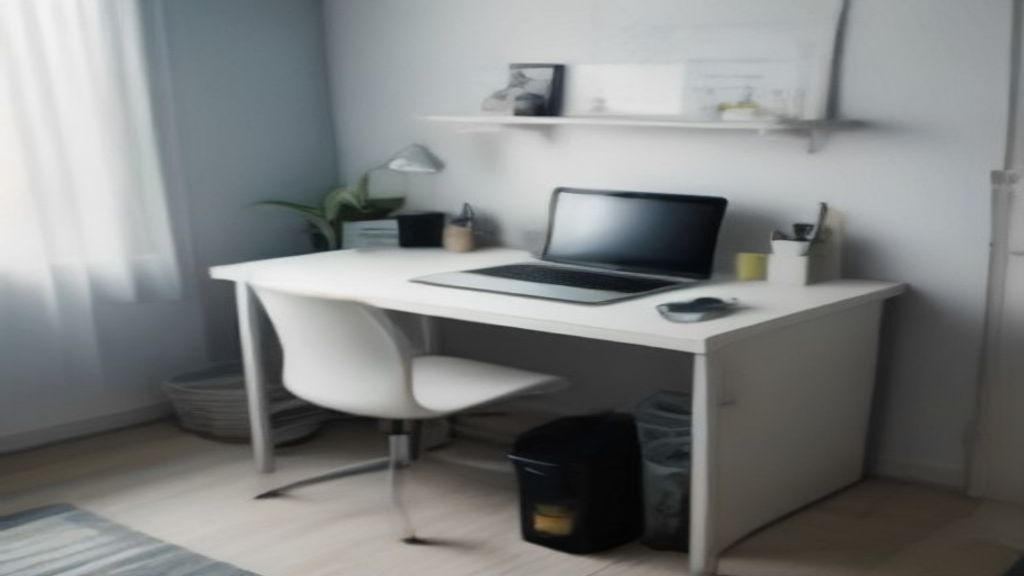
You found the perfect IKEA slim desk — 120 cm wide, 40 cm deep, looks like it was made for that awkward hallway nook. You bring it home, assemble it in an hour, and then you sit down. And that's when you realize the problem isn't the depth of the desk. It's the depth of your body.
I've been through this exact scene more than once, because I keep buying slim desks for small rooms and then having to adjust. The specs say 40 cm deep. That's the top. But your knees, your monitor arm, your feet — they all need more room than the top. Here's what I wish someone had told me.
The 40 cm Dream vs. the 60 cm Reality
An IKEA slim desk is usually 40–50 cm deep. That's fine for a laptop and a notebook. But the moment you add a monitor on an arm, a coffee mug, and your forearms, you're pushing everything back. Your eyes end up too close to the screen — I measured mine at roughly 50 cm from a 27-inch monitor, which is way too close. The ergonomic norm is 60–80 cm.
So here's the blunt math: the desk might be 40 cm deep, but your body needs 60–80 cm from your eyes to the screen. That means either you push the desk out from the wall (and it becomes a floating island) or you mount the screen on a pole and push it back — but then you lose the "slim" advantage.
I ended up pulling my slim desk about 15 cm off the wall so the monitor arm could swing into position. The desk still fits the room, but it's no longer flush against the wall. Nobody tells you that.
What 40 cm Actually Feels Like After a Week
Day one is great. By day three, you're resting your wrists on the desk edge instead of your palms. By day five, you've developed a hunch because you're leaning in to see the screen — I caught myself doing it in a video call. The desk wasn't too short, too narrow, or wobbling. It just wasn't deep enough for how I actually work.
The fix is usually a keyboard tray. A good one steals 10–15 cm of knee space, which is fine if you toss it underneath and pull out only when typing. But then the tray mechanism adds bulk under the slim top, and suddenly the "slim" aesthetic — the whole reason you bought it — gets cluttered.
Measure the Chair, Not Just the Desk
Before you buy, sit in your actual chair at your actual height and measure from your eyes to where the screen would sit. Or if you're starting from scratch, measure your current setup. Take the depth you think you need, add 15–20 cm for the monitor arm and a few extra for the coffee mug. That's your effective depth — the top plus the air in front of it.
If that number is under 60 cm, you're in the slim desk danger zone. Your back will complain, or you'll end up stacking books under the monitor (which I did once — it works but looks terrible). I'm not saying skip the slim desk entirely; I'm saying know what you're trading.
The one decision that really matters isn't the width or the color or even the price — it's the depth. Because you'll live with that depth every single day, whether you're hammering out emails or just browsing. IKEA's slim desks are a fantastic space-saving hack, but they're only worth it if you measure your own body first.
If you're still torn between desk styles, check my notes on a Small L Shaped Desk IKEA: First Week Setup and the One Decision That — same trap, different orientation. And if you're fighting a tiny room, Very Small Desk: How to Fit One When Your Room Says No covers the floor-plan tricks. For more desk-related tangles, browse the More guides in Desks.