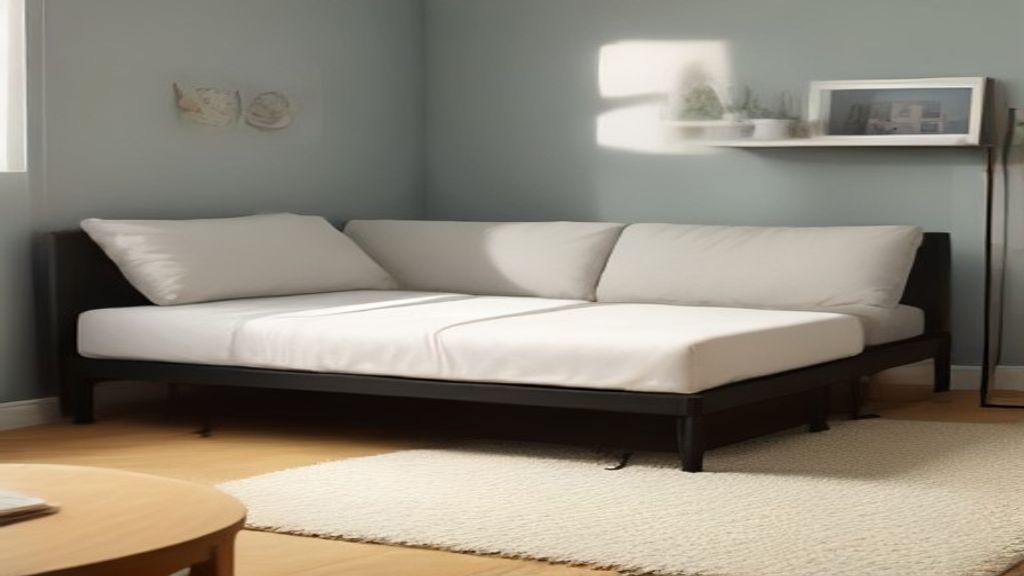
The first cheap sofa bed I bought had that new-fabric smell so strong it made my eyes water. I unboxed it in my living room, and within an hour, I knew I'd messed up. The frame wiggled like a loose tooth, and the mattress was so thin I could feel the metal bars through it. That was a $90 mistake I'm still annoyed about.
I'm not saying every sofa bed under $100 is trash. But if you walk in expecting a couch that also works as a bed, you'll be disappointed. What you're actually buying is a temporary sit-up-and-sleep surface for guests, or a crash pad for yourself when you're too tired to make it to the bedroom. Once I accepted that, the search got way easier.
The Mistake Most Buyers Make
The biggest mistake isn't buying cheap. It's not measuring the room. I measured the doorway, but I didn't measure the hallway that led to it. The box said 70 inches long, and my hallway is exactly 70 inches wide. I spent 20 minutes wedging it through, sweating and swearing, and it only fit because the box had some give.
So before you even click 'buy,' grab a tape measure. Measure every doorway, corner, and stairwell between the front door and where it'll live. A sofa bed that unfolds needs extra clearance around it — you'll need to pull it forward to open it. My first one had to be pulled 3 feet from the wall, which made my coffee table useless.
What $100 Actually Buys You
Let's be honest: under $100, you're getting a metal frame, cheap plywood, and a foam pad maybe 2 inches thick. That's not a bed you'll want to sleep on every night, but for the occasional guest, it works.
I tested a few models in my tiny apartment. The best one cost $85 and had a 2.5-inch foam mattress. It felt firm, but after two nights, I woke up with a sore lower back. That's a dealbreaker if you have back issues. The other one, at $70, had a 2-inch pad and a frame that creaked every time I rolled over. I woke up more times than I care to admit.
And the fabric? Polyester that pilled within a week. It's not the kind of material you want to put in a rental with dogs. If you're buying for a serious guest room, I'd rather spend a little more. If it's a spare area for my nephew's sleepovers, it's fine.
What to Check Before You Cringe-Read the Reviews
Find the weight limit to see if it'll survive college kids or just your cat. My $80 one said 300 pounds; I crouched on it carefully and it held, but it wobbled. If you're heavier than 200 pounds, plan to use it as a couch, not a pull-out.
Also, ask for the extended dimensions. Companies love to advertise the "sofa" size but hide how long it is when opened. I found one that claimed full-size bed, but the mattress was only 72 inches — that's about 4 inches shorter than a real full. Measured before I bought the second one, and I ended up with a couch that fits my 6-foot friend with just a little room left.
The fold-out mechanism is another spot they cut corners. Look for a locking bar that clicks into place; mine just slid out and could fold accidentally if someone sat too hard on the edge. I fixed mine with a rubber band, but that's not a solution to give a guest.
Why I'd Buy Again (Maybe) But Smarter
I still think a sofa bed under $100 can earn its spot in a small bedroom where you need a guest sleeper without sacrificing floor space. My current one has a hidden storage bench inside the frame — hold on, that was actually a second, more expensive model. The $100 one didn't have that. But I've seen futons in that price range that fold flat and double as a bed, and those are often cheaper and sturdier.
So here's my rule: if you need a real bed for adults every week, save up for a $300+ futon. If you need a place for a kid or an occasional overnight guest, a $85 pizza-box sofa bed can work. But measure, check the mattress, and don't trust pictures that show someone smiling while they sleep.
The One Value Test That Decides
I test any cheap sofa bed by sitting down fast and turning over in the mattress. Those two moves reveal creaks, wobbles, and how much you'll feel the frame.
And if the mattress feels thin, add a cheap memory foam topper — I put a 2-inch one from a local mattress store on mine, and it actually made it tolerable for about three nights. That's a hack that costs as much as upgrading the bed in the first place.
The real deciding factor is this: how many hours per year will someone actually sleep on it? If it's beyond five visits, skip it. The $100 will be wasted across headache and a sore neck. If it's a true backup, sure — just measure twice, and know that the smell will last a week.
In the end, the one thing that decides whether you'll be happy is how you answer, "Where is this really going to live and who's sleeping on it?" Get that straight, and you might find a $85 piece that doesn't haunt your dreams.
For more on the mattress that matters, see Sofa Bed Mattress: What $100 vs $500 Actually Buys You. If you're juggling budget beds generally, Cheap Beds with Mattress: What I Learned After Moving Twice is a good follow-up. And if you're diving into living room deals, check Cheap Living Room Sets Under $300: The Mistake That Cost Me a Couch.
That's the honest version. Measure, sit, sleep, and don't trust the listing numbers. You'll thank yourself later.